Golden Circle Iceland
Your complete guide to Iceland's most famous day trip — a ~300 km loop from Reykjavík to Þingvellir, Geysir and Gullfoss. Plan the route, pick the right tour, and know what to expect in every season.
The Golden Circle is Iceland's most popular day trip — a roughly 300-kilometre (186-mile) loop from Reykjavík that links three of the country's most spectacular natural attractions: Þingvellir National Park, the Geysir geothermal area, and Gullfoss waterfall. The whole route can be driven in a single day, which makes the Golden Circle the perfect introduction to Iceland for first-time visitors and a classic return trip for everyone else. You can see every stop plotted in driving order on our interactive Golden Circle map.
The name "Golden Circle" was coined by Iceland's tourism industry in the 1990s to package this trio of sights as one route — it stuck because it captures both the loop-shaped drive and the golden colour of Gullfoss when sunlight hits the spray. Today more than two million people travel the Golden Circle every year, making it Iceland's most-visited route by a wide margin. But its landmarks mattered long before tourism: Þingvellir was the site of the Alþingi, Iceland's national parliament founded in 930 AD and one of the oldest in the world (a UNESCO World Heritage Site since 2004), and Gullfoss was famously saved from a hydroelectric dam in the early 20th century after Sigríður Tómasdóttir threatened to throw herself into the falls — her memorial still stands above the canyon.
The Golden Circle Route
A 300km loop from Reykjavik covering three iconic stops
Reykjavik
Start
Reykjavik
Return
The Big Three Stops on the Golden Circle
What to see at Þingvellir, Geysir and Gullfoss — and how long to spend at each.
Þingvellir National Park
Þingvellir sits in a rift valley where the North American and Eurasian tectonic plates are pulling apart at about 2 cm a year, creating a dramatic landscape of fissures, cliffs and lava fields. Its centrepiece is Almannagjá, a vast canyon marking the edge of the North American plate — walk through it and you are literally walking between two continents. Þingvellir is also where the Alþingi met from 930 to 1798, and the crystal-clear Silfra fissure here offers some of the world's best snorkelling, with visibility over 100 metres. Allow 60–90 minutes; the main walk from the visitor centre through Almannagjá to Öxarárfoss waterfall takes about 45 minutes.
Geysir Geothermal Area
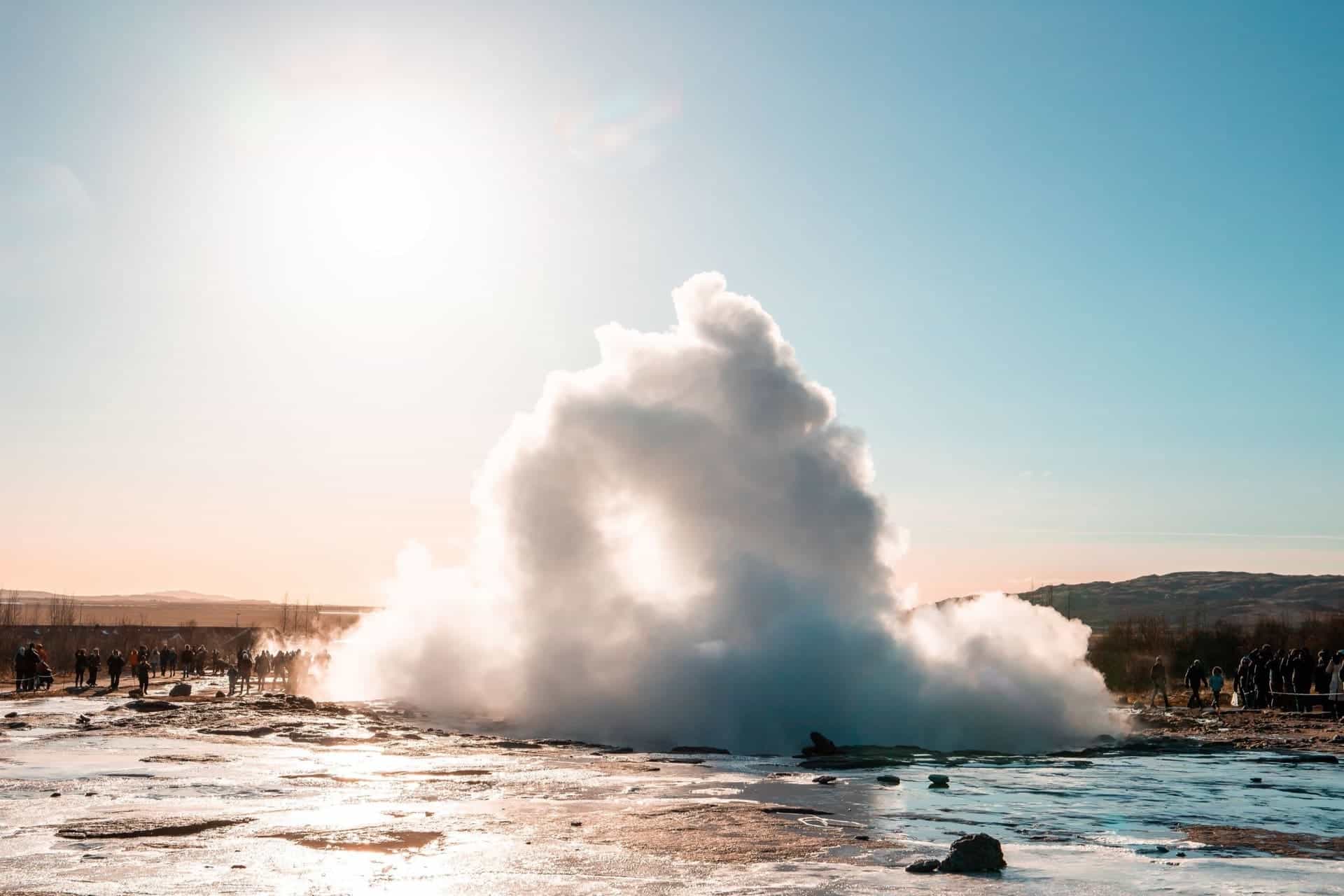
The Geysir field is a steaming landscape of hot springs, fumaroles and mud pots painted in vivid blues, greens and ochres. The original Great Geysir — which gave every "geyser" on Earth its name — is mostly dormant now, but its neighbour Strokkur erupts faithfully every 5–10 minutes, firing a column of boiling water up to 30 metres into the sky. A boardwalk lets you explore safely, and there is a restaurant and shop on site for lunch. Allow 30–45 minutes to catch several eruptions and walk the wider field.
Gullfoss Waterfall
Gullfoss, the "Golden Falls," is one of Iceland's most powerful waterfalls. The Hvítá river drops in two stages — first 11 metres, then a further 21 metres — for a total fall of 32 metres into a 70-metre-deep canyon you can feel thundering in your chest. Two platforms give different views: the upper one is panoramic, the lower one brings you close enough to be soaked by spray and catch frequent rainbows. In winter the falls are partially frozen into spectacular ice formations while the water still roars beneath. Allow 30–45 minutes; it is about a 10-minute walk from the car park to the lower viewpoint.

Geysir Geothermal Area
Watch Strokkur geyser erupt every 5–10 minutes amid bubbling hot springs and steaming vents in the Haukadalur valley — a must-see Golden Circle stop.

Gullfoss Waterfall
Iceland's most iconic waterfall, Gullfoss plunges 32 metres in two dramatic tiers into a rugged canyon on the Hvítá river. A must-see stop on every Golden Circle tour.

Þingvellir National Park
Walk between two tectonic plates at this UNESCO World Heritage site where Iceland's parliament was founded in 930 AD — history and geology in one stunning landscape.
More Golden Circle Attractions
Popular stops and hidden gems along the route.
Beyond the big three, several excellent stops sit along or near the route — adding one or two turns a good day into a great one. Kerið is a 3,000-year-old crater with an aquamarine lake (entry ~400 ISK); the Secret Lagoon in Flúðir is Iceland's oldest natural hot-spring pool (~3,000 ISK); Friðheimar is a geothermal tomato farm where you can have lunch among the plants; and Laugarvatn Fontana is a lakeside geothermal spa famous for rye bread baked in the ground. See all sixteen stops and baths on the Golden Circle map.

Blue Lagoon
The Blue Lagoon is Iceland's world-famous geothermal spa, set in a dramatic lava field on the Reykjanes Peninsula. Its signature milky-blue waters are rich in silica, algae, and minerals — making it one of the most iconic bathing experiences on earth.

Brúarfoss Waterfall
A hidden gem known for its stunning turquoise-blue cascades along the Brúará River — one of Iceland's most photogenic waterfalls, just off the Golden Circle route.

Efstidalur
A seventh-generation family dairy farm on the Golden Circle, beloved for homemade ice cream you can enjoy while watching the cows through a barn window, plus a farm-to-table loft restaurant.

Eyrarbakki
Eyrarbakki is a beautifully preserved coastal village in South Iceland, once a rival to Reykjavík, now home to Iceland's oldest wooden house and a charming maritime heritage.

Faxi (Vatnsleysufoss) Waterfall, Iceland
Faxi Waterfall: Serene Beauty in Iceland's Golden Circle

Flúðir
A small geothermal village in South Iceland, Flúðir is home to the Secret Lagoon — Iceland's oldest swimming pool — and a cluster of geothermal greenhouses that grow fresh produce year-round.

Friðheimar Tomato Farm
A working geothermal greenhouse on the Golden Circle where you dine among the tomato plants — famous for its all-you-can-eat tomato soup, fresh bread, and the farm's Bloody Marys.

Garðabær
A prosperous coastal town in Greater Reykjavík, Garðabær blends Viking-age history, the President of Iceland's official residence, and easy access to lava fields and shoreline walks.

Hafnarfjörður
A charming harbour town just south of Reykjavik, Hafnarfjörður blends ancient lava landscapes, Viking heritage, and Iceland's richest elf folklore into one compact and very walkable destination.

Haukadalur Valley
Haukadalur Valley

Kerið Crater
A vivid 3,000-year-old volcanic crater with striking red rock walls and a brilliant blue lake — a quick, colourful Golden Circle detour.

Langjökull Glacier
Iceland's second-largest glacier, Langjökull offers unforgettable adventures — from snowmobiling across its vast white expanse to walking inside a real glacier through the world's largest man-made ice tunnel.

Laugaras Lagoon
A stunning two-tiered geothermal lagoon on the banks of the Hvítá River, perfectly placed along the Golden Circle with naturally heated spring pools, a waterfall, saunas, and an acclaimed on-site restaurant.

Laugarvatn
A peaceful lakeside village on the Golden Circle where geothermal springs warm the shore — and the famous Fontana spa lets you soak in natural steam baths beside the lake.

Laugarvatn Fontana
A lakeside geothermal spa on the Golden Circle where steam rooms sit over natural hot springs and traditional rye bread is baked underground using the earth's heat.

Reykholt
A small geothermal village on the Golden Circle, Reykholt is home to Friðheimar — Iceland's celebrated tomato greenhouse where you can dine among the plants and watch an Icelandic horse show.

Reykjadalur
Reykjadalur — "Steam Valley" — is a geothermal wonderland above Hveragerði where a short hike rewards you with a naturally warm river you can actually bathe in, framed by steaming hillsides and Iceland's raw volcanic landscape.

Reykjavik
Iceland's vibrant capital city is the perfect base for Golden Circle day tours — a compact, walkable city full of colour, culture, and geothermal energy.

Secret Lagoon
Secret Lagoon: Tranquil Geothermal Escape in Iceland

Silfra Fissure
Silfra is a crystal-clear freshwater fissure in Þingvellir National Park where you can snorkel or dive directly between the North American and Eurasian tectonic plates, in water of extraordinary purity and visibility.

Sky Lagoon
A stunning oceanfront geothermal spa near Reykjavik with an infinity-edge lagoon and the signature 7-step Skjól Ritual rooted in Icelandic bathing tradition.

Skálholt Cathedral
Skálholt was the religious and cultural capital of Iceland for over 700 years — a serene historic site in the South Iceland countryside that rewards every curious traveller on the Golden Circle.

Solheimar Eco-Village
Founded in 1930, Sólheimar is the world's oldest eco-village — a thriving community of around 100 residents where inclusive living, organic farming, and handmade crafts come together in the heart of South Iceland.

Stokkseyri
A characterful coastal village on Iceland's South Shore, beloved for crashing Atlantic breakers, Icelandic folklore museums, and some of the country's most celebrated lobster.

Öxarárfoss Waterfall
Öxarárfoss is a scenic waterfall on the Öxará River in Þingvellir National Park, tumbling over the ancient Almannagjá gorge in one of Iceland's most historically charged landscapes.
Golden Circle Tours from Reykjavík
Compare group sizes, pickup arrangements, and cancellation terms for each available tour.
Golden Circle Small Group Tour
The classic loop in a group of no more than 19 — Þingvellir, Geysir and Gullfoss with a local guide and hotel pickup.
From ISK 19,273
Golden Circle + Secret Lagoon
The big three plus a soak in Iceland's oldest natural hot spring — the most popular way to end the day.
From ISK 15,999
Private Golden Circle Tour
Your own guide and vehicle, your own pace — ideal for families and photographers who want full flexibility.
From ISK 180,607
Review the current product price and booking terms before completing checkout.
Self-Drive vs Guided Tour
Both are great ways to see the Golden Circle — here's how to choose.
Self-drive
The Golden Circle is one of Iceland's easiest self-drive routes: the whole loop is on well-maintained paved roads (Routes 36, 35 and 1) and every stop has a large car park. A standard 2WD rental is fine in summer; from November to March a 4WD with winter tyres is strongly recommended for ice and snow. The drive without stops is about 3.5 hours; with stops, plan 6–8 hours. Self-driving gives you complete flexibility over timing and detours — the trade-offs are navigating yourself, taking on winter driving, and missing a guide's commentary. Driving distances for every leg are on the Golden Circle map.
Guided tour
Guided options range from coaches to small-group tours and private tours. Group limits, guide details, and pickup or meeting arrangements vary by product, so compare the selected tour details. In winter especially, a guided option can remove the need to drive in short daylight and icy conditions.
Best Time to Visit the Golden Circle
Spectacular year-round; each season is a different trip.
☀️ Summer (Jun–Aug)
Near-24-hour daylight around the solstice, the best hiking conditions, green landscapes, and the mildest temperatures (10–15°C). Peak season — go early (before 09:00) or late to beat the crowds, and book tours ahead.
🍂 Autumn (Sep–Oct)
Fewer crowds, autumn colours, and the start of Northern Lights season. Weather grows more changeable and daylight drops quickly.
❄️ Winter (Nov–Feb)
Short days (4–6 hours of light), frozen waterfalls, snow-covered scenery, and a real chance of the Northern Lights. Roads can be icy and some side stops close — a great time for a guided tour.
🌱 Spring (Mar–May)
Lengthening days, melting snow and the most powerful waterfalls of the year from snowmelt. Fewer tourists than summer with better weather than winter.
For a month-by-month breakdown, see our best time to visit the Golden Circle guide.
Plan Your Golden Circle Visit
What it costs
The Golden Circle is affordable by Icelandic standards. The three main natural sites are free, with free parking at Geysir and Gullfoss.
- Guided small-group tour: 12,000–17,000 ISK per person
- Private tour: 89,000–149,000 ISK per group
- Self-drive fuel for the loop: ~5,000–7,000 ISK
- Car rental: 8,000–15,000 ISK/day (varies by vehicle and season)
- Parking at Þingvellir: 750 ISK · Kerið entry: 400 ISK · Secret Lagoon: 3,000 ISK
- Lunch along the route: 2,500–5,000 ISK
What to pack
Iceland's weather is famously unpredictable, so in any season bring: a waterproof jacket and trousers; warm mid-layers (fleece or wool); thermal base layers; sturdy waterproof walking shoes; a hat, gloves and scarf (even on summer evenings); sunglasses and sunscreen; a camera with spare batteries (cold drains them fast); a swimsuit for the hot springs; and a reusable water bottle — Iceland's tap water is excellent.
Sample itineraries
- Classic half-day (5–6 hrs): Leave Reykjavík ~09:00 → Þingvellir (60 min) → Geysir (40 min) → Gullfoss (40 min) → back by ~15:00.
- Full day with extras (8–10 hrs): Leave ~08:30 → Þingvellir (75 min) → Friðheimar or Laugarvatn Fontana for lunch → Geysir (45 min) → Gullfoss (45 min) → Kerið (30 min) → Secret Lagoon (60 min) → back by ~18:30.
- Photography-focused (10–12 hrs): Go early or late for golden-hour light, with extra time at each stop and lesser-known viewpoints; best in the shoulder seasons.
Operator details vary across the listed Iceland tour options. Browse route places and resources →
Frequently Asked Questions
Everything you need to know about the Golden Circle.