
How Much Is the Entrance Fee at Kerid Crater?
700 ISK per person, paid at the gate. That is the current service fee according to the official Kerið site, and it is the only charge on the standard Golden Circle route.
Parking is free. The fee covers entry to the crater itself, the rim path and the stairway down to the lake.
Payment is taken at a small booth beside the car park. Cards work, and there is rarely a queue outside the middle of a summer afternoon.
Why Kerid Charges When Other Sites Do Not
The short answer is ownership, and it explains most of the difference.
Þingvellir, Geysir and Gullfoss are publicly protected sites where the state charges for parking rather than entry. Kerið sits on privately owned land, held by a group of local landowners.
The fee funds the path around the rim, the wooden stairway down to the water and the ongoing repair of ground that several hundred thousand pairs of boots cross each year.
It has been charged since 2013, and it was contentious at the time. The counterargument that won was straightforward: without maintenance the crater would erode into something not worth stopping for.
At 700 ISK it is roughly the price of a coffee, which is a reasonable trade for a site in genuinely good condition. Our page on Kerið crater covers what the site includes.
Opening Hours
Officially, Kerið is open when the sun is shining, which is the most Icelandic opening hours statement you will read.
In practice that means roughly 08:00 to 21:00 through the summer and something closer to 10:00 to 17:00 in the depths of winter, tracking daylight rather than a fixed clock.
There is no gate that locks. Outside staffed hours the honesty box and the ticket booth may be unmanned, and the path is still there.
Winter storms are the only thing that genuinely closes the site, and that is usually because Route 35 is closed rather than the crater.
Check road status at umferdin.is before setting off between October and April.
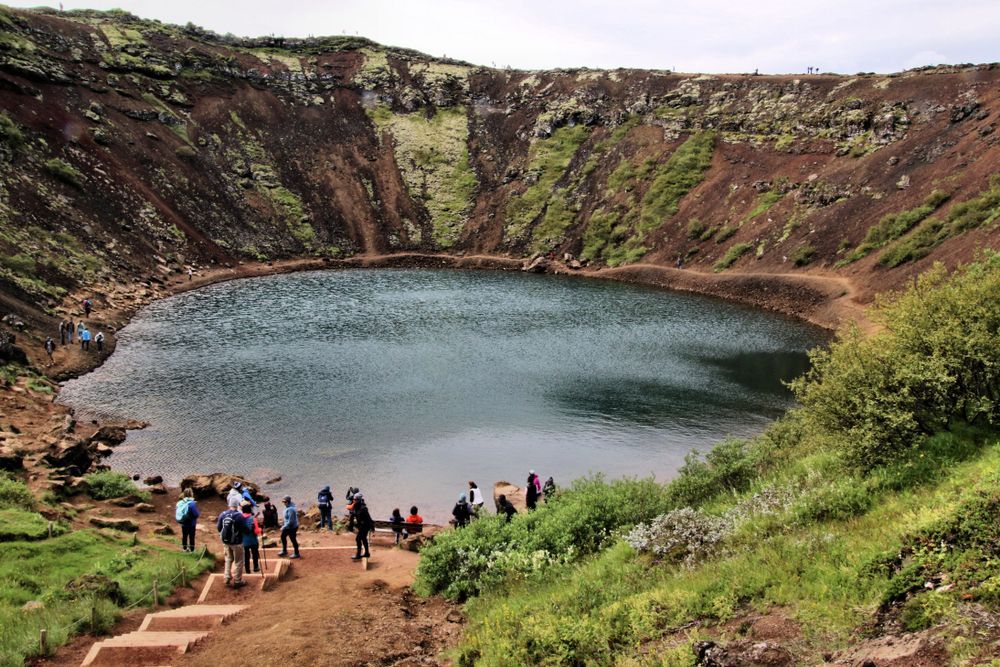
The rim loop takes about 20 minutes and gives the view down into the lake from every angle.
How Much Time Do You Need?
Between 30 and 45 minutes for most visitors, and the split is easy to plan.
The rim loop takes about 20 minutes at a walking pace, longer if you stop for photographs at each viewpoint, which most people do.
The stairway down to the lake takes 5 to 10 minutes each way, with the climb back up being the part that surprises people.
Add 5 minutes for parking, paying and the walk from the car, and 30 minutes is the realistic minimum.
Forty-five minutes lets you do both the rim and the descent without hurrying. An hour is more than the site needs.
A common mistake is allocating 15 minutes because it looks small from the car park. The crater is 270 metres across at its widest, which is a longer walk than it appears.
The Rim Walk
The main event, and it is easier than the setting suggests.
The path circles the whole crater on a gravel and compacted-earth surface, gently undulating rather than steep.
Viewpoints on the northern side give the classic composition, with the red scoria wall on one side and the lake below.
The eastern side is the highest point and has the widest view out across the Grímsnes lava field towards the mountains.
There is no railing along most of it. The edge is not sheer everywhere, and it is sheer enough in places to keep children close.
Footing is loose gravel in dry weather and slippery in wet, so proper shoes matter more than the flat profile suggests.
The Stairway to the Lake
Worth doing, and skipped by roughly half of visitors.
Wooden steps drop from the southern side of the rim down to a small shore at the water's edge. There are around 200 of them.
From the bottom the perspective inverts. Instead of looking down at a lake, you are looking up at 55 metres of red and black wall, which is the more impressive of the two views.
The water is 7 to 14 metres deep depending on the season and is fed by groundwater rather than rain, so the level shifts through the year.
Swimming is not permitted. The colour comes from minerals in the water and the volcanic soil around it rather than from anything you would want to be in.
The climb back is the only real exertion at Kerið and takes about 8 minutes at a steady pace.
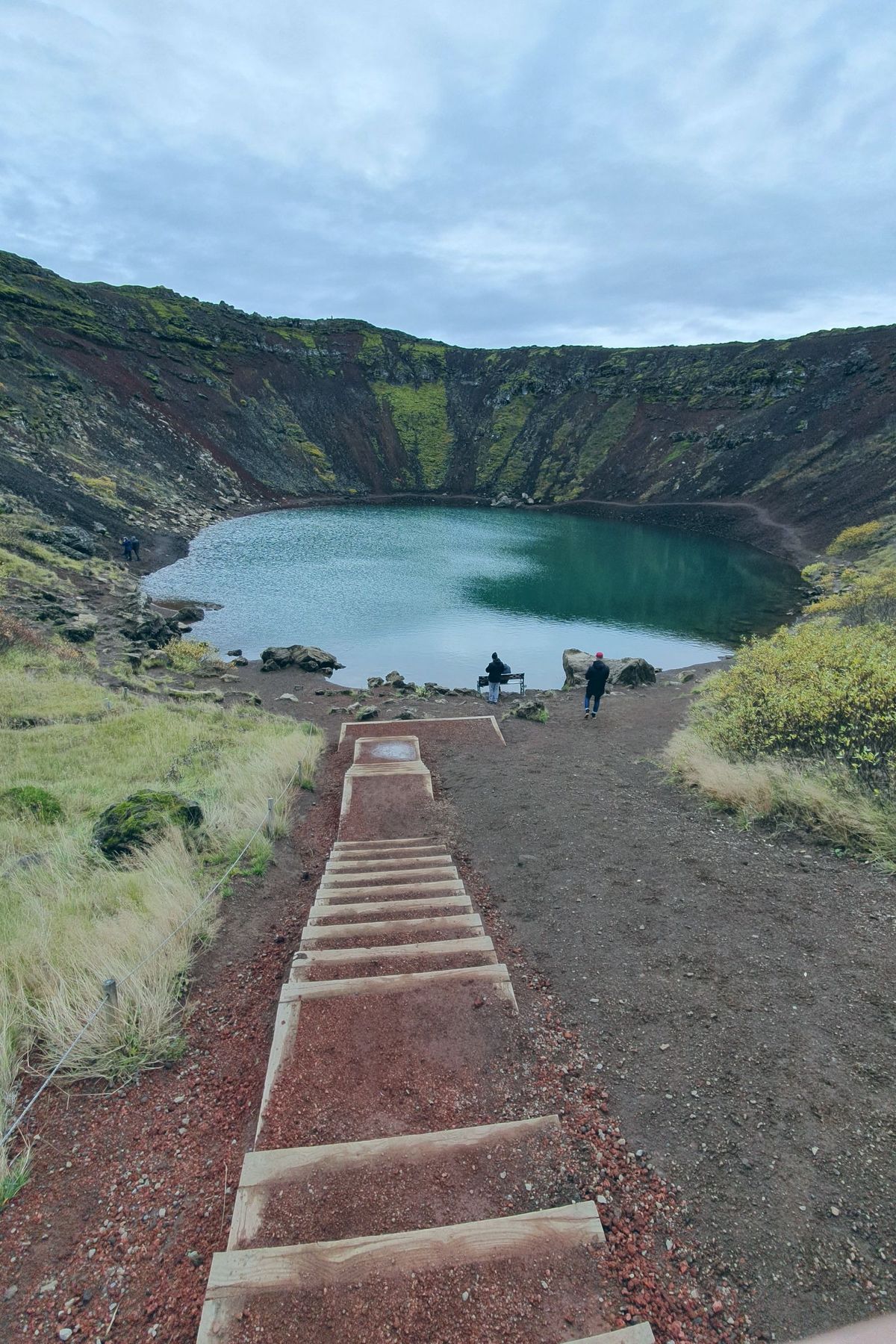
Around 200 wooden steps drop to the shore, and the climb back is the only exertion on site.
Best Time of Day
The crater faces the sky rather than a direction, which changes the usual advice.
Midday gives the strongest colour in the water, with light reaching the bottom of the bowl and the aquamarine at its most vivid.
Early morning and late afternoon give better light on the red rim, with low sun raking across the scoria and picking out the texture.
For crowds, arrive before ten or after four. Coach itineraries hit Kerið between eleven and three, usually as the last stop of a Golden Circle day heading back to Reykjavík.
In midsummer the long evenings mean you can be there at nine at night in good light with nobody else present, which is the best version of this stop.
Practical Points
Seven things worth knowing before you arrive.
Parking is free and there is space for cars and coaches beside the entrance. It fills in the middle of the day in July.
Toilets are at the car park and there is a small kiosk in summer. Do not plan lunch here.
The site is not wheelchair accessible beyond the first viewpoint. The rim path is uneven and the stairway is steps only.
Dogs are permitted on a lead on the rim path.
There is no shelter anywhere on the site, so wind and rain are felt fully.
Dress in layers with a windproof shell. At Hjarðarland, the nearest long-running station to the Golden Circle, Met Office climate data gives a July average daily high of 16.5°C, which is not warm once wind is involved.
Winter brings ice on both the rim path and the steps, and traction spikes are genuinely useful.
Where Kerid Fits in a Golden Circle Day
Position matters here, because Kerið is not on the same road as the main three.
It sits on Route 35 between Selfoss and Reykholt, south of the main loop. Coming from Gullfoss it is about 50 minutes, and it is the natural last stop before the drive back to Reykjavík.
Some itineraries take it first, driving out on Route 35 and hitting Kerið before Geysir. That works and it beats the crowds, at the cost of arriving at Gullfoss later in the day.
Friðheimar tomato farm is 20 minutes away and makes an obvious pairing for lunch. Our page on Friðheimar covers the booking, which you should do in advance.
Selfoss, 15 minutes south, has the nearest supermarket and petrol, which matters on a self-drive day.
The Secret Lagoon at Flúðir is 25 minutes from Kerið and turns the day into a 10 hour one.
Whichever order you take, the loop runs about 230 kilometres in total with roughly three and a half hours of driving.
Our guide to what the Golden Circle covers sets out the distances between all of these.
Is Kerid Worth the Fee?
Yes, and the case is easy to make.
It is the only site on the route that looks like this. Þingvellir is a rift, Geysir is steam and Gullfoss is water, and none of them is a red volcanic bowl with a lake in the bottom.
The site is well maintained precisely because it charges, and the difference is visible against the eroded paths at some free Icelandic sites.
It takes 45 minutes, which is short enough to add to a full day without cutting anything else.
The one situation where it is not worth it is a very short winter day. With four hours of December light, Kerið is the stop to drop rather than the one to add.
See Kerid Without the Coach Crowds
Kerið is at its best early or late, and a small-group departure can time it around the coaches rather than alongside them. Our small-group Golden Circle tour with Kerið and Friðheimar includes the entrance fee, keeps groups under twenty and allows enough time to walk the rim and go down to the lake. Tell us your dates and we will find you a departure.
Compare Golden Circle Tours
Check each selected product for its current operator, guide, itinerary, meeting point, and terms.
View Our Tours