
What Is Reykjadalur?
A valley above Hveragerði where a geothermal stream mixes with cold meltwater to produce a river warm enough to sit in. The name means steam valley, and on a cold morning you can see why from the car park.
Getting there means a hike of about 3 kilometres each way with roughly 340 metres of climb. There is no road, no shuttle and no shortcut.
At the top, a boardwalk runs along a stretch of the river with wooden screens for changing. You get in, find a depth that suits you, and sit in a river in the middle of a mountain valley.
The Hike In
Straightforward, uphill and longer than it looks on the map.
The trailhead is at the Reykjadalur car park about 2 kilometres north of Hveragerði, roughly 45 kilometres from Reykjavík on Route 1.
The path climbs steadily from the start, gaining most of its height in the first kilometre and a half. It is a well-worn track rather than a technical trail.
Allow 45 to 75 minutes going up depending on fitness, and 30 to 45 minutes coming back down.
The whole outing runs 3 to 4 hours, including a soak, which is the number to plan around rather than the walking time.
There is a footbridge and a couple of stream crossings on the way, all of them straightforward in normal conditions.
The Geothermal Scenery
Half the reason to do this walk, and it starts before you have gained any height.
Steam vents open along the valley sides, some of them close enough to the path to feel the heat as you pass.
Boiling mud pools and hot springs sit in the side gullies. The ground around them is unstable, and the water is at boiling point.
Stay on the marked path. The crust between vents is thinner than it looks, and burns here are serious with an hour's walk back to the car park.
The river itself runs through the valley floor, getting progressively warmer as you climb towards the hot inflows.
The whole landscape is a working geothermal field, part of the Hengill system that also supplies power to the capital. Geothermal generation across Iceland runs to 5,916 GWh a year, according to the National Energy Authority.
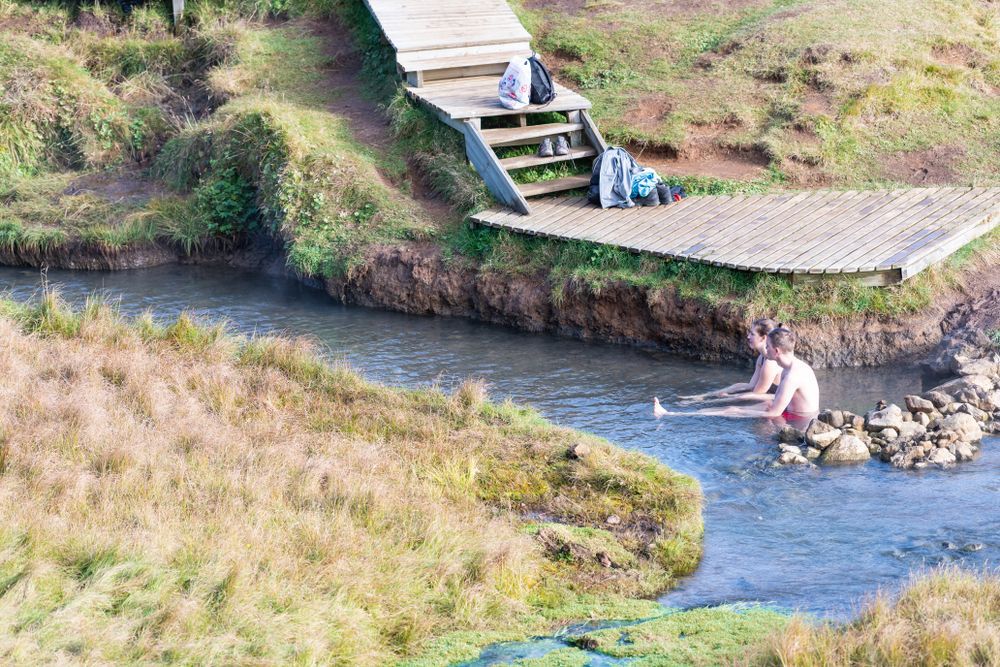
The river warms as you move upstream, and finding the right spot is the whole trick.
Bathing in the River
The technique is simple once someone explains it, and nobody does.
The stream is hot at the top where the geothermal inflows enter and cold at the bottom where the meltwater dominates. Between them is a stretch where the two have mixed to something comfortable.
Walk upstream from the boardwalk until the water feels right, then sit down. Ten metres either way changes the temperature noticeably.
Upstream is hotter. If a spot is too warm, move down; if it is too cool, move up. That is the whole method.
Depth varies from ankle-deep to sitting depth. The deepest pools are usually where people have moved rocks to dam the flow.
Do not go above the marked bathing area. The water upstream reaches temperatures that will scald.
Facilities and Changing
Modest, and better than they were.
Wooden screens along the boardwalk provide changing cover. They are open at the top, and they are not private in any full sense.
There are no toilets at the bathing area. Use the ones at the car park before you set off.
There is no shop, no café and no drinking water at the top. Bring what you need.
The boardwalk keeps most people out of the mud along the bank, which is what it is there for.
Everything you carry up, you carry back down. There are no bins.
Our page on Reykjadalur covers the site in more detail.
Parking and Costs
The hike is free. The car park is not.
Parking is charged through the Parka or EasyPark apps, at roughly 200 ISK for the first hour and around 250 ISK per hour after, with a five-hour pass for about 1,000 ISK.
A five-hour pass covers a normal visit comfortably, including the walk both ways and a long soak.
Pay when you arrive rather than afterwards. The system is app-based, and enforcement is by plate.
There is a café at the car park in summer, and the town of Hveragerði, two kilometres away, has shops, a bakery and fuel.
What to Bring
Seven things, and the third is the one people forget.
Swimwear, worn under your clothes for the walk up if you would rather not use the changing screens.
A towel, and a small quick-dry one, is better than a hotel bath sheet you have to carry.
Flip-flops or sandals for the walk between the bank and the water, since the river bed is stony.
Proper walking shoes for the hike itself. Trainers manage in dry summer conditions and nothing else.
Layers and a windproof shell. The valley is exposed, and getting out of warm water into wind is the coldest moment of the day.
Water and something to eat, since there is nothing at the top.
A dry bag for the wet swimsuit on the way down.
When to Go
Four seasons, and two of them are straightforward.
Summer is the easiest, with dry ground, long light and the most people. July and August see genuine crowds at the boardwalk in the middle of the day.
Spring and autumn are quieter, with muddier ground and better light.
Winter is possible and considerably harder. The path ices, the ascent is in snow, and daylight in December gives you barely a four-hour window.
Traction spikes are essential between November and March, and the walk should not be attempted in poor weather.
Early morning and evening are the quiet windows in summer. Arriving at eight in the morning changes the experience completely.
Live road and trail conditions are worth checking at SafeTravel before setting off outside summer.
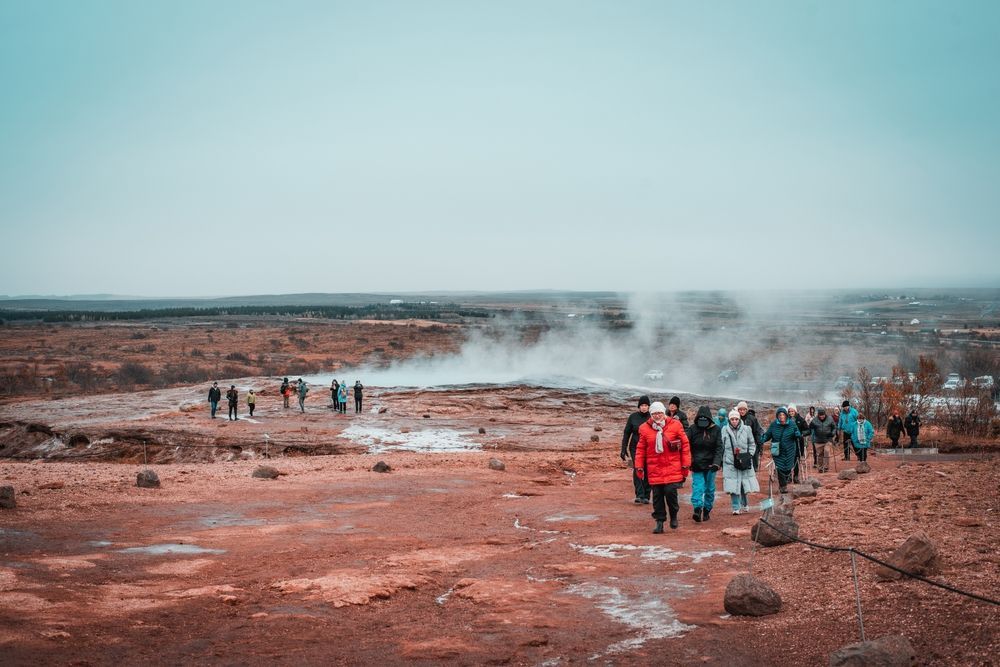
The valley is a working geothermal field, and the ground beside the path is not safe to walk on.
Safety and Common Sense
Five points, and they are not decorative.
Stay on the path. The geothermal ground on either side is unstable, and the water in the vents is boiling.
Do not drink the river water, and keep your head out of it. Geothermal surface water can carry bacteria.
Check the weather. The valley is exposed, and conditions change quickly, and there is no shelter along the route.
Take a phone with charge. There is patchy but usable coverage along most of the trail.
Do not bathe alone in winter. Getting out of warm water into a freezing wind with an hour's walk back is where things go wrong.
At Hjarðarland, the nearest long-running station to the wider area, Met Office climate data gives a January average daily low of −4.3°C.
How It Fits an Itinerary
Reykjadalur is not on the Golden Circle, and it is close enough to pair with it.
Hveragerði sits on Route 1 about 45 minutes from Reykjavík and roughly an hour from Kerið crater at the southern end of the Golden Circle loop.
That makes it a half-day on its own rather than an addition to a full loop. Four hours plus driving is most of a day.
The realistic options are Reykjadalur on one day and the Golden Circle on another, or a very early start and a compressed loop.
If you want a soak on a Golden Circle day itself, the Secret Lagoon at Flúðir needs no hike at all. Our comparison of Fontana and the Secret Lagoon covers the two bathing options on the route.
Hveragerði itself is worth twenty minutes, with a geothermal park in the middle of town where the ground steams beside the pavement.
Our guide to what the Golden Circle covers sets out how long the loop needs on its own.
Is It Worth the Walk?
Yes, with one condition.
If you are comfortable with a 6-kilometre round trip and 340 metres of climb, this is one of the best free things in Iceland, and the walk is half of it.
If you want a hot soak without earning it, the Secret Lagoon, Laugarvatn Fontana and Sky Lagoon all exist, and none of them require boots.
The river itself is genuinely lovely and genuinely busy in summer. Go early, go in spring or autumn, or accept the company.
The steam valley on the way up is what people remember, more than the soak at the end.
Fit a Soak Into a Golden Circle Day
Reykjadalur is a half-day of its own, and the Golden Circle has bathing options that need no hiking boots at all. Our small-group Golden Circle tour with Kerið and Friðheimar covers the main sites with groups under twenty, and we can advise on adding a lagoon at the end. Tell us your dates and we will work out the timings.
Compare Golden Circle Tours
Check each selected product for its current operator, guide, itinerary, meeting point, and terms.
View Our Tours