
What Is Skalholt?
The site of Iceland's first bishopric, founded in 1056, and for around seven centuries the country's religious, political and educational centre.
It sits in the Biskupstungur district about 15 minutes from Flúðir and 30 minutes from Geysir, just off the Golden Circle route.
What you see today is a memorial church built between 1956 and 1963 on the footprint of the old cathedral, with a crypt underneath holding what the archaeologists found.
Entry is free and it takes 30 to 45 minutes.
Why Skalholt Mattered
Understanding this turns a plain white church into one of the most significant places in the country.
Iceland converted to Christianity by decision of the Alþingi around the year 1000. Fifty-six years later, Ísleifur Gissurarson became the first bishop, and Skálholt became the see.
The northern bishopric at Hólar followed in 1109, and between them the two dioceses ran the church, the schools and much of the law for the next seven hundred years.
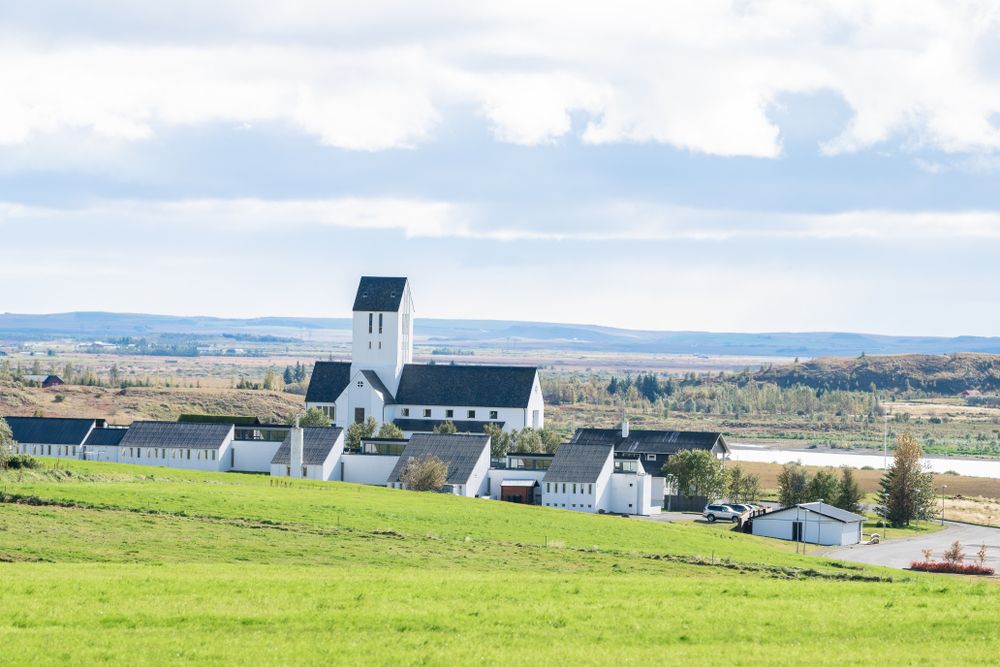
Skálholt held the country's main school, its largest library and its most powerful office outside the assembly at Þingvellir.
At its height this was a settlement of over a hundred people, which in medieval Iceland made it something close to a town.
Nothing above ground survives from that period. Fire, earthquake and the 1784 quake that finally ended the see removed it all.
The Bishops
Two names dominate the story, for very different reasons.
Þorlákur Þórhallsson was bishop from 1178 to 1198 and is Iceland's only saint, canonised locally in 1198 and formally recognised by Rome in 1984. He is the country's patron saint.
Jón Arason was the last Catholic bishop of Iceland, and he was executed at Skálholt in 1550 along with his two sons for opposing the Reformation imposed by the Danish crown.
That execution is the moment Iceland's church changed. The Reformation arrived by royal decree rather than by argument, and the beheadings at Skálholt were how it was enforced.
Páll Jónsson, bishop from 1195 to 1211, is the one you can see. His stone sarcophagus was uncovered by archaeologists in 1954 and now sits in the crypt.
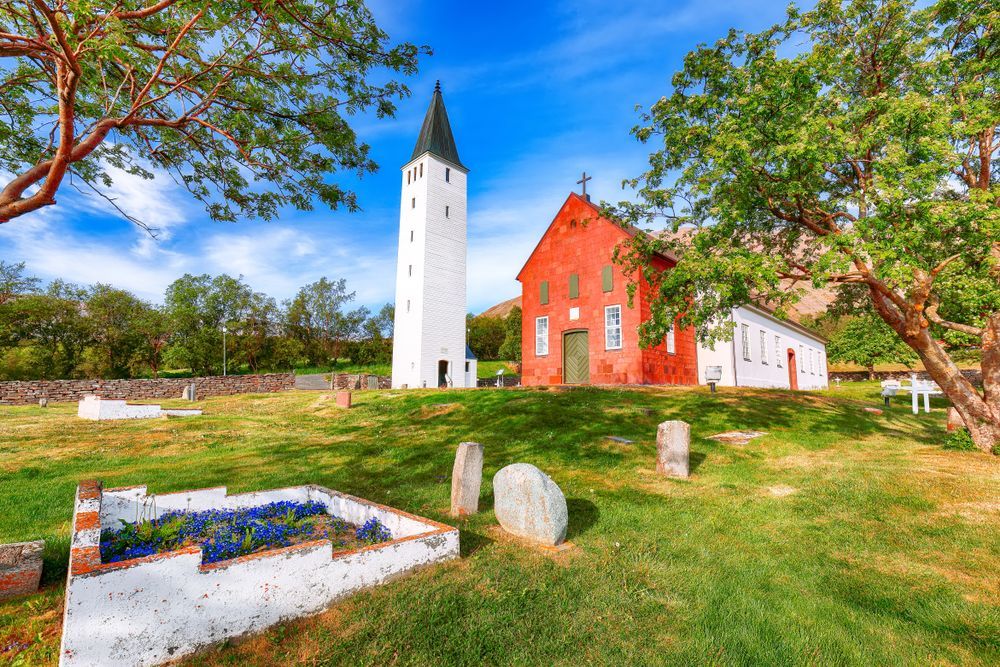
The present church dates from 1956 to 1963 and stands on the footprint of the medieval cathedral.
The Church Today
Plain from outside, better inside, and the crypt is the reason to go.
The building is a modern Lutheran church, white and unfussy, with a tall narrow tower. It was consecrated in 1963 to mark the 900th anniversary of the bishopric.
The interior is spare in the Nordic manner, with a large mosaic altarpiece by Nína Tryggvadóttir behind the altar and stained glass by Gerður Helgadóttir.
The crypt is reached by stairs inside the church. It holds Páll Jónsson's sarcophagus, a stone coffin carved from a single block, along with excavated foundations and relics.
A tunnel runs from the crypt out into the churchyard, following the line of a medieval passage found during the excavation.
Skálholtsskóli, the church centre beside the cathedral, runs concerts and a summer music festival, and the acoustics in the church are excellent.
What Else Is on Site
Four things beyond the church itself, and none of them takes long.
The reconstructed turf house, Þorláksbúð, stands beside the cathedral and shows how the buildings here would have looked before stone and timber.
The archaeological site is marked out on the ground, so you can see the footprint of the older cathedral against the present one.
A memorial to Jón Arason and his sons stands in the churchyard.
The graveyard holds bishops going back centuries, and the setting looking out over the Hvítá valley is genuinely fine on a clear day.
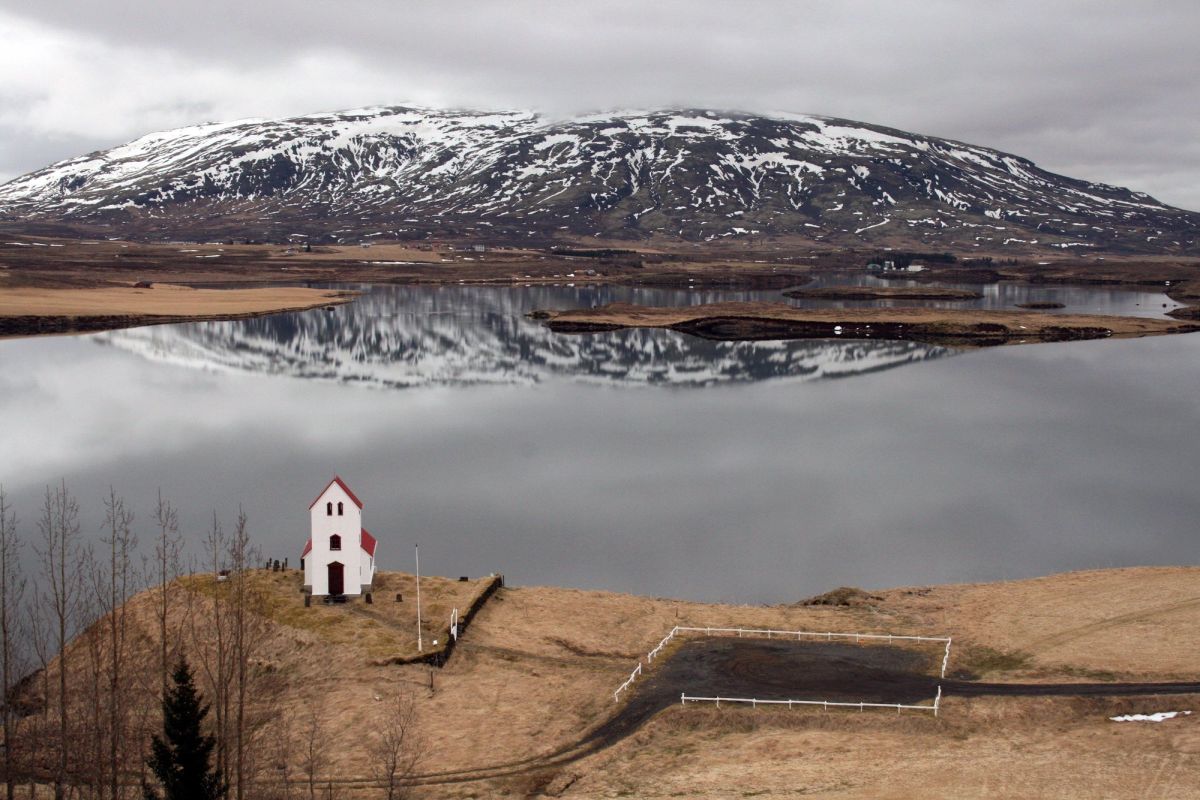
The setting over the Hvítá valley is half the reason to make the detour on a clear day.
There is a café and a small shop in the church centre, with hours that vary by season.
Our page on Skálholt covers the practical details.
How It Fits the Golden Circle
A cultural stop on a route that is otherwise entirely geological, which is exactly the argument for it.
Skálholt is 30 minutes from Geysir, 35 from Gullfoss, 15 from Flúðir and 20 from Kerið, on Route 31 off the main loop.
Adding it costs 45 minutes to an hour including the detour, which fits comfortably into a standard day.
It pairs naturally with the Secret Lagoon at Flúðir or with lunch at Friðheimar, both of which sit on the same side of the loop.
Coach itineraries almost never include it, which is why the car park is usually half empty even in July.
The comparison worth making is with Þingvellir, where the Alþingi met from around 930 until 1798. Our guide to the history of Þingvellir covers the secular half of the same story.
Between them, the two sites are where Iceland was governed for the whole medieval period.
Faxi waterfall is 15 minutes away and takes fifteen minutes, which makes an easy pairing for anyone collecting the quieter stops. Our guide to Faxi covers the parking there.
Visiting Practicalities
Six things worth knowing.
Entry to the church and the crypt is free, and so is parking.
Opening hours vary by season and are longer in summer. The church is generally open through the day between June and August and more limited in winter.
Allow 30 to 45 minutes, or an hour if the café is open and you want the view. The site is reasonably accessible, though the crypt is down a flight of stairs with no lift.
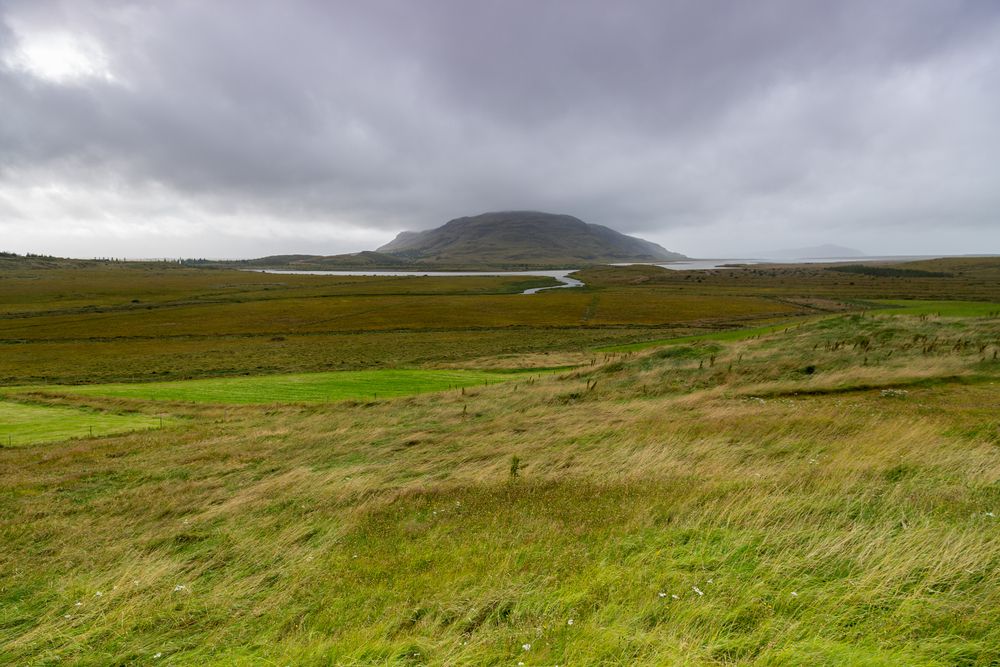
Services and concerts occasionally close the church to visitors, so check before making a special trip.
Visit South Iceland carries the regional listing alongside the church's own information.
Facilities are limited to the church centre, so use the toilets there rather than assuming more along Route 31.
Live road status for Route 31 and the wider loop is published at umferdin.is, which matters between October and April.
Is Skalholt Worth Visiting?
Yes, for the right visitor, and honestly not for everyone.
If you have any interest in how Iceland was actually governed and educated before the modern period, this is the single most important site on the Golden Circle after Þingvellir.
If you want landscape, it is a plain white church in a field and you will be finished in fifteen minutes.
The crypt is what tips it. Standing next to a stone coffin carved for a bishop who died in 1211, in a room under the church that replaced the cathedral that replaced his, is a genuinely different experience from a waterfall.
It is also free, quiet and 20 minutes from Kerið, which makes the cost of finding out very low.
The official Skálholt site carries the current opening hours and the concert programme.
Add the Human History to a Golden Circle Day
The Golden Circle is sold on geology, and the two places where Iceland was actually run for seven centuries sit at either end of it. Our small-group Golden Circle tour with Kerið and Friðheimar keeps groups under twenty and has the flexibility to include a short cultural stop when the timing allows. Tell us your dates and we will find you a departure.
Compare Golden Circle Tours
Check each selected product for its current operator, guide, itinerary, meeting point, and terms.
View Our Tours
