
How Do You Get to Bruarfoss?
There are two ways now, and the easy one is recent. A car park signed as Brúarfoss Parking sits close to the falls, costs 750 ISK for a standard vehicle and leaves a walk of about five minutes.
The original route from the Brúarfoss Trail car park is still there, running about 3.5 kilometres each way along the river and taking roughly an hour in each direction.
Most visitors now take the short option. The long one is a genuinely good walk and it is no longer the only way in.
What Makes Bruarfoss Different
Colour, and it is the only thing this waterfall trades on.
Brúarfoss is small. The drop is a couple of metres across a series of steps, and it is nothing like Gullfoss half an hour up the road.
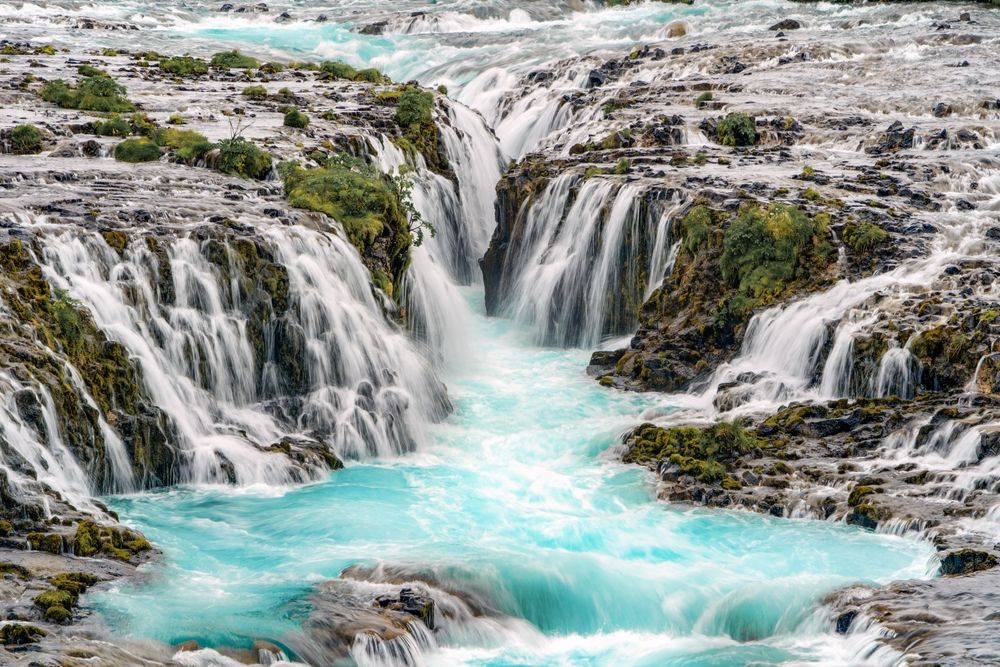
What it has is water in a shade of turquoise that looks wrong in photographs. The Brúará carries glacial meltwater off Langjökull, and fine rock flour in suspension scatters light towards blue.
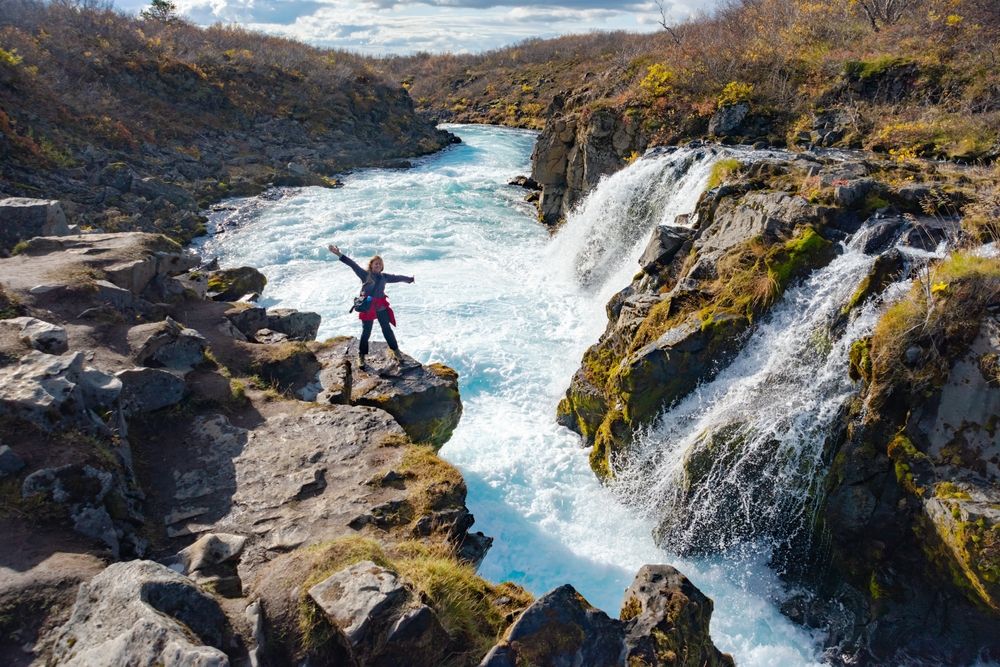
The falls funnel into a narrow channel below a footbridge, which concentrates the colour and gives the standard viewpoint.
The name means bridge falls, from a natural stone arch that once spanned the river here and was reportedly destroyed deliberately centuries ago.
The Brúará rises on the same ice cap that feeds the Hvítá, and our piece on how Gullfoss was formed covers what that glacial sediment does downstream.
The same river runs on to join the Hvítá downstream, by which point the colour has gone entirely.
Our page on Brúarfoss covers the site and the access.
The Short Route
What most people do now, and it takes half an hour of your day.
Park at the newer car park, signed as Brúarfoss Parking and marked on mapping apps under that name.
The fee is 750 ISK for a car, paid through the Parka app or at the machine. It is one of the few paid car parks in the area alongside Kerið and Þingvellir.
From there the walk is about five minutes on a made path to the footbridge above the falls.
The bridge is the viewpoint. Standing on it looking upstream is the composition everyone photographs.
Allow 20 to 30 minutes in total including the walk both ways and time to look at it properly.
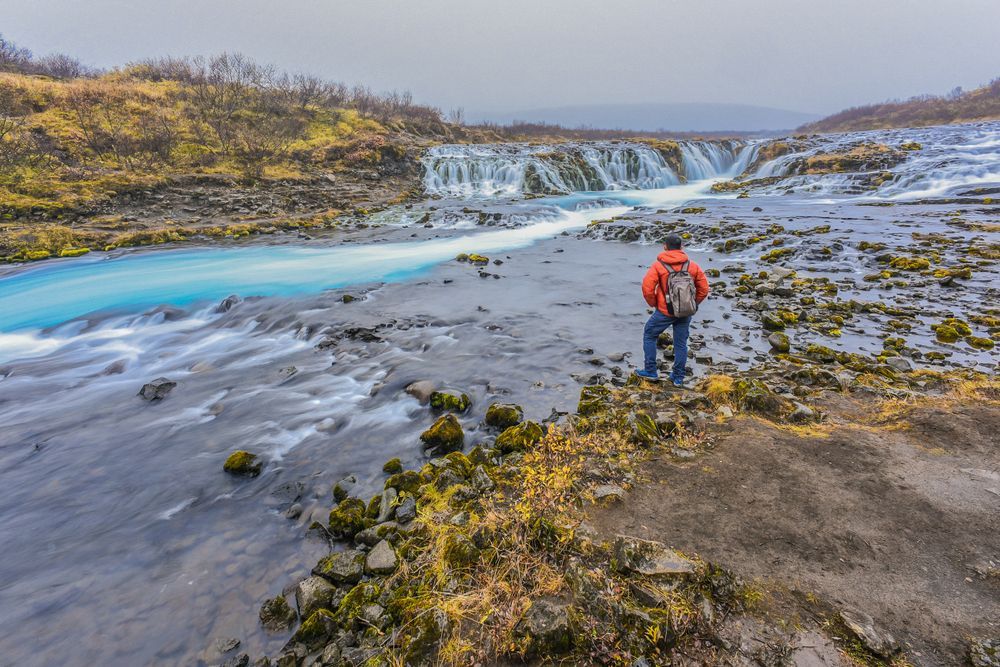
The footbridge above the falls is the standard viewpoint, and it is five minutes from the newer car park.
The Long Trail
Still open, still worth doing if you have the time and the weather.
The Brúarfoss Trail car park sits further downstream and has generally been free, though signage and arrangements at both car parks have changed more than once.
From there the path follows the Brúará upstream for about 3.5 kilometres, taking around an hour each way at a walking pace.
Two smaller waterfalls sit along the route, Hlauptungufoss and Miðfoss, and both are worth the stop. Neither is signed clearly.
The terrain is uneven, boggy in places and genuinely muddy after rain. Waterproof boots rather than trainers.
Seven kilometres round trip plus stops makes this a two and a half hour outing, which is a serious addition to a Golden Circle day.
Take it if you want the walk. Take the short route if you want the waterfall.
Where Not to Park
Worth being direct, because this has been a real problem here.
Brúarfoss sits among private summer houses, and for years visitors parked on residential roads, walked through gardens and left rubbish.
That is what produced the current arrangement, the paid car park and the signage. Ignoring it undermines access for everyone who comes after you.
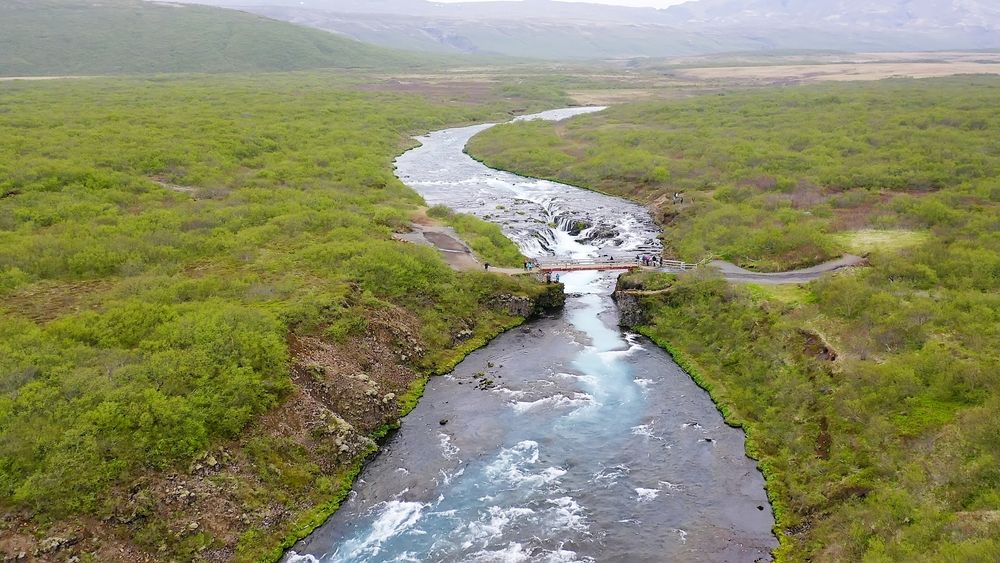
Park only in the designated car parks. Do not park on verges, in front of gates or on the summer house roads.
Stay on the marked paths, which cross private land in places.
Iceland's public access rules allow walking across uncultivated land but not driving or parking on it, and SafeTravel covers the wider country code.
The same principle applies across Iceland, where most land is farmed or privately owned even when it looks empty.
When the Blue Is Actually Blue
The single most important thing to know before making the detour.
The colour needs light. On a bright day the water is genuinely turquoise, and on an overcast one it is grey-green and unremarkable.
Direct sun on the water is what does it. Midday to early afternoon gives the best angle in summer.
Meltwater season matters too. Late spring and summer carry the most glacial flour, which is what produces the colour.
After heavy rain the river runs high and brown, and the effect disappears entirely for a day or two.
At Hjarðarland, the nearest long-running station to the route, Met Office climate data puts September as the wettest month at 147 mm and November as the clearest for cloud cover.
If the sky is flat grey, consider skipping it. Brúarfoss on a dull day is a small waterfall in a wood, and there are better uses of the 40 minutes.
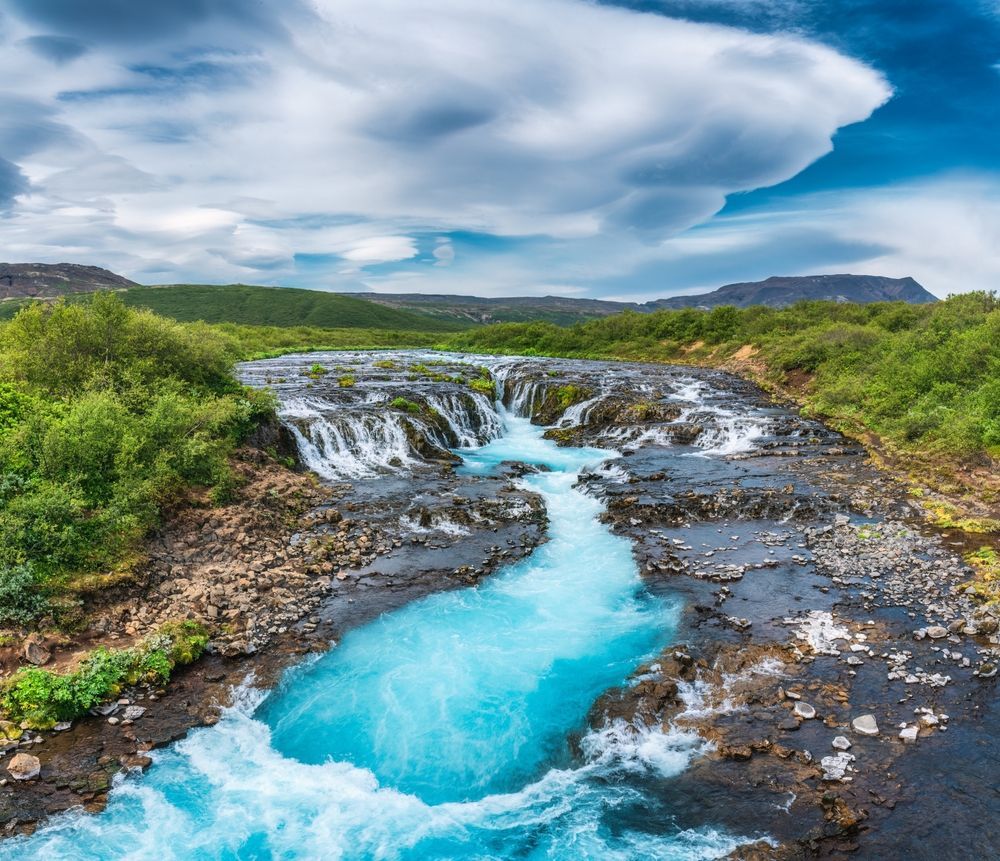
Direct light on the water is what produces the colour. Overcast turns it grey-green.
Through the Seasons
Four different versions of the same short walk.
Spring brings the highest flow as snowmelt comes off the ground, and the trail is at its muddiest.
Summer gives the best colour and the most visitors, though Brúarfoss is quiet compared with anything on the main loop.
Autumn thins the crowds and adds colour to the birch scrub along the river.
Winter freezes the edges and makes both routes icy. The short walk is manageable with traction spikes and the long trail is not a winter proposition.
Live road status for the approach is published at umferdin.is, and Route 37 is the road that matters.
Fitting It Into a Golden Circle Day
Brúarfoss sitsWaterfall is 20 minutes away and takes 15 minutes, so the two are off the main loop rather than on it, which is why coaches drive past.
It is about 15 minutes from Gullfoss, 20 from Geysir and roughly an hour and a half from Reykjavík.
The short route adds 30 to 40 minutes to a Golden Circle day including the detour, which is easy to absorb.
The long trail adds two and a half to three hours, which means dropping something else.
Faxi waterfall is 20 minutes away and takes 15 minutes, which makes the two of them a natural pair for anyone collecting the quieter stops. Our page on Faxi covers the parking there.
Both are the kind of stop that turns a standard itinerary into a slightly different one, since the coaches drive straight past.
Our guide to things to do near Gullfoss sets out how the smaller stops fit around the main three.
Is Brúarfoss Worth It?
Yes on a bright day, and honestly no on a grey one.
On a clear afternoon in June it is the most distinctive water on the Golden Circle and nothing else looks like it.
On an overcast November morning it is a modest cascade at the end of a muddy path.
The five-minute route has changed the calculation completely. When this meant a two and a half hour hike, it was a commitment. At 750 ISK and half an hour, it is an easy yes when the sun is out.
Check the forecast, then decide at Gullfoss rather than the night before.
See the Quieter Stops on a Small-Group Day
The Golden Circle has more than three sights, and the difference between a coach itinerary and a good day is usually the stops nobody else makes. Our small-group Golden Circle tour with Kerið and Friðheimar keeps groups under twenty and has the flexibility to add a short detour when conditions suit. Tell us your dates and we will find you a departure.
Compare Golden Circle Tours
Check each selected product for its current operator, guide, itinerary, meeting point, and terms.
View Our Tours
