
Yes, you can do the Golden Circle without a car, and most visitors who see it never touch a steering wheel. What you cannot do is reach the three main stops on a scheduled public bus, because no Strætó route serves Þingvellir, Geysir or Gullfoss.
The practical car-free option is a day tour from Reykjavík. Coach tours, small-group minibuses and private vehicles all cover the same loop, include pickup in the city, and hand the winter road decisions to a driver who makes them for a living.
This guide covers what the public buses genuinely reach, why a DIY bus trip almost never works, what the tour options cost, and how pickups run in Reykjavík.
Is There a Public Bus to the Golden Circle?
Iceland's national bus network is run by Strætó, and it exists to move residents between towns rather than tourists between waterfalls. There are no trains anywhere in the country, and no scheduled coach service stops at the Golden Circle sites.
Strætó rebuilt its countryside network on 1 January 2026. According to Strætó's own notice on the route changes, the south Iceland routes are now 51, 52, 53, 71, 72 and 73, with the Reykjavík to Selfoss service split out on its own so it can run more often on weekdays.
What the buses actually cover
Route 51 runs Selfoss to Reykjavík, which is the one leg of the region a visitor can rely on. Route 72 runs Selfoss to Flúðir, passing near the Secret Lagoon. Route 73 runs Selfoss to Grímsnes, the district that contains Kerið crater.
None of them goes near Þingvellir, Geysir or Gullfoss. The January 2026 changes also removed the stops at Þrastarlundur, Þóroddsstaðir and Þjórsárdalsvegur from routes 72 and 73, which took out the roadside stop closest to Kerið.
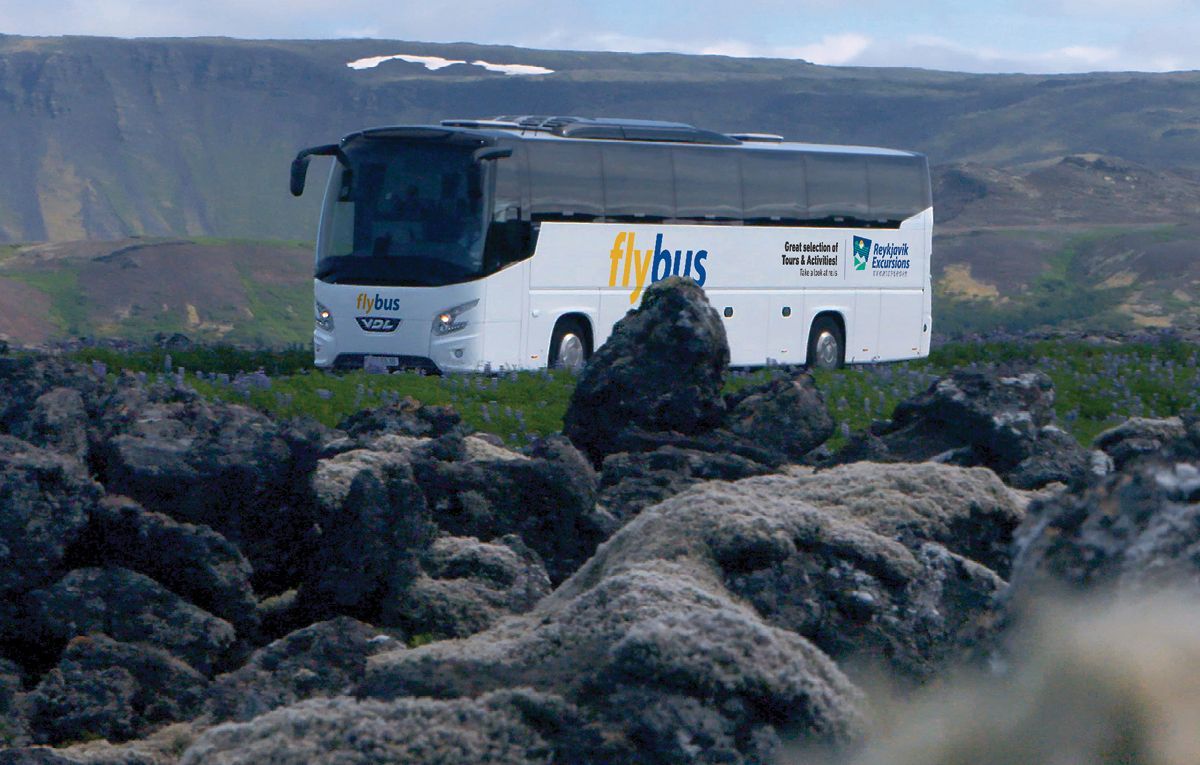
Scheduled coaches connect towns and the airport. Sightseeing routes are a separate service.
Why the bus does not work for sightseeing
Even where a bus passes within a few kilometres of a sight, the timetable defeats you. Rural services run a handful of times a day, are built around school and work hours, and often skip weekends entirely.
The distances between stops rule out walking. Geysir to Gullfoss is 10 kilometres on a road with no pavement and a 90 kilometre per hour limit, and Þingvellir to Geysir is 60. Hitching is legal and common in summer among backpackers, though it is not a plan you can schedule a flight around.
There is also nowhere to leave a bag. None of the three sites has luggage storage, and the visitor centres close well before the last theoretical bus back.
How Strætó fares and tickets work
Strætó sells tickets through the Klappið app, which covers both the city buses and the countryside routes. You can also pay the driver, though carrying exact change is a poor plan on a rural service.
Country routes are priced by zone, so a Reykjavík to Selfoss trip costs several times a city fare. The route 73 timetable for Selfoss to Grímsnes shows how thin the service is once you leave the main road, which matters more than the price.
The one DIY bus itinerary that half-works
If you are set on using scheduled transport, the version that comes closest is a two-day trip. Take route 51 to Selfoss, stay overnight, use route 72 to Flúðir for the Secret Lagoon the next morning, and return the same way.
That gives you a geothermal pool, farmland and a sense of rural south Iceland. It does not give you the Golden Circle, since you will have seen none of the three headline sites.
For a single day, the honest answer is that a tour costs less than two nights of accommodation in Selfoss and shows you far more.
Other Car-Free Ways People Try
Every summer a few travellers attempt the loop under their own steam. Two of the methods work, in the sense that people complete them, and one is a waste of money.
Cycling is genuinely done. Reykjavík to Þingvellir is about 50 kilometres with a long climb over Mosfellsheiði, and the full loop is a two or three day tour with camping at Þingvellir or Laugarvatn. Route 35 carries coach traffic and has a narrow shoulder, so it suits confident riders rather than casual ones.
Hitchhiking is legal and reasonably common on this route in June and July, when traffic is heavy and half of it is going where you are. It falls apart in winter, in rain, and any time you need to be back for a flight.
Taxis are the expensive mistake. A metered return trip from Reykjavík to Gullfoss with waiting time runs well past the price of a private tour vehicle, and you get a driver rather than a guide.
Guided Day Tours: The Practical Car-Free Option
Day tours from Reykjavík are the reason the Golden Circle works without a car. They leave daily year-round, cover 230 to 300 kilometres, and return you to the city in the evening.
They differ mostly in vehicle size, which affects everything else: how fast the group moves between stops, how much the guide can tell you, and what the day costs.
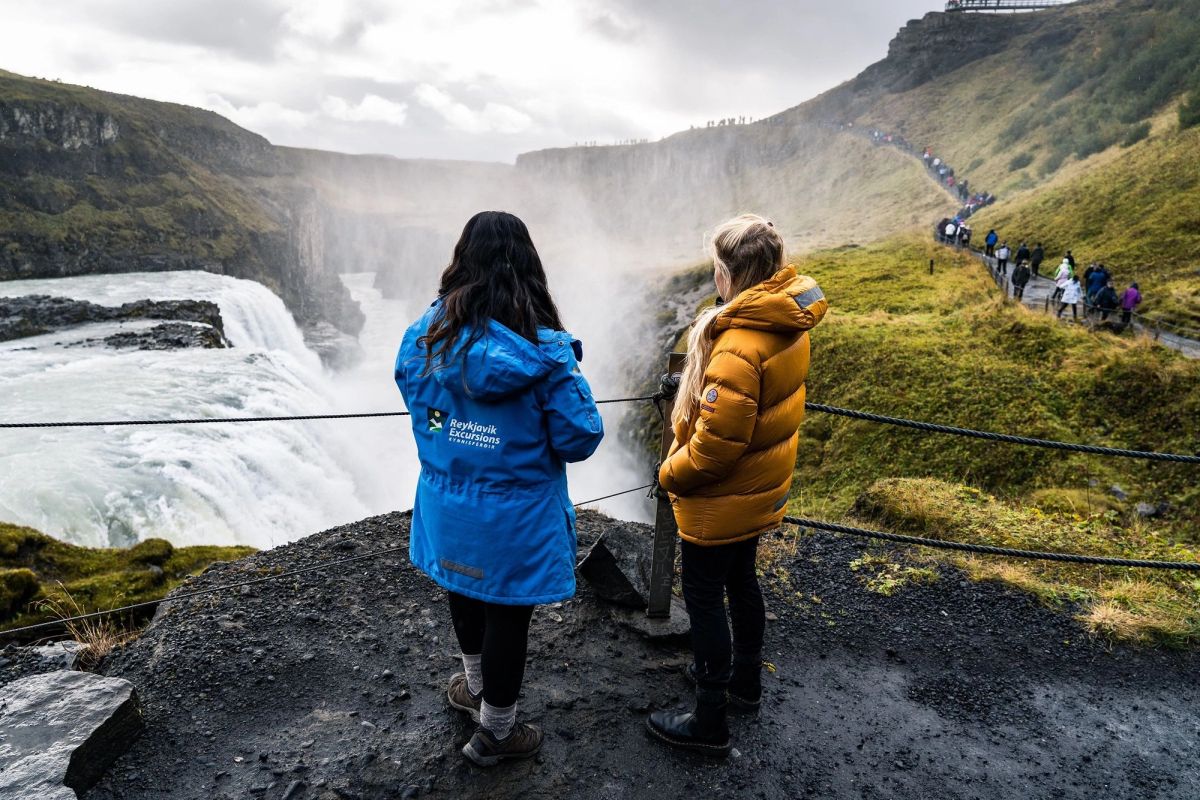
A driver-guide at Gullfoss. On a tour the stop lengths are fixed, usually around 40 minutes each.
Classic coach tours
The standard full-day coach is the cheapest way to see the loop and the most common. Our own Golden Circle Classic Tour runs 9 hours for 13,152 ISK per person, covering Þingvellir, Geysir and Gullfoss with a driver-guide and commentary along the way.
Groups are large, often 40 to 60 people. That means a few minutes of waiting at each stop while everyone reboards, and a fixed 40 minutes at each site whether you wanted 20 or 60.
Coaches are also the most robust option in bad weather. A full-size vehicle handles wind better than a minibus, and the operator has other departures to rebook you onto if a road closes.
Small-group minibus tours
Small-group tours cap the vehicle somewhere between 8 and 19 seats. Ours runs 8.5 hours for 19,630 ISK and adds Kerið crater and the Friðheimar tomato farm to the standard three stops.
The practical gain is time. A 15-seat minibus unloads in two minutes rather than ten, which over four stops gives you close to an extra half hour on your feet, and the guide can answer questions rather than broadcast.
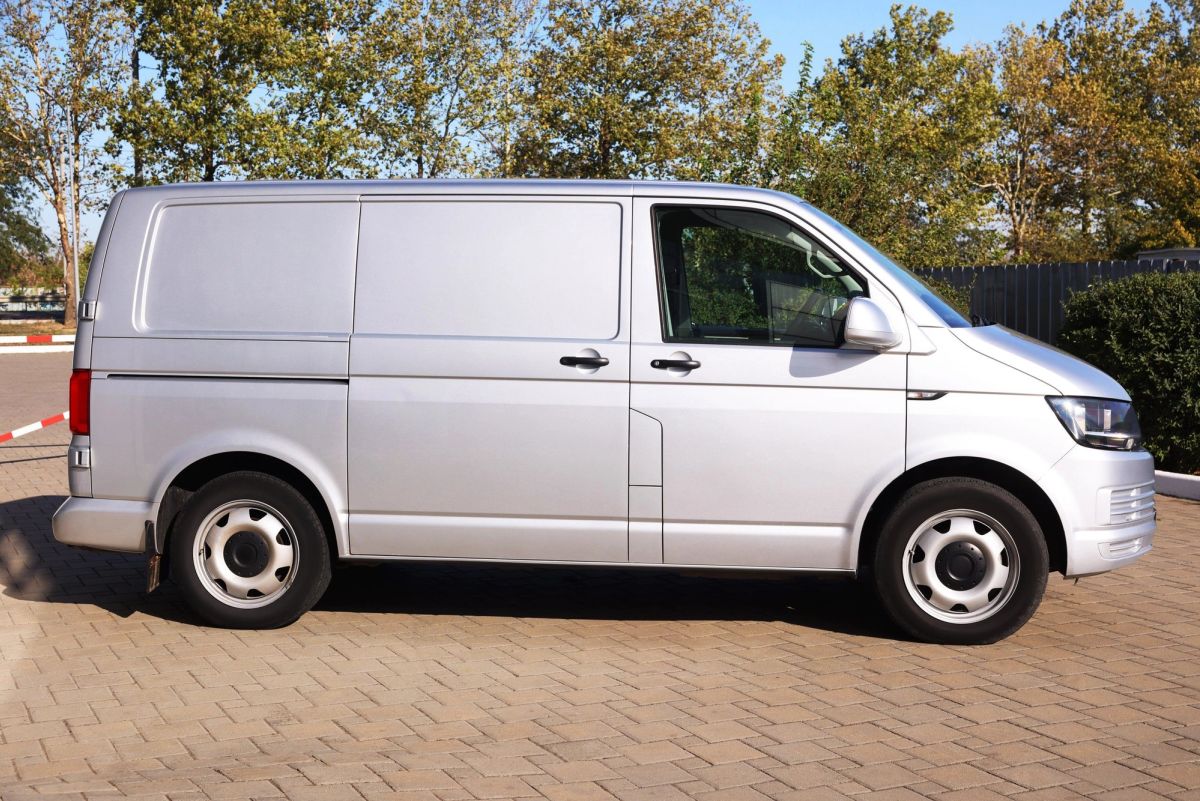
Small-group vehicles move between stops faster, which converts directly into time at each site.
Private tours
A private tour puts your group in its own vehicle with its own schedule, from 183,951 ISK for up to 19 guests. Split across a family of six that is competitive with six small-group seats, and it buys you an 8am start before the coaches arrive.
Private is also the option that handles awkward requirements: a wheelchair, a toddler's nap, a photographer who wants 90 minutes at Gullfoss, or a flight at 6pm. Our private Golden Circle tour runs 8 to 9 hours and adjusts the order of stops on the day.
Combo tours
Combo tours attach an activity to the loop: snorkelling at Silfra, snowmobiling on Langjökull, a soak at the Secret Lagoon or Sky Lagoon, or the Blue Lagoon on the way back. They run 9 to 12 hours.
For a car-free traveller these are unusually good value, because arranging the same two things separately would need a rental car or two transfers. The Blue Lagoon combination in particular saves you a return trip out to Reykjanes on a different day.
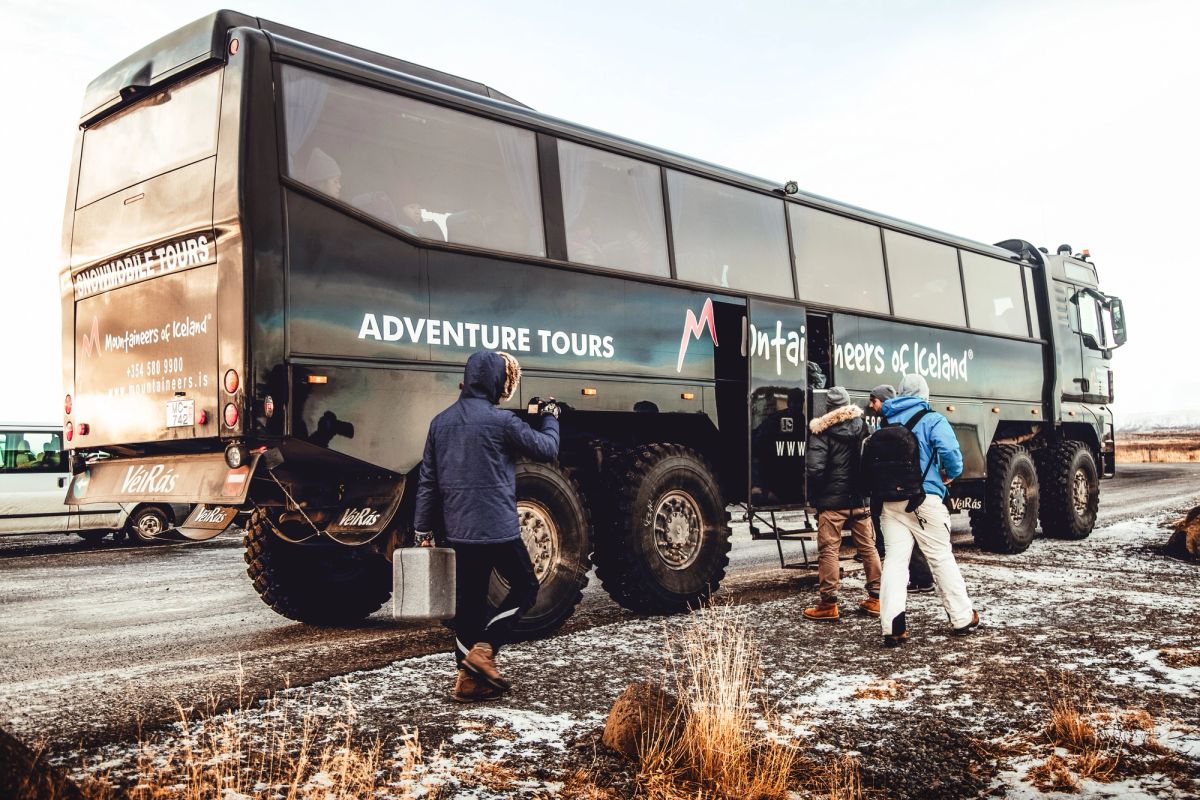
Combo departures use bigger vehicles when the day includes a glacier or highland section.
What Car-Free Tours Cost
Prices below are our current rates in Icelandic krónur, which sit in the normal range for the market.
- Classic coach tour, 9 hours: 13,152 ISK per person
- Small-group tour with Kerið and Friðheimar, 8.5 hours: 19,630 ISK per person
- Golden Circle with the Blue Lagoon, 10 hours: 35,099 ISK per person
- Golden Circle with Silfra snorkelling, 9 to 10 hours: 48,990 ISK per person
- Golden Circle and snowmobiling on Langjökull, 10 to 11 hours: 63,188 ISK per person
- Private tour for up to 19 guests, 8 to 9 hours: 183,951 ISK per vehicle
Compare that with driving. A small rental car in summer runs roughly 8,000 to 15,000 ISK a day before insurance, fuel for the loop adds 5,000 to 7,000, and Þingvellir parking is another 1,000 ISK per car. Two people driving land close to two coach seats, and a solo traveller is always better off on a tour.
Lunch is the same either way. Budget 2,500 to 4,000 ISK a head at the Gullfoss or Friðheimar cafes, or bring a packed lunch, since tours give you time to eat but do not include the food.
Pickup and Meeting Points in Reykjavík
Most Reykjavík tours use a bus-stop system rather than door-to-door pickup. The city centre has around 20 numbered stops, and your booking confirmation tells you which one covers your accommodation.
Be at the stop 10 minutes before the window opens, because the pickup runs to a route rather than a clock and drivers do not wait long. Pickup usually starts 30 minutes before the stated departure time, and the coach then leaves from the main bus terminal.
Hotels in the outer suburbs and in Hafnarfjörður or Garðabær are often outside the pickup zone. If yours is, the fix is to take a city bus or taxi into the centre for the departure, or to book a private tour that collects you where you are.

Private vehicles collect from any address, including hotels outside the standard pickup zone.
Getting to Reykjavík Without a Car First
Keflavík Airport sits 50 kilometres from the city, and the Flybus airport transfer connects the two for every arriving flight. It runs 35 to 45 minutes to the BSÍ terminal, the Plus version drops you at your hotel, and departures are timed to landings rather than to a fixed clock, so a delayed flight does not strand you.
Book the airport transfer and your Golden Circle day separately rather than assuming one connects to the other. Arriving at 6am and joining an 8am tour is possible, though your bag has nowhere to go, so most people take the first day slowly.
Roughly 2.25 million foreign visitors arrived through Keflavík in 2025 according to the Icelandic Tourist Board, and a large share make exactly this transfer within an hour of clearing customs. The coaches are sized for it, so a seat is rarely a problem even without a booking.
Within the city you barely need transport at all. Reykjavík's centre is walkable end to end in half an hour, and the Strætó city buses cover everything beyond that.
Car-Free Beyond the Golden Circle
The same logic covers the rest of the country's headline sights, which is worth knowing before you decide a rental car is unavoidable.
The South Coast runs as a day tour from Reykjavík covering Seljalandsfoss, Skógafoss and Reynisfjara, at about 400 kilometres and 10 hours. Whale watching leaves from the old harbour and needs no transport at all.
The lagoons are all reachable by scheduled transfer. The Blue Lagoon sits on the airport road and has its own coach service, the Sky Lagoon is a 15-minute drive from the centre with a shuttle, and the Secret Lagoon is usually visited as part of a Golden Circle combo.
What genuinely needs a car is the Westfjords, the eastern fjords and anything on an F-road. For a first trip built around the southwest, you can see almost everything on a seat someone else is driving.
What You Give Up Without a Car
You lose the early start. Tours leave between 8am and 9am, which puts everyone at the same sites at the same time, while a self-driver can be at Gullfoss at 8am with the place to themselves.
You lose the detours. Brúarfoss needs a 45-minute walk from a small car park, Efstidalur is a farm stop most coaches skip, and Faxi is a ten-minute diversion that no scheduled tour makes. Those are the stops that turn a good day into a memorable one.
You also lose the ability to stop for weather. A self-driver who sees the cloud lifting can wait 20 minutes at a viewpoint. A tour keeps to its timetable.
What You Gain
You gain a guide. The geology at Þingvellir and the history of the Alþingi are far more interesting with someone explaining them, and most visitors would not otherwise learn that the assembly met there from about 930 until 1798.
You gain winter safety. Between November and March the drivers check road.is and the Met Office before every departure and change the running order when a road turns, which is judgement a first-time visitor does not have.
You also gain the day itself. Three and a half hours of driving is a real cost when you are jetlagged, and watching the Bláskógabyggð farmland go past from a coach seat is a better use of it.
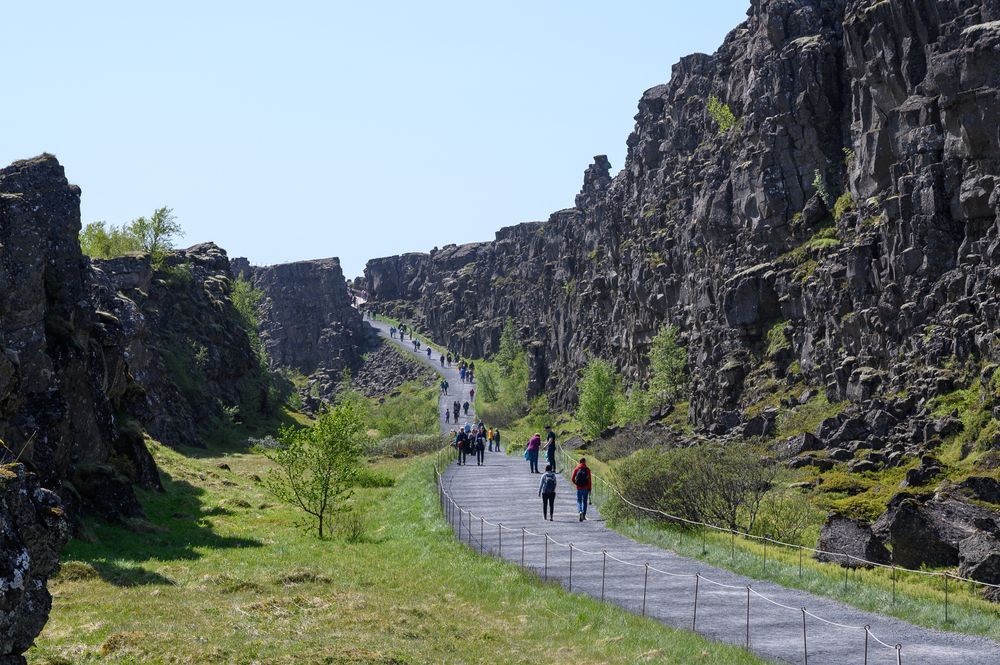
Þingvellir rewards a guide, since the assembly site itself is easy to walk past without noticing.
A Car-Free Day, Hour by Hour
Here is how a standard coach day actually runs, so you can plan around it.
- 08:00 to 08:30: pickup from your city-centre bus stop, then a short wait at the terminal
- 09:30: arrive at Þingvellir, roughly 40 minutes at the Hakið viewpoint and Almannagjá
- 11:15: arrive at Geysir, 45 to 60 minutes including lunch or a coffee
- 12:45: arrive at Gullfoss, around 45 minutes at both viewpoints if the lower path is open
- 14:00: Kerið crater or Friðheimar on tours that include them
- 17:00 to 18:00: back in Reykjavík
Winter departures compress that, since usable light runs from about 10:30am to 4:30pm in December. Most operators keep all three stops and shorten each one rather than dropping a site.
Tips for Car-Free Travellers
Book two or three days ahead in summer and the day before in winter. Popular small-group departures sell out in July, and winter tours can fill when a storm cancels the previous day's run.
Check the cancellation terms before you pay. Most Iceland day tours allow free cancellation up to 24 hours ahead, and weather cancellations by the operator are refunded or rebooked.
Bring what you need for the whole day in a small bag you can carry. The coach is locked at each stop on some tours, and the weather at Gullfoss can be entirely different from the weather when you boarded.
Dress as if you will be outside for the whole day, because you will be. Tours stop regardless of weather, and standing at Gullfoss in February in a city coat is a miserable 40 minutes. Check road.is the night before in winter, since a red route on the map usually means your departure will be reshuffled.
Pick your stop count honestly. A four-stop tour in December means 20 minutes at each site in the dark, and three stops done properly beats five done at a jog.
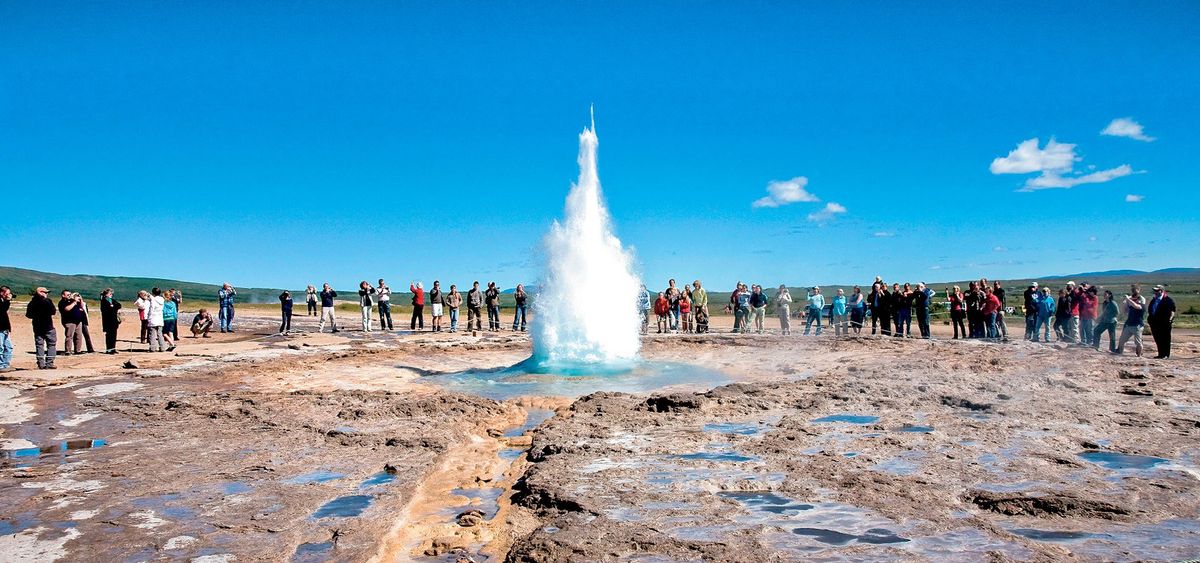
Geysir is where tour groups converge between 11am and 1pm, so it pays to walk the upper loop first.
Book the Day and Leave the Driving
If you are travelling without a car, the Golden Circle is one of the easiest places in Iceland to reach, provided you book a seat rather than a bus ticket. Our small-group Golden Circle tour with Kerið crater and Friðheimar farm collects you in central Reykjavík, covers all three main sites plus two extras, and gets you back in time for dinner.
Check the pickup list against your accommodation before you book, and pick a departure that suits how early you like to start.
Compare Golden Circle Tours
Check each selected product for its current operator, guide, itinerary, meeting point, and terms.
View Our Tours
