
Is Gullfoss Frozen in Winter?
Not entirely, and that is what makes it worth seeing. The Hvítá is a glacial river with too much volume and too much movement to freeze through, so the main cascade thunders on at temperatures well below zero.
What does freeze is everything around it. Ice shelves form along the canyon rim, spray freezes into columns on the rock faces, and the whole gorge turns white while the water runs black through the middle of it.
Gullfoss is open year-round and free to enter. The upper viewpoint stays accessible in almost all conditions, while the lower path beside the first tier closes regularly once ice takes hold.
What Changes When the Cold Arrives
The falls themselves are the same falls. Everything around them is different.
The average flow of the Hvítá is about 109 cubic metres per second, dropping 11 metres then 20 into a canyon 70 metres deep, according to the Environment Agency of Iceland.
Winter flow runs lower than the summer figure of around 130, because the Langjökull meltwater that feeds the river slows when the glacier is frozen. The waterfall looks marginally narrower and the canyon looks considerably larger.
Spray behaves differently too. In summer it produces rainbows across the lower tier. In winter it lands on every surface and freezes there, which is why the railings turn into ice sculptures by January.
Snow cover on the surrounding plain removes the greens and browns entirely, leaving a landscape of white, black rock and the ochre of the water.
How Cold Does It Actually Get?
Colder than the numbers suggest, because the site is exposed on three sides.
At Hjarðarland, the nearest long-running station to the Golden Circle, Met Office climate data gives a January average daily high of 1.8°C and an average low of −4.3°C across the 1991 to 2020 normals.
That sounds mild, and it is until the wind arrives. A 15 metre per second gust at 0°C feels like −10°C, and Gullfoss has no shelter of any kind at the upper viewpoint.
Damp is the other factor. Spray drifting across the platform soaks an unprotected jacket in ten minutes, and wet clothing in wind is what actually makes people cold.
The practical consequence is that you will spend less time outside than you planned. Twenty minutes at the viewpoint in February feels much longer than an hour there in July.
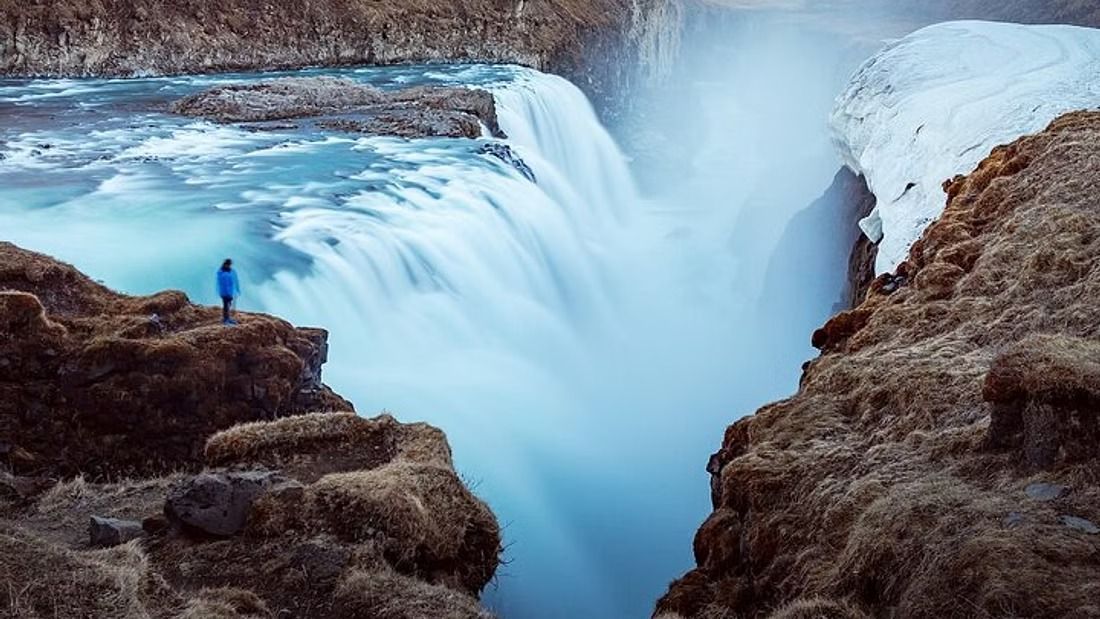
The upper viewpoint stays open through most of the winter, and it is fully exposed to the wind.
What the Falls Look Like Month by Month
Winter is not one season at Gullfoss, and the differences are worth knowing before you pick a date.
November brings the first hard frosts and usually the first snow, with ice forming at the canyon edges. Daylight is shrinking fast and the falls are still running near autumn volume.
December and January are the darkest and often the most striking. The canyon is fully snow-covered, ice formations are at their thickest, and the low sun sits just above the horizon for the few hours it is up.
February holds the ice and gains daylight, which makes it the best compromise month for most visitors.
March starts the thaw. Meltwater raises the flow, ice begins breaking away from the rim, and the site becomes muddy rather than frozen underfoot.
The ice is at its most photogenic in a cold, dry spell after a snowfall. A mild wet January week can leave the canyon grey and slushy instead.
Daylight and the Northern Lights
The short days are the biggest planning constraint of a winter Golden Circle trip.
In late December the sun is above the horizon for around four hours in southwest Iceland, rising after eleven and setting before four. Add twilight either side and you have perhaps six hours of usable light.
That is enough for the three main stops, but only just, and it means a Golden Circle day in December starts and ends in the dark.
The compensation is that darkness arrives while you are still out. Gullfoss sits far from any town lighting, and on a clear night with active aurora the canyon is one of the better places in the southwest to watch from.
Our Golden Circle and northern lights combination is built around exactly that, covering the daytime loop and then chasing clear sky after dark.
Aurora is never guaranteed. A clear sky matters more than solar activity for a single evening, and Icelandic winter skies are cloudy more often than not.
Getting to Gullfoss in Winter
Route 35 is the road that matters, and it is maintained through the winter rather than closed for it.
Maintenance does not mean clear. Snow, drifting and ice make the surface variable, and the section past Geysir towards the falls is the most exposed part of the loop.
Live road status is published by the Icelandic Road Administration at umferdin.is, and the same source carries wind and closure warnings. Check it on the morning rather than the night before.
Storms close the road outright a handful of days each winter. When that happens, no operator is running and no rental car should be either.
Self-Driving or a Guided Tour?
The honest version, because both work and one is easier.
Self-driving gives you flexibility and the ability to wait out a squall. It also means you are on Icelandic winter roads in a vehicle you are not used to, in the dark, on studded tyres you have never driven on before.
A guided tour removes all of that. The driver has done the road hundreds of times, the vehicle is set up for the conditions, and the decision about whether today is a driving day has already been made by someone who knows.
For a first winter visit, the guided option is the one we would recommend to a friend. Our Golden Circle day tour runs year-round and adjusts the route when the weather demands it.
If you do drive, take a 4x4, keep the fuel tank above half, and never park facing into a drift.
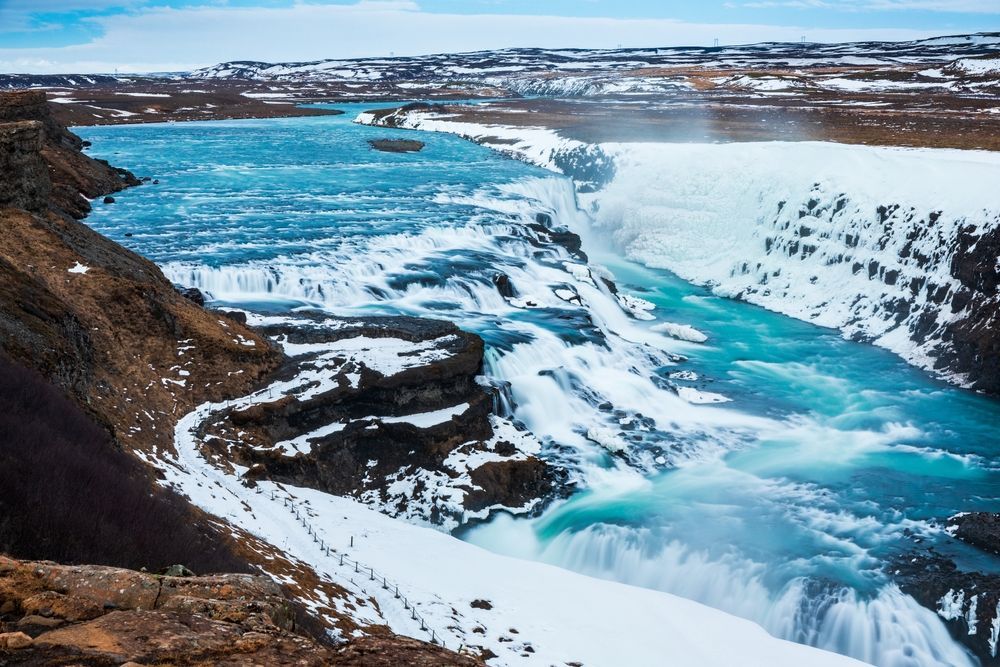
By January the spray has coated the rock faces, and the canyon edges carry a permanent ice shelf.
Paths, Viewpoints and Access
Two viewpoints, and in winter they are not equally available.
The upper viewpoint sits beside the visitor centre and gives the wide view down the whole canyon. It is a short, level walk from the car park and stays open in almost all conditions.
The lower path drops towards the first tier and gives the close view where you feel the spray. It closes frequently between November and March, and the closure is enforced rather than advisory.
When the lower path is open it is often the iciest surface on the site, because the spray that makes it dramatic also coats it. The steps down are the part where people fall.
Handrails are in place along the main routes and they are worth using rather than photographing from. Ice on a handrail is still better than no handrail.
The visitor centre stays open through winter with a café and toilets, and it is the warm room that makes a February visit workable.
What to Wear and Bring
Six things, and the third is the one people forget.
Waterproof outer layers, both jacket and trousers. Spray plus wind means you get wet from the side rather than from above.
Warm mid-layers, preferably fleece or wool rather than cotton, since cotton stays cold once damp.
Traction spikes that slip over your boots. These cost very little, weigh nothing, and are the single item that changes a winter visit at Gullfoss from tense to easy. Buy them before you travel or at any Icelandic petrol station.
A proper hat and gloves. Waterproof gloves specifically, because wet wool gloves in wind are worse than bare hands.
Boots with a real sole. Trainers on ice at a canyon rim are a genuinely poor idea.
A dry bag or pocket for your phone. Cold drains batteries fast and spray finishes the job.
Fitting Gullfoss Into a Winter Golden Circle Day
Daylight is the constraint, so the running order matters more in January than in July.
Leave Reykjavík early, ideally before nine, so the first stop happens as the light arrives.
Take Þingvellir first, since it needs walking and reads better in daylight than in dusk. Our guide to what the Golden Circle covers sets out the standard order.
Geysir second, where Strokkur erupts every five to ten minutes regardless of season and the geothermal ground stays snow-free.
Gullfoss third and last of the main three, arriving in the early afternoon while there is still light in the canyon.
Allow 45 minutes at the falls rather than the hour a summer visit takes, because the cold shortens everyone's patience.
If you have daylight left, the Secret Lagoon at Flúðir is 30 minutes away and a hot soak after a frozen canyon is the correct end to a winter day.
Is Winter a Good Time to Visit Gullfoss?
Yes, with the caveat that it is a different experience rather than a lesser one.
The ice, the snow-filled canyon and the low golden light give you something summer cannot. Photographers in particular get far more from a February visit.
Crowds are a fraction of the summer numbers, and the upper viewpoint in January can be almost empty on a weekday.
The costs are real. Shorter days, closed paths, cold that limits how long you stand there, and a road that occasionally decides the day for you.
If you can only visit once and want everything open, come in summer. If you want the canyon at its most dramatic, come in February.
See the Frozen Canyon With Someone Else Driving
Winter roads are the part of a Golden Circle day that nobody enjoys, and they are the part a guide removes entirely. Our small-group Golden Circle tour with Kerið and Friðheimar runs through the winter in vehicles set up for the conditions, with enough time at Gullfoss to walk the viewpoints properly. Tell us your dates and we will tell you what the light will be doing.
Compare Golden Circle Tours
Check each selected product for its current operator, guide, itinerary, meeting point, and terms.
View Our Tours
