
What Is Oxararfoss?
A waterfall inside Þingvellir National Park, where the Öxará river drops around 13 metres over the Almannagjá rift wall into the gorge below. It is the only waterfall in the park and one of the easiest in Iceland to reach.
The setting is what makes it. The water comes over the edge of the North American plate, lands on a jumble of basalt boulders and runs off along the floor of the rift.
It is a ten-minute walk on boardwalk from the nearest car park, which puts it within reach of almost everyone visiting on a Golden Circle day.
The River That Was Moved
The most interesting thing about Öxarárfoss is that it may not be natural.
The Öxará rises north of the park and originally ran a different course. Medieval accounts suggest the river was diverted into the Almannagjá gorge, probably in the early years of the assembly, to bring water to the thousands of people camping on the valley floor each summer.
If that account is right, the waterfall is a by-product of a public works project from roughly a thousand years ago, which makes it one of the oldest engineered landscape features in the country.
Historians disagree about how much of the diversion was deliberate and how much the river found its own way. There is no dispute that the Öxará became the assembly's water supply.
The name means axe river. The story attached to it involves an axe thrown into the water, and like most such stories it explains nothing and gets repeated anyway.
The park's own account notes that after the conversion to Christianity in the year 1000, laws were among the first things written down, and Þingvellir National Park is the best source for what is documented and what is tradition.
Where It Sits in the Park
Understanding the geography makes the walk obvious.
Þingvellir's main path runs from the Hakið visitor centre down through the Almannagjá gorge to the valley floor. Öxarárfoss sits at the northern end of that same gorge.
From the bottom of the gorge path, turn north and the boardwalk takes you to the falls. From the P2 Efri-Vellir car park, you approach from the other direction on a shorter route.
Downstream, the Öxará runs past the assembly site, the church and Drekkingarhylur, the pool where women convicted under Danish law were drowned between the sixteenth and eighteenth centuries.
The Þingvellir National Park layout puts all of this within a 1.5 hour walk if you take it in one loop.
How to Get There
Two approaches, and the right one depends on what else you are doing.
For the shortest walk, park at P2 Efri-Vellir, which sits below the falls. From there it is roughly 10 minutes on level boardwalk and a short set of steps.
For the full experience, park at P1 Hakið above the gorge, walk down through Almannagjá in about 15 minutes, then continue north along the boardwalk for another 10.
Parking is 1,000 ISK for a car with five seats or fewer, and one payment covers all the park's fee car parks for the day. Our guide to Þingvellir parking explains how the licence plate cameras work.
Coming from Reykjavík, the drive is about 45 minutes on Route 36.
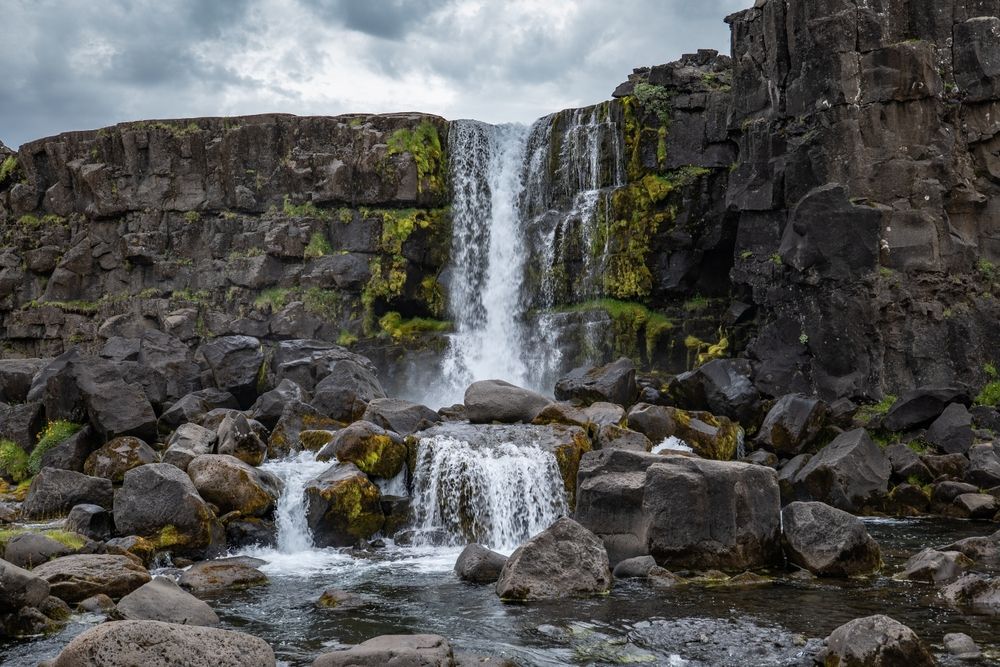
The falls land on boulders rather than a plunge pool, which is why the sound carries down the gorge.
The Walk Itself
Short, easy and better than the distance suggests.
The boardwalk crosses lava and low scrub, curving so that the falls stay hidden until the last stretch. That reveal is deliberate and it works.
There are steps at the end down to the viewing platform beside the boulder field, and a lower area where you can get close to the water.
The surface is boardwalk and asphalt throughout, which makes it manageable with a pushchair as far as the platform. The final steps are not.
Handrails run along the exposed sections. In summer this is a stroll; in winter the same boards ice heavily and the handrails matter.
Allow 30 minutes for the round trip from P2 including time at the falls, or an hour if you are coming down through the gorge.
Through the Seasons
The same waterfall, three quite different experiences.
Spring brings the highest flow as snowmelt comes off the ground north of the park. May and early June are when Öxarárfoss is at its loudest.
Summer settles into a steadier flow with moss and scrub green around the boulders. This is also when the boardwalk is busiest, particularly between eleven and three.
Autumn thins the crowds and turns the surrounding vegetation red and gold, which sets off the dark rock well.
Winter is the dramatic one. Ice columns form along the rift wall while water still runs through the middle, and in a hard cold spell the falls can freeze almost completely.
The winter boardwalk is cleared but ices over, and traction spikes over your boots make the difference between walking and shuffling. Our guide to Þingvellir in winter covers what is open and what is not.
Daylight is the other winter constraint, with barely four hours of sun in late December and the falls in shadow for most of them.
Road status on Route 36 is published at umferdin.is, and it decides whether a winter visit happens at all.
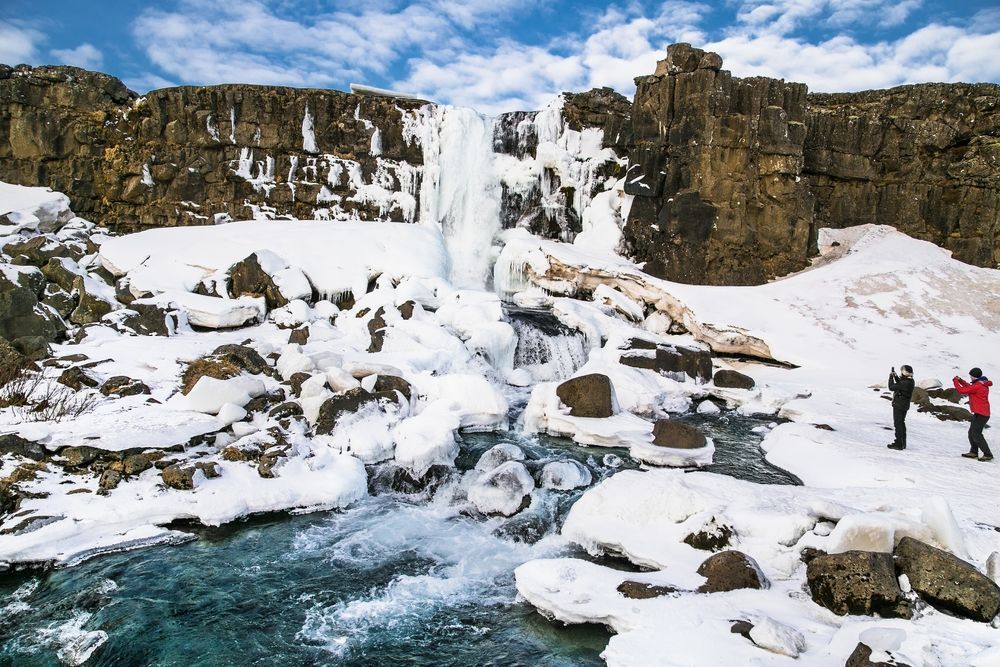
Ice columns build along the rock face while the centre keeps running.
Photographing It
Four things worth knowing before you get there.
The light is difficult in the middle of the day. The gorge wall shades one side of the falls while the sky above blows out, which is why so many photographs of Öxarárfoss look flat.
Early morning and evening are better, with low sun raking along the rift wall rather than straight down into it.
The boulder field at the base gives the strongest foreground. Getting low among the rocks puts scale into a waterfall that is not especially tall.
Overcast is genuinely good here. Flat light suits dark basalt and white water, and Iceland provides plenty of it.
Spray reaches the platform in wind, so a cloth for the lens is more useful than a filter.
Fitting It Into a Golden Circle Day
Öxarárfoss is an addition to a Þingvellir stop rather than a stop of its own.
A standard Þingvellir visit of an hour covers the viewpoint, the gorge and Lögberg. Adding the falls takes it to about 1.5 hours.
That still fits comfortably into a Golden Circle day, with Geysir 50 minutes east and Gullfoss ten minutes beyond that. Our guide to what the Golden Circle covers sets out the full route.
In winter the arithmetic tightens. With four hours of December daylight, adding the falls means dropping something else.
The park is protected under Act No. 47/2004 and covers 22,788.7 hectares according to the Environment Agency of Iceland, so staying on the marked routes is a requirement rather than a suggestion.
Is It Worth Visiting?
Yes, with an honest caveat about expectations.
Öxarárfoss is not a great waterfall by Icelandic standards. It is 13 metres in a country that has Gullfoss an hour away and Dettifoss in the north.
What it has is context. You are looking at water falling over a tectonic plate boundary, beside a site where a parliament met for eight centuries, on a river that people may have moved by hand a thousand years ago.
The walk is also genuinely pleasant, and it takes you into a part of the park that most visitors skip in favour of the viewpoint and the car.
Come for Þingvellir, walk to the falls while you are there, and treat it as the good ending to the gorge rather than the reason for the trip.
Compare Golden Circle Tours
Check each selected product for its current operator, guide, itinerary, meeting point, and terms.
View Our Tours
