
What Was Filmed at Thingvellir?
The Almannagjá gorge served as the mountain road leading to the Bloody Gate, the fortress guarding the entrance to the Vale of Arryn. It appears in season four, first when Sansa Stark travels there with Petyr Baelish, and again later in the season when Arya Stark and Sandor Clegane arrive at the gate.
The end of the path near Öxarárfoss is where the Bloody Gate itself was placed, built into the shot with visual effects rather than constructed on site.
Both sequences use the same stretch of rift wall. Standing at the top of the gorge, you are looking at the exact frame, minus the fortress and the extras.
Why This Gorge
Location scouts across the whole series were looking for landscapes that read as impossible, and Þingvellir delivers that with a car park attached.
The Almannagjá wall rises up to 40 metres in places, running dead straight for a considerable distance, which gives a corridor effect that a natural valley rarely produces.
The rock is dark basalt with moss growing in the cracks, and it holds detail in overcast light. Iceland's flat grey skies, which visitors complain about, are excellent for continuity in filming.
The scale is real rather than built. Nothing in the frame needs to be dressed, which is cheaper and reads better than a set.
The practical clincher is access. This is a national park with a paved path, a car park and toilets, so a crew of a hundred can work there without a helicopter.
The Bloody Gate and the Road to the Vale
The Vale sequences hold together geographically, which is unusual for the series.
In the story, the road to the Eyrie climbs through the mountains and passes the Bloody Gate, an ancient fortification set into a narrow pass. Nothing gets to the Eyrie without going through it.
The production used the gorge for the approach, shooting along the base of the wall so the cliff dominates the frame. The riders are small and the rock is enormous, which is the entire point of the scene.
Arya and the Hound arrive at the gate on horseback. The horses are Icelandic, which the production used throughout for their size and their surefootedness on rough ground.
Sansa's arrival earlier in the season uses the same landscape from a different angle, filmed with more snow on the ground.
The gate itself is not there and never was. What is there is the rock, the path and the light.
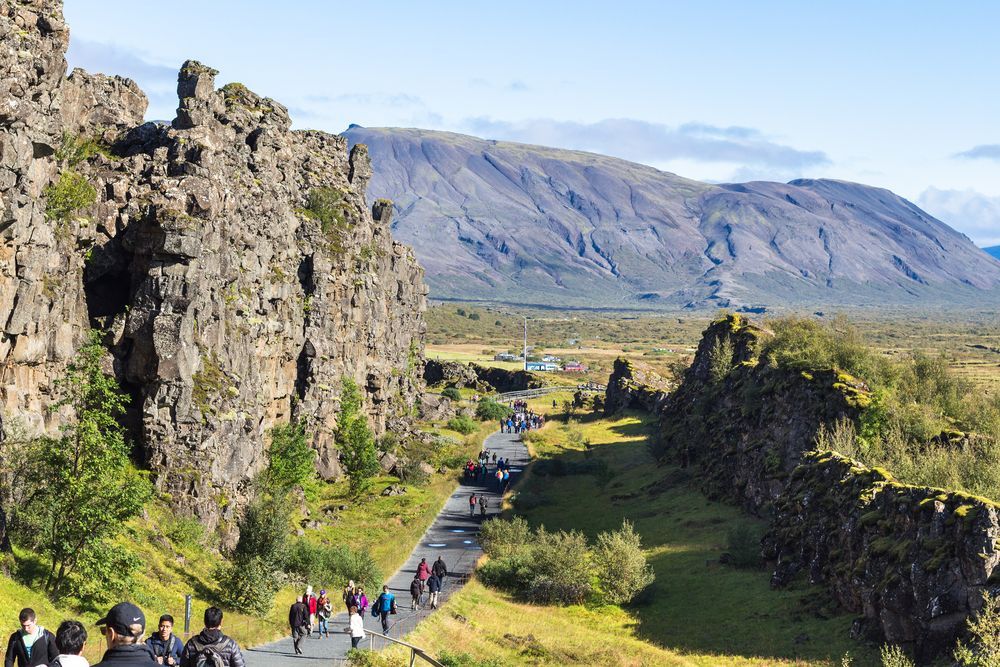
The corridor effect between the rift walls is what made this stretch usable on screen.
Thorufoss and the Dragon
Twenty minutes from the park, and the location most fans miss.
Þórufoss sits on the Laxá river beside Route 48, between Þingvellir and Reykjavík. It is a broad waterfall dropping about 18 metres into a small canyon.
In season four this is where Drogon takes a goat from a herd of the Lhazareen, in the sequence that convinces Daenerys her dragons have stopped being manageable.
There is a small parking area beside the road and a short walk to the viewpoint. No fee, no facilities and usually nobody there.
It is genuinely worth the detour on the way back to Reykjavík, and it is a good waterfall independent of the television.
Other Iceland Locations in the Show
Þingvellir is one stop on a much longer Icelandic list, and the rest is nowhere near the Golden Circle.
North of Lake Mývatn, Grjótagjá is the lava cave with the hot spring where Jon Snow and Ygritte have their scene. It is on private land and swimming is no longer permitted.
Dimmuborgir, also near Mývatn, served as Mance Rayder's wildling camp, with its lava pillars standing in for the country beyond the Wall.
Svínafellsjökull and the glaciers of Vatnajökull provided the Frostfangs and the Fist of the First Men, which is where the White Walker sequences were shot.
Kirkjufell on Snæfellsnes is the arrowhead mountain the Hound sees in his vision, and it appears again in season seven.
Höfðabrekkuheiði near Vík and the black beaches of the south coast fill in for Eastwatch-by-the-Sea and the surrounding country.
Covering all of them takes a week of driving. Þingvellir and Þórufoss are the only two that fit into a normal day trip from Reykjavík.
If you want the Mývatn locations, they belong to a north Iceland trip or an Akureyri cruise call rather than to the Golden Circle.
Visiting the Locations Yourself
Straightforward, free to walk, and the same route everyone takes for the history.
Park at P1 Hakið beside the visitor centre, which sits directly above the gorge. Parking is 1,000 ISK for a car and covers the whole day, and our guide to Þingvellir parking explains how the plate cameras work.
Walk down through Almannagjá on the paved path. This takes about 15 minutes and it is the stretch you have seen on screen.
At the bottom, turn north along the boardwalk towards Öxarárfoss. This is the approach used for the Bloody Gate, and the waterfall at the end is worth the walk regardless.
Allow an hour for the gorge and the falls together, or 1.5 hours if you continue across the valley floor to the church.
Add Þórufoss on the drive back to Reykjavík, which costs about 20 minutes including the stop.
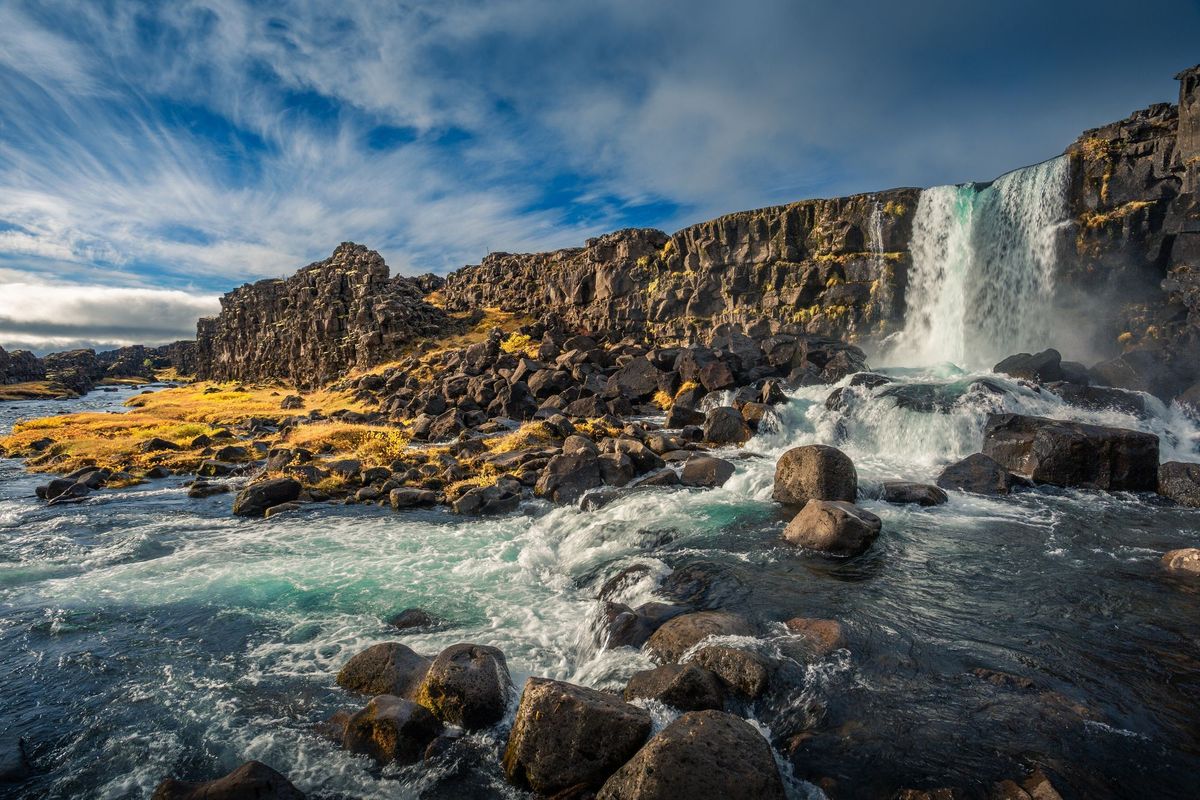
The path towards Öxarárfoss is the approach used for the Bloody Gate sequences.
Tips for Fans
Six things that make the visit better than a checklist tick.
Go early or late. The gorge is at its most cinematic in low sun, and between eleven and three in summer it is full of people.
Shoot along the wall rather than across it. The frames from the show all use the length of the gorge, which is what produces the sense of scale.
Winter looks closer to the show than summer does. Several of the Vale scenes have snow on the ground, and at Hjarðarland, the nearest long-running station to the route, Met Office climate data gives a January average daily high of 1.8°C, which is cold enough to keep it.
Take the lower path rather than the rim. The show shot from ground level looking up, and the viewpoint at the top gives a different and less dramatic composition.
Do not climb on the rock or step off the boardwalks. This is a protected site under Act No. 47/2004 covering 22,788.7 hectares according to the Environment Agency of Iceland, and the moss takes decades to recover.
Bring spikes in winter. The gorge path is cleared but it ices over, and the boardwalk to the waterfall is worse.
Read up on the actual history before you go. The valley held Iceland's parliament from around 930 until 1798 according to Þingvellir National Park, which is a better story than the fictional one.
Combining It With the Golden Circle
The filming locations sit inside a standard day trip rather than requiring their own.
Þingvellir is the first stop on the classic loop, so the gorge walk fits without any rearrangement. Our guide to walking between the tectonic plates covers the same route from the geological angle.
Geysir is 50 minutes east and Gullfoss ten minutes beyond that, which completes the three main stops in about eight hours from Reykjavík.
Þórufoss goes on the return leg rather than the outbound one, because the turning is easier from that direction.
Icelandic horses are a natural addition for anyone who noticed them in the show, and several farms along Route 35 run one and two hour rides.
Our classic Golden Circle tour covers the three main sites with enough time at Þingvellir to walk the gorge rather than photograph it from the rim.
Is It Worth Visiting for the Show Alone?
Honestly, no, and that is fine.
There is no set, no marker and no sign telling you which frame you are standing in. The production left nothing behind, which is a condition of filming in a national park.
What is there is a rift valley where two tectonic plates pull apart, a thousand years of political history and one of the best short walks in Iceland.
The show is a good reason to come and a poor reason to stay. Come for Almannagjá, notice the Bloody Gate, and leave having seen something older than Westeros.
Walk the Gorge on a Golden Circle Day
Almannagjá is the stretch of rock that convinced a television production it had found the edge of the world, and it takes fifteen minutes to walk down. Our small-group Golden Circle tour with Kerið and Friðheimar keeps groups under twenty and allows enough time at Þingvellir to reach the bottom of the gorge and the waterfall beyond it. Tell us your dates and we will find you a departure.
Compare Golden Circle Tours
Check each selected product for its current operator, guide, itinerary, meeting point, and terms.
View Our Tours