
Is the Golden Circle Wheelchair Accessible?
Partly, and more than most people expect. The upper viewpoint at Gullfoss, the main paths at Þingvellir and the boardwalks at Geysir can all be reached without steps, and every main stop has accessible toilets and parking.
What is not accessible is the lower path at Gullfoss, which involves a long flight of steps, and the steeper unsurfaced trails at Þingvellir. Neither of those is the main viewpoint, so a wheelchair user still sees the headline sight at every stop.
The honest summary is that the Golden Circle works well with planning and poorly without it. Surfaces vary within a single site, gradients are steeper than they look in photographs, and winter changes everything.
Þingvellir National Park
Þingvellir is the largest site and the most variable, with excellent access in some places and none in others.
What works
The Hakið visitor centre at the top of Almannagjá has accessible parking, accessible toilets, a lift and a viewing platform. From that platform you see the whole rift valley, the lake and the assembly site below, which is the classic Þingvellir view.
Much of the assembly area sits on a wooden boardwalk built above the lava, which rolls well and is wide enough for a chair. The lower car parks at P2 and P5 put you closer to the church and the Silfra area on flatter ground.
What does not
The paved path down through Almannagjá drops around 40 metres over its length and is steep enough that most manual chair users need a companion or an electric chair with good brakes.
Öxarárfoss is reached on a boardwalk that ends in steps, so the waterfall itself is not accessible, though the approach is.
Parking and the fee
Þingvellir charges a parking service fee of 1,000 ISK for a car, and there is a specific exemption. According to the park's parking rules, guests with a disabled parking permit in the car do not need to pay, though they must visit the Hakið visitor centre to remove their plate from the camera system or send an email.
Do that on arrival rather than on the way out. The camera reads plates automatically, and sorting it afterwards is more work than it sounds.
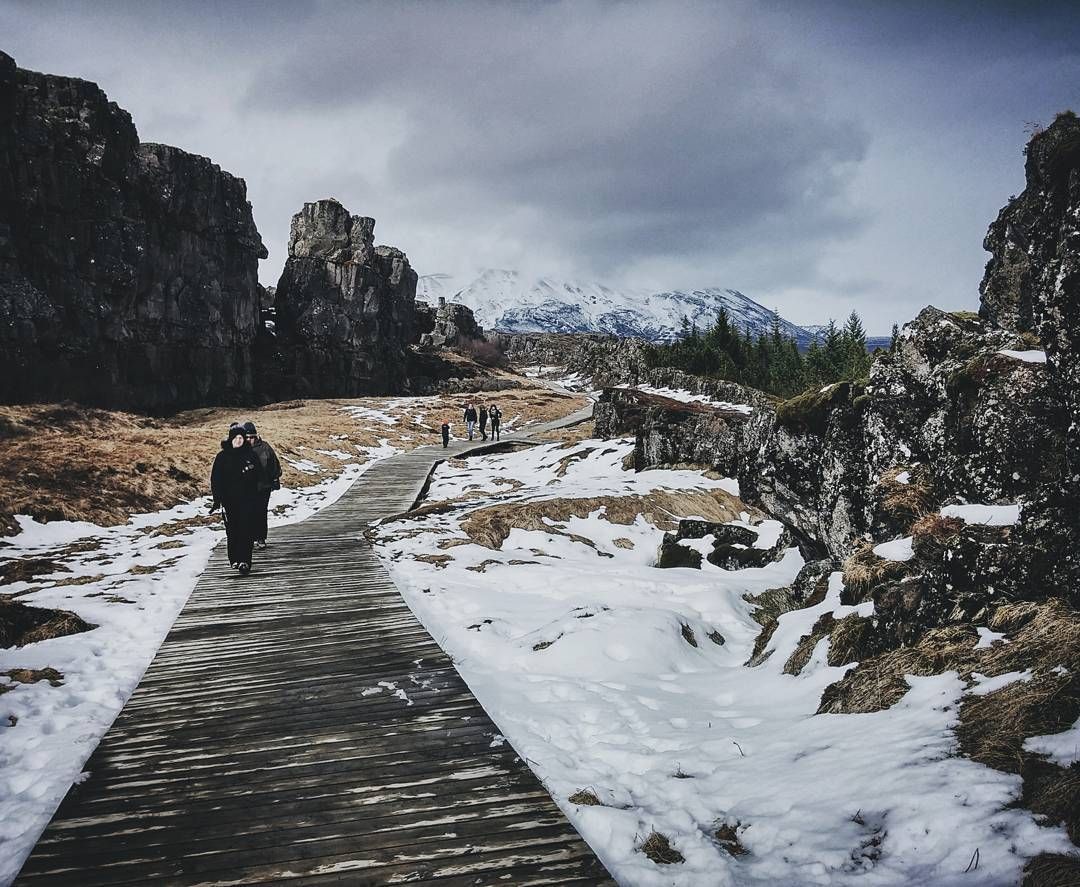
Much of the Þingvellir assembly site sits on a wide wooden boardwalk rather than gravel.
The Geysir Geothermal Area
Geysir is the most consistently accessible of the three main stops, and for many visitors it is the highlight of the day.
At the Geysir geothermal area, the main path from the car park to the Strokkur viewing area is flat, hard-packed and short, roughly 200 metres. The rope line sits at a height you can see over from a seated position, and the geyser erupts every five to ten minutes, so you are never waiting long.
The service building across the road has accessible toilets, a cafe, a shop and level parking close to the entrance. It is the best facility stop on the whole route.
What is harder is the upper loop past Blesi and Konungshver, which climbs on gravel and has some loose sections. You can see most of the field from the lower path, so skipping it costs you less than it might elsewhere.
Note the surface underfoot. Geothermal ground stays warm, and the paths can be wet, which makes gravel softer than usual for chair wheels.
Gullfoss
Gullfoss has two viewpoints, and only one of them is reachable without steps, which is the single most important thing to know before you arrive.
The upper viewpoint
The upper car park sits beside the visitor centre and cafe, and a surfaced path runs from it to a viewing platform above the canyon. That path is level, short and gives you the full view of both tiers and the gorge.
This is the accessible viewpoint, and it is the better one for photographs. The Environment Agency of Iceland records the upper fall at 11 metres and the lower at 20, and from the platform you see the whole drop at once.
The lower path
The lower route descends a long staircase of roughly 100 steps to a rock shelf beside the falls. It is not accessible, and it closes for much of the winter when it ices over.
Nobody should feel they are missing the main event. The lower path gives you spray and noise, the upper gives you the view, and most visitors prefer the upper one anyway.
Facilities
The visitor centre has accessible toilets, level entry and a cafe known for its lamb soup. Accessible parking bays sit directly outside.
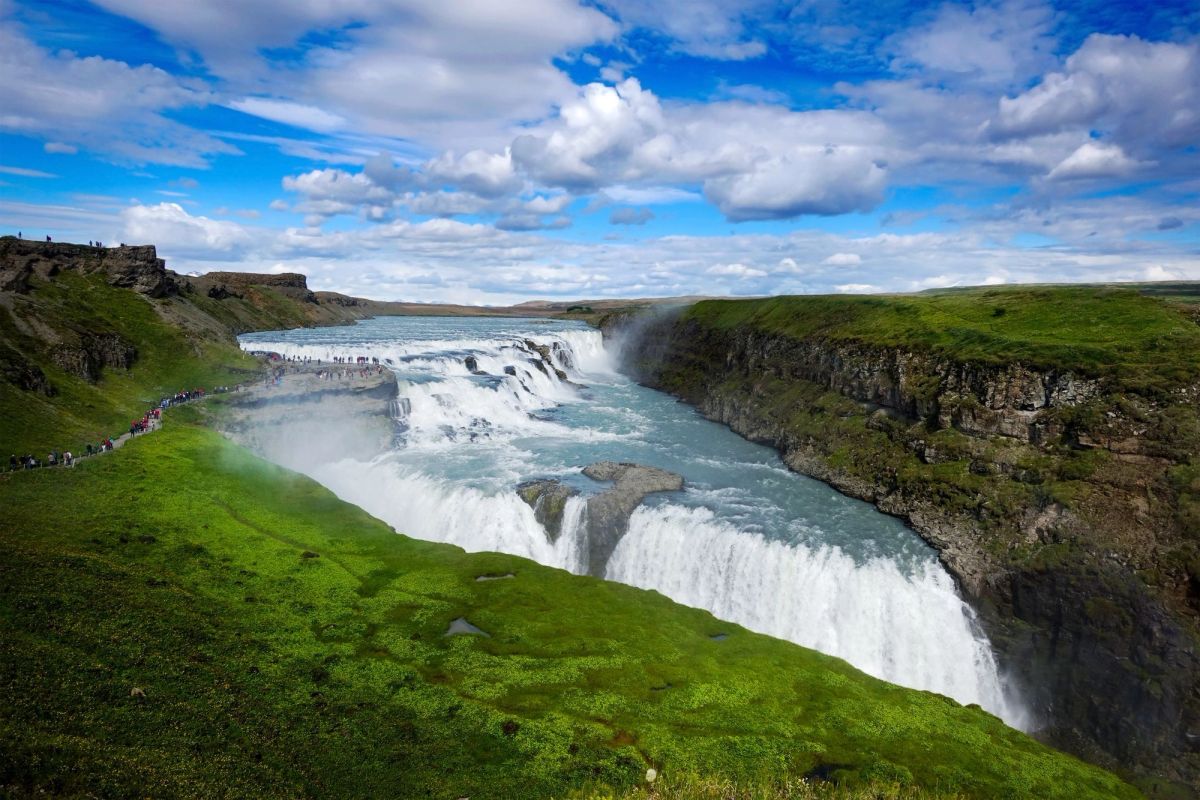
From the upper platform you see both tiers and the canyon, which is the view most people picture.
Kerið Crater
Kerið is a mixed case and worth checking against your own needs.
The car park sits at the rim, and a level gravel path leads a short distance to a viewpoint over the crater and its lake. That much is manageable for many chair users with a companion, though the surface is loose in places.
The full rim walk is uneven, and the staircase down to the water is steep and not accessible. Entry costs 700 ISK, and it is worth asking at the booth whether the near viewpoint alone justifies the fee on the day.
Friðheimar and the Indoor Stops
The indoor stops on the route are the easiest part of the day and the most overlooked in accessibility guides.
The Friðheimar tomato farm is a greenhouse restaurant with level entry, a flat concrete floor and accessible toilets. Tables are spaced for service trolleys, which means they are spaced for chairs.
Laugarvatn Fontana and the Secret Lagoon both have accessible changing facilities, and Fontana has a pool lift. Water access varies, so ring ahead and ask specifically rather than relying on a website symbol.
Efstidalur, the dairy farm between Laugarvatn and Geysir, has level entry to the ice cream bar and restaurant, and the cowshed window is at seated height.
Getting There: Transport Options
This is where the day is won or lost, and there are three approaches.
Adapted private transport
A private vehicle with a ramp or lift, booked in advance, is the most comfortable option. It gives you door-to-door service, luggage space for equipment, and a driver who can adjust the order and length of stops.
Several Icelandic operators run wheelchair-accessible vans with tie-downs. Book early, since the fleet across the country is small and summer dates go months ahead.
Private tours in a standard vehicle
If you can transfer into a seat and travel with a folding chair, a standard private Golden Circle tour works well and costs less than an adapted vehicle.
Tell the operator exactly what you need when booking: transfer assistance, boot space for a chair, extra time at stops, or a shorter day. A private driver can build all of that in.
Standard coach tours
Large coaches have steps and no lift, so they suit ambulant travellers with limited mobility rather than chair users. If you walk short distances but cannot manage a long one, the fixed 40-minute stops actually help, since nobody is expected to walk far.
Ask about the walk from the coach park to each viewpoint. At Gullfoss and Geysir it is short, and at Þingvellir it can be longer depending on where the driver parks.

Private vehicles collect from any address and can be booked with a ramp or lift on request.
Accessible Toilets on the Route
There are four reliable stops, and the gaps between them are long.
- Þingvellir Hakið visitor centre, at the top of Almannagjá
- Þingvellir service centre near the lower car parks
- The Geysir centre across the road from the field
- The Gullfoss visitor centre beside the upper car park
Friðheimar, Efstidalur and the fuel stations at Selfoss and Laugarvatn fill the gaps. Between Þingvellir and Geysir there is a 60-kilometre stretch with nothing, which is worth planning around.
Most site toilets charge 200 to 300 ISK where they are not attached to a cafe, and they take cards.
Winter Accessibility
Winter changes the answer at every stop, and not always for the worse.
Ice is the main problem. Surfaced paths at Gullfoss and Þingvellir get gritted, though a thaw and refreeze can beat the grit, and a chair on ice is genuinely dangerous.
Daylight is the second. Usable light runs from about 11am to 3:30pm in December, so a slower-paced day fits three stops rather than five.
The upside is space. Car parks are empty, viewing platforms have room to manoeuvre, and nobody is queuing at the accessible toilet.
Check conditions in the morning. Our guide to the Golden Circle in winter covers what closes and when, and the Icelandic Road Administration publishes live surface conditions for the exact route numbers.
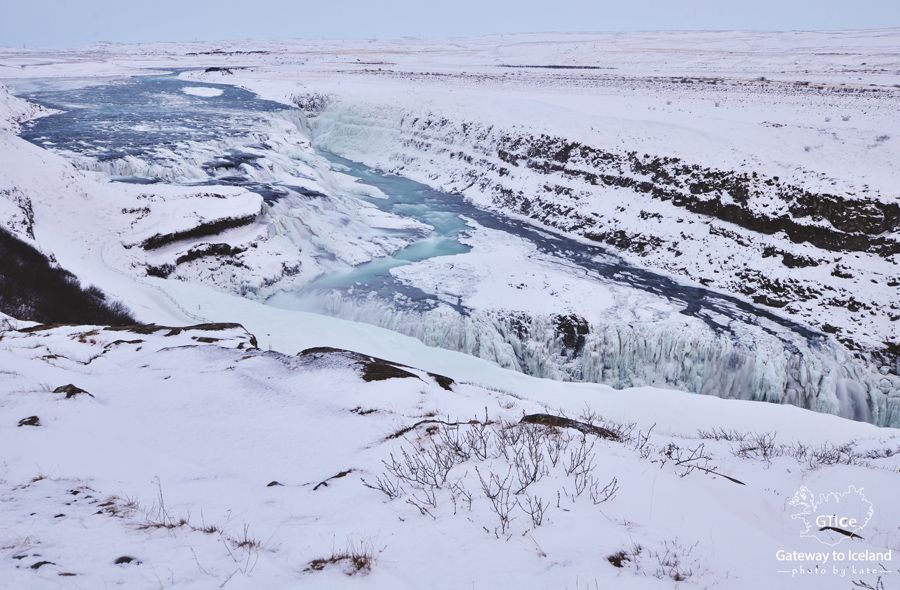
Winter brings empty car parks and icy surfaces, which is a genuine trade rather than a straight loss.
Beyond Mobility: Other Access Needs
Accessibility on this route is usually discussed as wheels and steps, and the other needs are worth naming.
For visitors with limited vision, Geysir is the strongest stop, because the experience is largely sound and steam and heat rather than a distant view. Guides will describe the eruption timing, and standing near the rope line lets you feel the ground vibration before the burst.
For deaf and hard-of-hearing visitors, ask whether the tour uses an audio system and whether a written itinerary or transcript is available. Small-group vehicles are far easier for lip-reading than a 50-seat coach with a microphone.
For autistic travellers and anyone sensitive to crowds, timing solves most of it. An 8am start or a late afternoon loop avoids the 10am to 3pm crush entirely, and a private vehicle removes the unpredictability of a shared coach.
Sensory notes worth knowing in advance: Geysir smells strongly of sulphur, Gullfoss is loud and wet at both viewpoints, and the wind at Þingvellir is constant rather than gusting.
Equipment and Hire in Reykjavík
You do not have to bring everything with you.
Mobility equipment hire exists in Reykjavík, covering manual and electric wheelchairs, rollators and shower chairs, though the market is small and stock is limited in summer. Book weeks ahead rather than days.
Ice cleats that fit over shoes cost around 3,000 ISK and are sold in outdoor shops across the city. For anyone walking short distances in winter, they make more difference than any other single item.
Rental cars can be booked with hand controls from some companies, again with long lead times. Confirm in writing rather than by phone, and check the specific model.
If you use an electric chair, ask your accommodation about overnight charging before you arrive. Icelandic sockets are the standard European two-pin at 230 volts.
Weather as an Access Issue
Wind matters more here than in most countries, and it is a genuine accessibility factor rather than a comfort one.
At the nearest long-running station to Geysir, Met Office climate data puts mean wind speed at 5.2 metres per second in February and 3.4 in July. Gusts several times that are normal in winter.
A gust of 20 metres per second will move a wheelchair on a smooth surface and will knock an unsteady walker off balance. On those days the viewpoints are the problem rather than the paths.
Check SafeTravel for weather alerts on the morning you travel. If an orange warning is out for Suðurland, move the day rather than adapting to it.
Planning an Accessible Day
A workable itinerary looks different from the standard one, and shorter is better.
- 09:00 depart Reykjavík, later than a standard tour, so you avoid the coach wave
- 10:15 Þingvellir, Hakið platform and the upper boardwalks, 45 minutes
- 11:45 Geysir, the flat path and the service centre, 60 minutes including a break
- 13:15 Gullfoss, upper platform and the cafe, 60 minutes
- 14:45 Friðheimar for a late lunch, 60 minutes
- 17:00 back in Reykjavík
That is four stops rather than six, with a proper break in the middle and a toilet at every one. It is a better day than a rushed version with two extra car parks in it.
Build in more time than you think you need. Transfers, ramps and finding the right parking bay all take minutes that a standard itinerary does not allow for.
Questions to Ask Before You Book
Ask these directly, and ask for specifics rather than reassurance.
Does the vehicle have a ramp or a lift, and what is the maximum chair weight and size it takes? Fleet details vary, and a general ‘yes’ is not enough.
How far is the walk or roll from where the vehicle parks to each viewpoint at each stop? This is the question that most often reveals a problem.
Can the driver adjust stop lengths, and can any stop be dropped? A private booking should say yes to both.
Is there a companion or carer rate? Many Icelandic operators offer one, and few advertise it.
What happens if conditions make a stop unsafe on the day? A good operator will have an alternative rather than a refund.
Is the Day Worth It?
For most travellers with mobility needs, yes. You reach the main viewpoint at all three headline sites; the facilities at each are genuinely good by international standards, and the driving legs are short enough to be comfortable.
The Golden Circle is also the most accessible day trip in Iceland by a clear margin. The South Coast involves longer drives and rougher ground at Reynisfjara, and Snæfellsnes is a 12-hour day with fewer facilities.
Go in expecting to see three sights properly rather than five in passing. That is the version of this route that works, and it is a better day out than the rushed alternative anyone else is having.
Plan the Day Around Your Needs
The single best decision for an accessible Golden Circle is a private vehicle and a driver who knows the parking bays at each stop. Our private tour of the loop runs to your timings, with as many or as few stops as suit you and no fixed 40-minute clock. Tell us what you need when you enquire, including chair dimensions and transfer help, and we will confirm exactly what we can do before you book.
Compare Golden Circle Tours
Check each selected product for its current operator, guide, itinerary, meeting point, and terms.
View Our Tours
