
Can You See the Midnight Sun on the Golden Circle?
Yes. From late May to mid-July the sun barely sets in Iceland, and the Golden Circle's three main sites are open, free and accessible around the clock. Standing at Gullfoss at midnight in June with the canyon lit orange is the single best version of this route.
Around the summer solstice, Reykjavík gets roughly 21 hours of daylight, with the sun dipping below the horizon for about three hours and never going properly dark. What that gives you is a golden hour that lasts for four or five hours instead of one.
Evening tours exist to use that window. They leave between 6pm and 8pm, cover the same three stops, and put you at each one after the coaches have gone home.
When the Midnight Sun Actually Runs
The phenomenon is a spectrum rather than a switch, and knowing the shape of it helps you pick a date.
From mid-May the nights stop getting dark. By 1 June the sun sets near 11:45pm and rises again just before 3am, with continuous twilight in between.
Around 21 June, the solstice, Reykjavík has about 21 hours between sunrise and sunset and no astronomical darkness at all. This is the peak, and the two weeks either side of it are effectively identical.
Through July the window narrows steadily. By 1 August you are back to a proper sunset around 10pm and a genuinely dark hour after midnight, and by late August the first aurora of the season becomes possible.
The practical bracket for an evening Golden Circle is roughly 20 May to 25 July. Outside that you can still do a late loop, but you are chasing a sunset rather than living inside one.
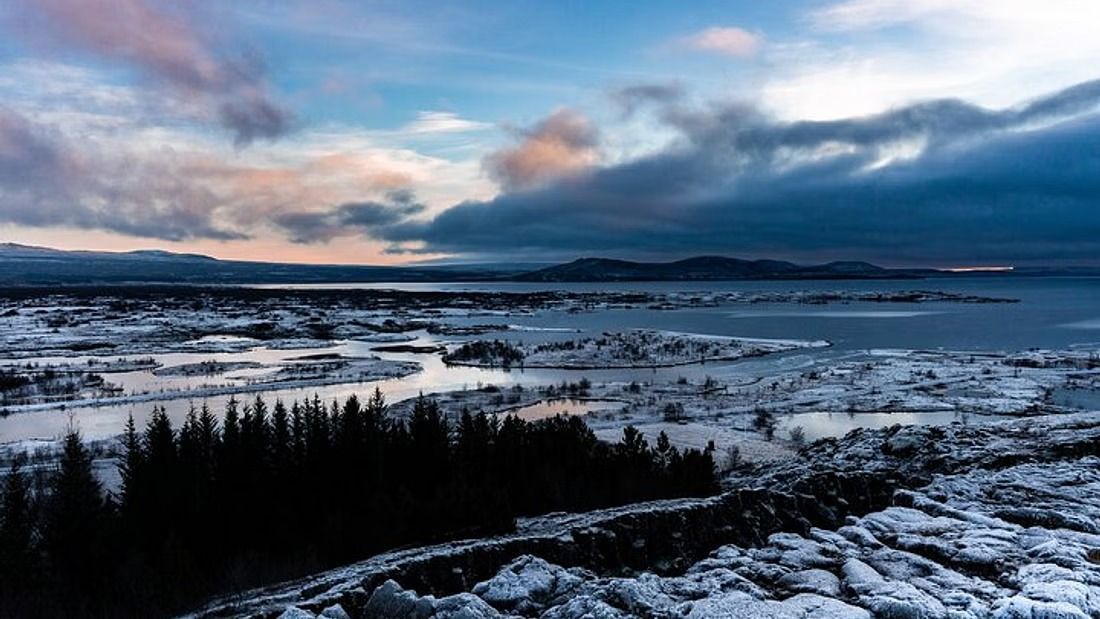
Þingvellir in late June, where the rift valley holds low light for hours rather than minutes.
Why Evening Beats Midday in Summer
Three reasons, and they compound.
The light is better. Between 9pm and 1am the sun sits low and comes in sideways, which separates the tiers at Gullfoss, picks out the layers in the Almannagjá wall and turns the steam at Geysir gold. Midday in July gives you hard overhead light that flattens everything.
The crowds are gone. Coaches leave Reykjavík between 8am and 9am and are back by 6pm, so the car parks empty out from about 7pm. At 10pm you can have the Gullfoss upper platform to yourself.
The temperature is fine. At the nearest Met Office station to Geysir, monthly climate data puts June's average daily low at 5.8°C and July's at 7.8°C, so an evening in a fleece and a shell is comfortable rather than cold.
The one thing you lose is the cafes. Site kitchens at Gullfoss and Geysir close in the late afternoon and evening, so eat before you leave or bring food with you.
What Each Stop Looks Like Late
The light does not hit the three sites the same way, which is worth knowing when you plan the order.
Þingvellir
The rift valley at Þingvellir National Park runs roughly northeast to southwest, so late evening light comes down its length rather than across it. The Almannagjá wall glows from about 9pm and holds until midnight.
Þingvallavatn is the other reason to be here late. On a still evening the lake goes flat and gives you the whole valley twice, which is the shot people come back for.
Parking still costs 1,000 ISK for a car under the park's published rates, and the machines and the online payment both work at any hour. The visitor centre closes in the evening, so use the toilets before you leave the city.
Geysir
Steam and low sun are a good combination. From about 10pm the plumes across the Haukadalur field turn orange, and the light comes through the Strokkur column from behind, which turns the water briefly translucent.
Strokkur erupts every five to ten minutes regardless of the hour, so the show at the Geysir geothermal area does not stop. The service building across the road closes in the evening, and the field itself never does.
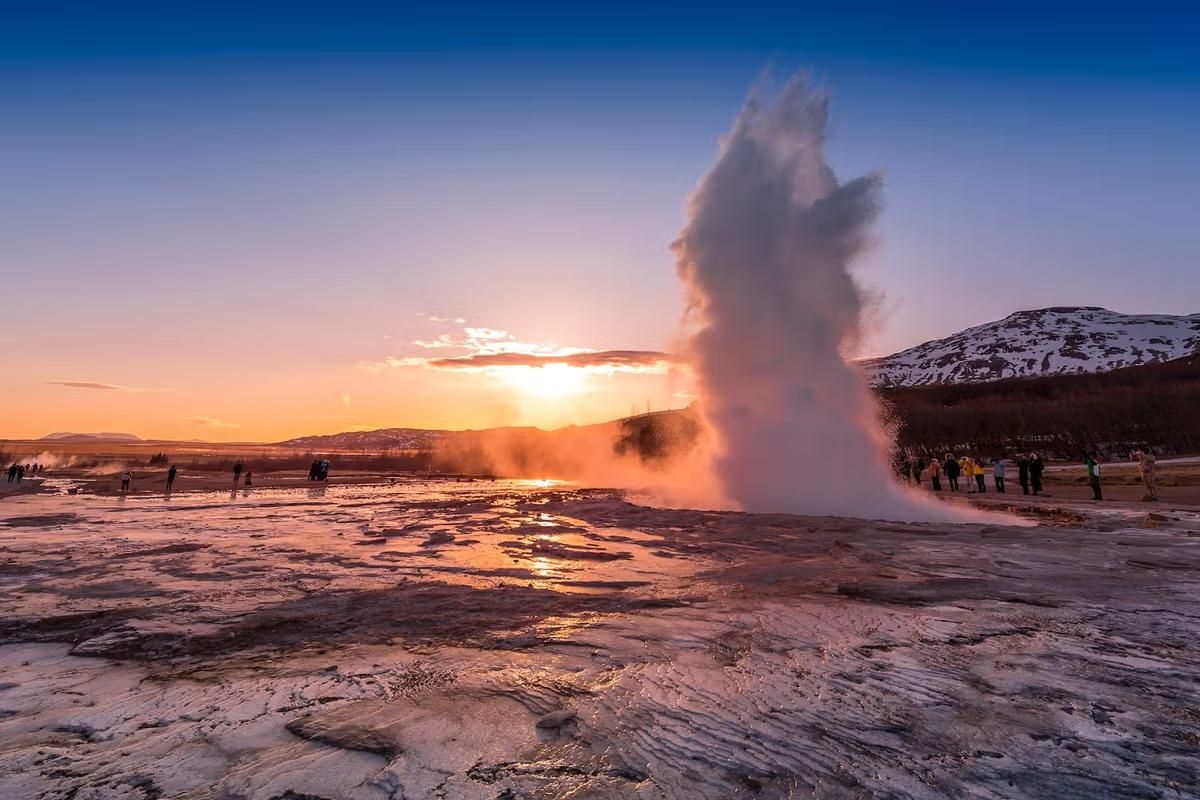
Backlit steam is the reason Geysir photographs better at 10pm than at any hour in the middle of the day.
Gullfoss
Gullfoss faces broadly southwest, which means late evening light comes straight into the canyon. This is the best-lit stop of the three after 9pm, and the rainbow in the spray is more reliable than at any other time.
The Environment Agency of Iceland records summer flow at 130 cubic metres per second against an annual average of 109, so the falls are running at their heaviest in exactly the weeks the light is best.
More water also means more spray, which is what catches the low sun and throws the rainbow across the canyon. Stand with the sun behind you on the upper platform, and it appears within a minute or two.
Both viewpoints at Gullfoss waterfall stay open. The lower path onto the rock shelf is ice-free in summer, which is the one thing a winter visit cannot offer.
An Evening Loop, Hour by Hour
Here is a self-drive plan for late June, built around the light rather than around opening hours.
- 17:30 leave Reykjavík after an early dinner
- 18:45 to 20:00 Þingvellir, Almannagjá and Öxarárfoss with the crowds thinning
- 20:45 to 21:45 Geysir, several eruptions and the upper pools
- 22:00 to 23:15 Gullfoss, both viewpoints in the best light of the day
- 23:45 Faxi or Brúarfoss if you have energy left
- 01:00 back in Reykjavík
Reverse it if you want Gullfoss at the earliest and Þingvellir at the very end, which puts the lake reflection at around midnight. Both orders work, and the difference is which site you want in the strongest light.
Guided evening departures run 6 to 8 hours with pickup between 6pm and 7pm, following broadly the same shape with fixed stop lengths.
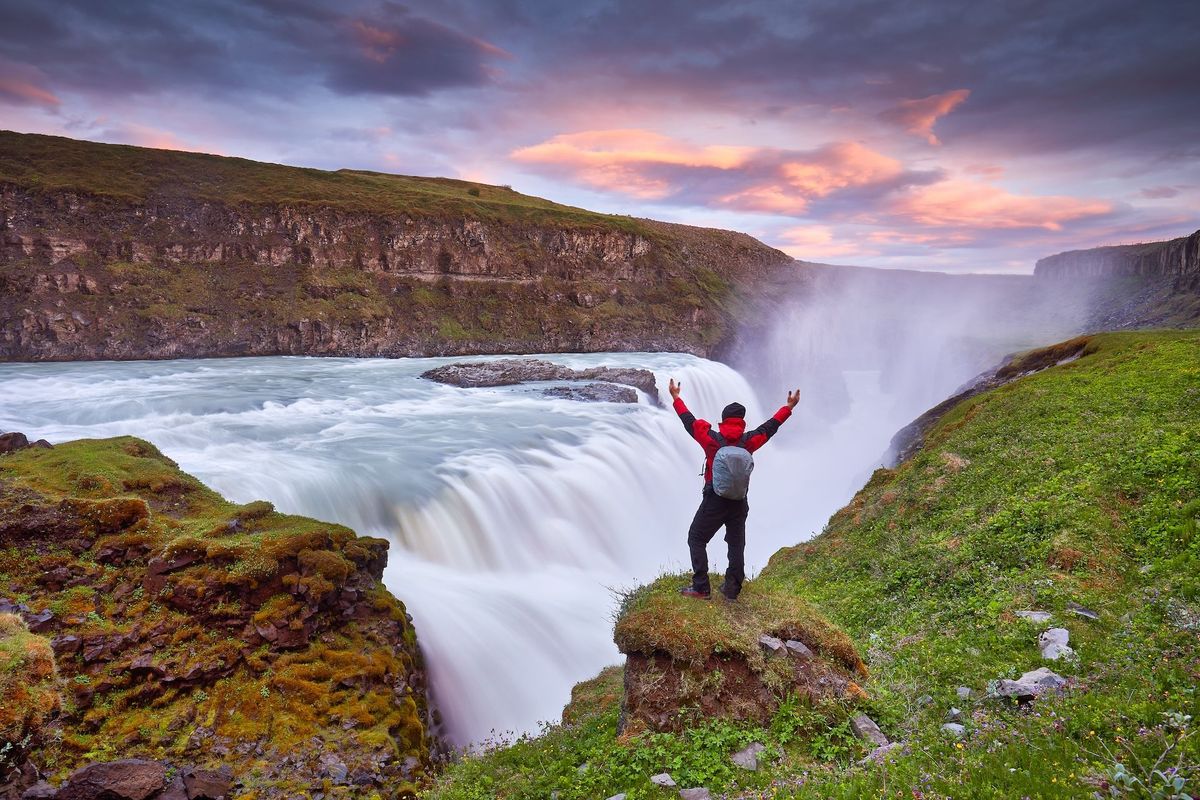
The Gullfoss upper platform after 10pm in July, when most of the day's visitors have already gone.
What to Add to a Midnight Sun Loop
Long light makes extra stops possible in a way winter never does.
The Secret Lagoon at Flúðir stays open into the evening and is the best possible end to a warm loop. A soak at 10pm in daylight is a strange and excellent experience, and our Golden Circle and Secret Lagoon tour builds it into the day for 20,300 ISK.
Brúarfoss needs a 45-minute walk from a small car park, which is a poor idea in December and a good one at 11pm in June.
The lupine fields along Route 35 peak in late June and are best photographed at low sun. Pull over safely, stay off the moss, and shoot from the roadside rather than wading in.
Kerið Crater closes its ticket booth in the evening, so check the hours before you plan to arrive after 8pm.
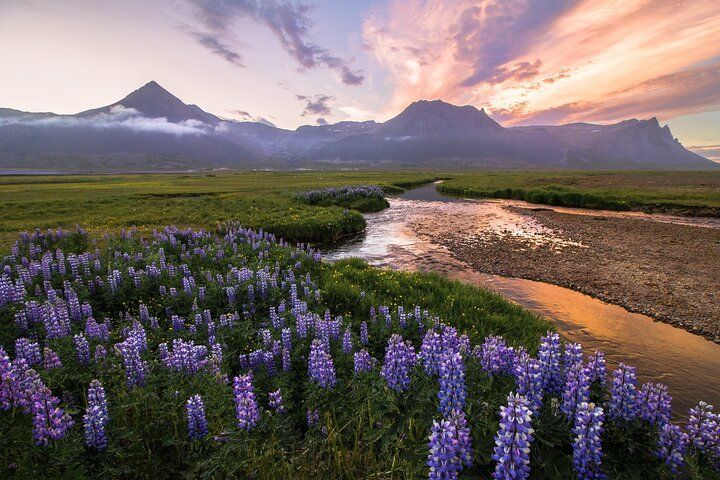
Lupines flower through late June along Route 35, and they hold colour best in low evening light.
Photographing the Midnight Sun
The light is generous and the exposure is trickier than it looks.
Shoot into the low sun for the classic look, using the waterfall spray or the geyser steam to break the glare. Stop down to f/16, and you get a clean sunstar off the edge of a cliff or a rock.
Meter for the sky and lift the shadows afterwards. The dynamic range between a lit sky and a shaded canyon at 11pm is wide enough that automatic metering usually blows out the highlights.
A polariser helps at Gullfoss and hurts at Þingvellir. It strengthens the rainbow in the spray, and it deadens the reflection on the lake, so take it off when you reach the water.
Bring a tripod if you want silky water. Even at midnight the light is bright enough to hand-hold, which means people often skip the long exposures that make this stretch of river look its best.
The Science, Briefly
The midnight sun happens because Iceland sits at about 64 degrees north, close enough to the Arctic Circle that the earth's tilt keeps the sun near the horizon through midsummer.
At the Arctic Circle itself, 66.5 degrees, the sun genuinely never sets on the solstice. Reykjavík is two and a half degrees short of that, which is why the sun dips just below the horizon for a couple of hours and the sky stays lit the whole time.
Grímsey, the small island 40 kilometres off the north coast, is the only part of Iceland that crosses the line. Everywhere else, including the entire Golden Circle, gets what astronomers call civil twilight rather than true midnight sun.
The practical effect is identical. You can read a newspaper outdoors at 2am in June anywhere on this route, and photography stays workable all night.
The Trade-Off With the Northern Lights
The two great Icelandic light shows are mutually exclusive, and the midnight sun is the reason.
Aurora needs a dark sky, which Iceland does not have between roughly late April and mid-August. Any operator selling a June Northern Lights tour is selling you a drive.
The season swaps over quickly. The last realistic aurora nights are in the second week of April, and the first are in the last week of August, with September through March the reliable window.
If you have a choice of dates and want both kinds of light, late August and early September are the crossover. Evenings are still long enough for a late loop, and the nights are dark enough for a display.
What to Wear on a Summer Evening
Warmer than the temperature suggests and colder than you would dress for a European June evening.
June and July daily highs at the nearest station are 14.7°C and 16.5°C, and the lows are 5.8°C and 7.8°C. You are out during the low, not the high.
Wear a fleece or light down layer with a windproof shell over it. Wind at Gullfoss is the deciding factor, and the spray reaches the upper platform on any breezy evening.
Bring an eye mask for afterwards. Sleeping in continuous daylight is the part of an Icelandic summer that surprises people most, and hotel curtains vary.
Practical Points for Late Visits
A handful of things that only matter after 8pm.
Fuel up before you leave the city or at Selfoss. Stations on the loop are unmanned card pumps in the evening, and some older foreign cards struggle with them.
Bring food. There is nothing hot to buy on the route after the site kitchens close, and the shop at Geysir keeps shorter hours than the field.
Watch for sheep on the road. They graze along Routes 35 and 37 from June, and they are hardest to see in the flat light around midnight.
Check the Icelandic Met Office area forecast for Suðurland before you go. A cloudy evening removes the entire reason for the trip, and moving your loop by one day is usually enough.
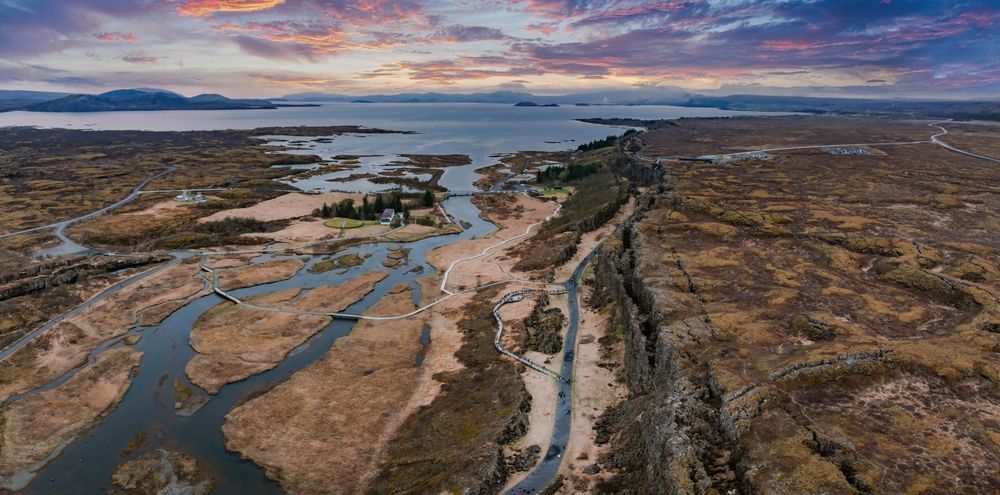
Þingvallavatn goes flat on a still evening, which is the reason to finish the loop rather than start it here.
Is an Evening Tour Worth It?
For a summer visit, yes, and it is the easiest upgrade available on this route. Same three sites, same price bracket, better light and a fraction of the people.
The case against is sleep. A tour that returns at 1am costs you the following morning, which matters if you have an early flight or a full schedule the next day.
The other consideration is the daytime alternative. If you only have one day and you want the visitor centres, the cafes and the horse show at Friðheimar, a daytime loop is the more complete experience.
The version that satisfies most people is a late afternoon start. Leave at 4pm, do the loop through the evening, and you get the light without being out until 1am.
Book the Loop for the Light
If you are visiting between late May and July, the loop is worth doing when everyone else is having dinner. Our private Golden Circle tour runs to your timings rather than a fixed departure, which is the simplest way to be at Gullfoss at 11pm with the car park nearly empty.
Tell us which stop you want in the best light, and we will build the running order around it.
Compare Golden Circle Tours
Check each selected product for its current operator, guide, itinerary, meeting point, and terms.
View Our Tours

