
The strongest Golden Circle photo spots are the upper and lower viewpoints at Gullfoss, Strokkur mid-eruption at Geysir, the Almannagjá walkway and Öxarárfoss in Þingvellir, and the red rim of Kerið crater. Between them you get a glacial waterfall, an erupting geyser, a continental rift and a volcanic caldera inside 300 kilometres.
What separates a good Golden Circle photograph from a snapshot is almost always timing rather than gear. The same viewpoint at 8am and at 1pm gives you two completely different pictures, and only one of them has the car park out of frame.
This guide goes stop by stop with the angles that actually work, then covers light by season, the settings worth dialling in before you arrive, and the current position on drones.
Gullfoss: Two Viewpoints, Two Different Pictures
Gullfoss is the most photographed spot on the route and the one people most often get wrong, because they shoot it from the first railing they reach and leave.
The scale is worth knowing before you frame anything. The Environment Agency of Iceland puts the upper fall at 11 metres and the lower at 20, with average flow of 109 cubic metres per second rising to 130 in summer.
That volume is what fills your frame with spray, and it is why lens cloths matter here more than filters.
The upper platform
The platform above the car park gives you the full two-tier drop with the canyon running away to the left. Shoot wide at 16 to 24mm to hold both tiers and the canyon wall, and put a person on the lower path in frame for scale.
Mid-morning light comes from behind you in summer, which flattens the canyon. Late evening light rakes across it and separates the tiers, which is the shot most people are actually after.
The lower path
The path down onto the rock shelf beside the falls puts you close enough to feel the water. This is where you get the power shots, and where your front element gets soaked in under a minute if the wind is southerly.
Work quickly. Set exposure before you step out, wipe, shoot, wipe, and check the frame afterwards rather than chimping in the spray. The path closes when it ices over, which is most of the winter.
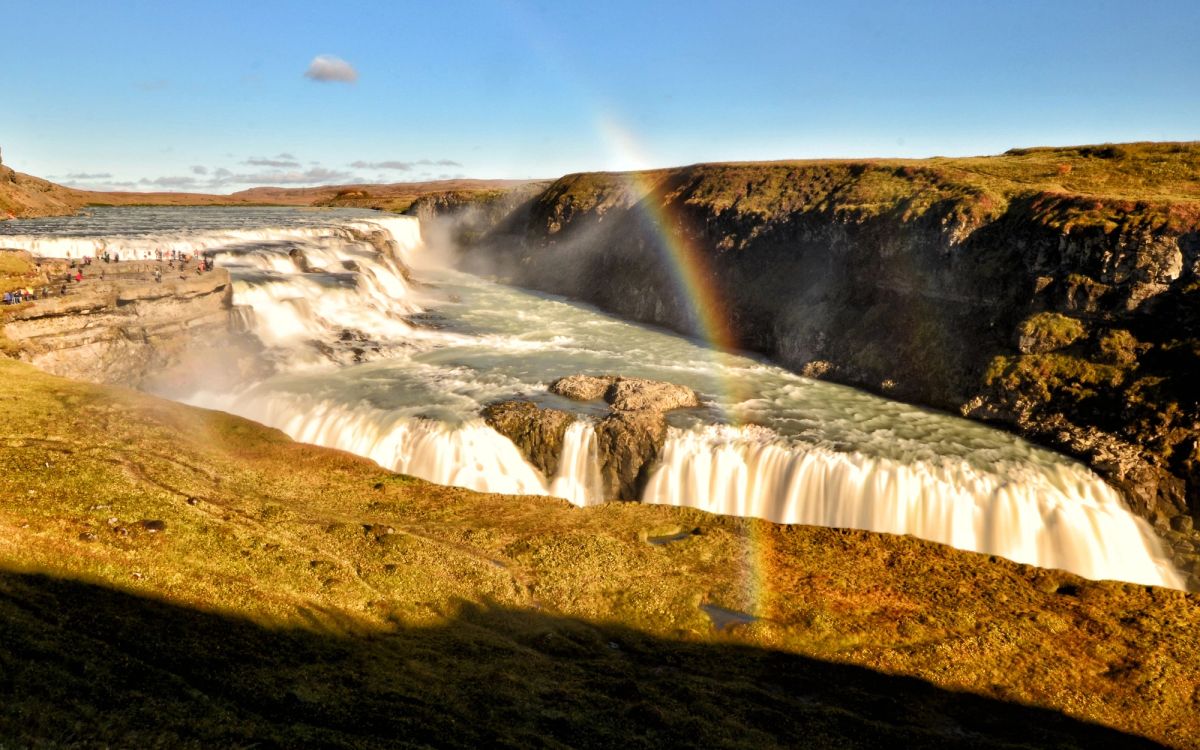
Sun behind you and spray in front produces a rainbow across the canyon on most bright afternoons.
The rainbow window
On a bright day with the sun low and behind you, the spray throws a rainbow across the canyon. It appears mid-morning in winter and late evening in summer, and it lasts as long as the wind holds the spray in place.
Meter for the highlights so the rainbow does not blow out, then lift the shadows afterwards. A polariser will strengthen or erase the rainbow depending on its angle, so rotate it while you watch rather than setting it and forgetting.
Settings that work at Gullfoss
For silky water, 1/4 to 1 second at f/11 with a neutral-density filter, which is a dark filter that lets you use slow shutter speeds in daylight. For texture in the water, 1/500 or faster.
Both are correct pictures of the same waterfall. Shoot one of each before you move on, because you will not get a second chance at that light. Which platforms are open on the day is set out on the Gullfoss attraction page, and in winter that decides half your compositions.
Strokkur and the Geysir Area
Strokkur is the easiest action shot in Iceland because it repeats. It erupts every five to ten minutes and throws water 15 to 20 meters up, occasionally higher, which means you can set up, frame, and wait rather than react.
Watch the vent rather than the crowd at the Geysir geothermal area. A second or two before the eruption, the pool swells into a smooth blue dome, and that dome is your cue to start shooting.
Where to stand
Stand upwind. The wind decides everything here, and the group on the downwind side spends the eruption wiping lenses while you are still shooting.
Get low if you can. Shooting from a crouch behind the rope line puts the column against the sky rather than against the hillside, and it removes the row of phone screens from your foreground.
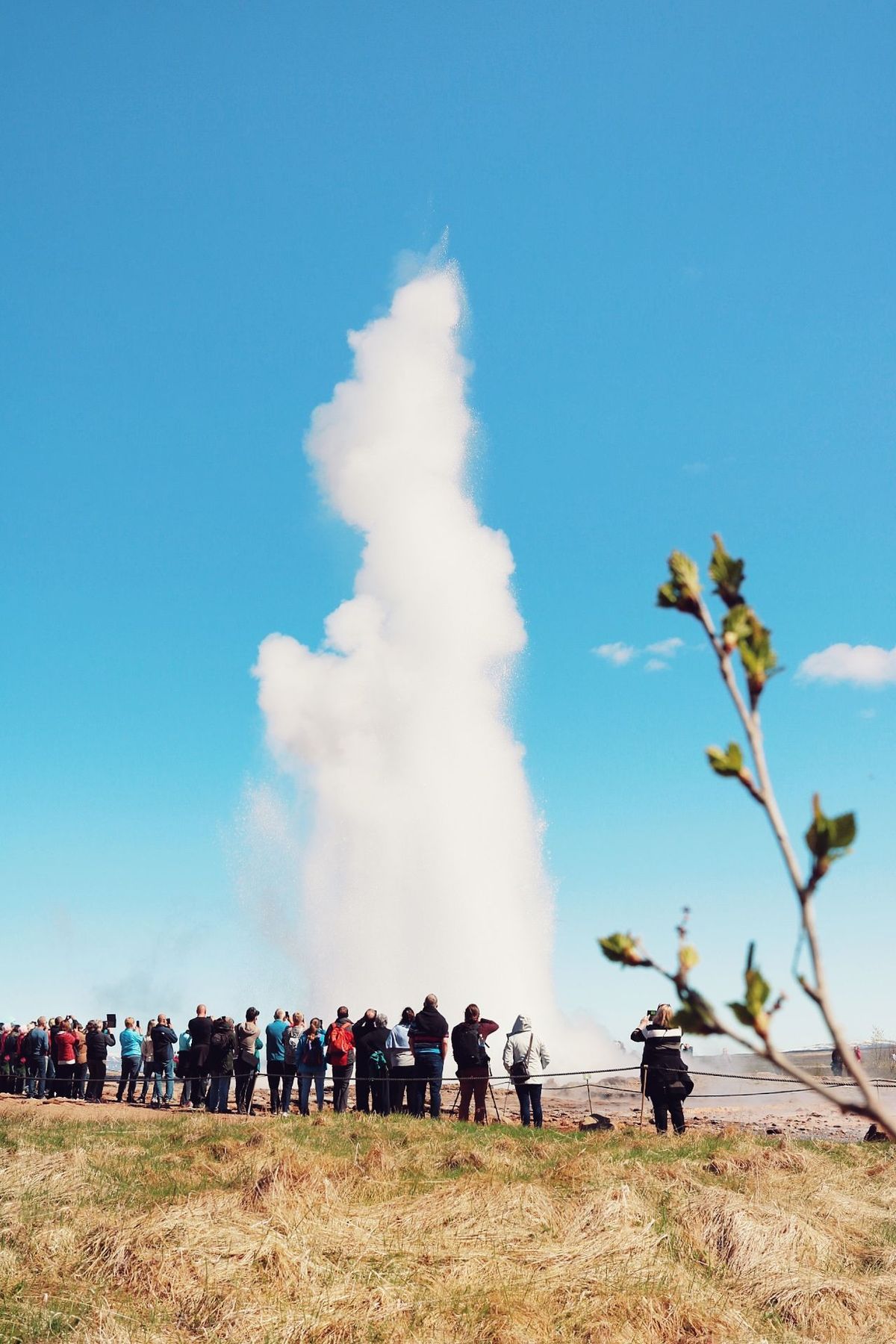
Framing Strokkur against clear sky rather than the hillside keeps the water column readable.
Settings for the eruption
Shutter priority at 1/1000 freezes individual droplets at the top of the column. Drop to 1/125 and the water blurs into a plume, which reads better in flat light.
Burst mode is the honest answer. The eruption lasts under two seconds, and the frame you want is usually the third or fourth in the sequence, just as the column peaks.
The pools and steam vents
The rest of the Haukadalur field rewards a slower walk. Blesi is a paired pool where one half runs clear and the other is milky blue with suspended silica, and it photographs best from the north side in soft light.
Konungshver sits further up the slope with a steady plume. In cold air the steam thickens noticeably, which is why the field looks far more dramatic in February than in July.
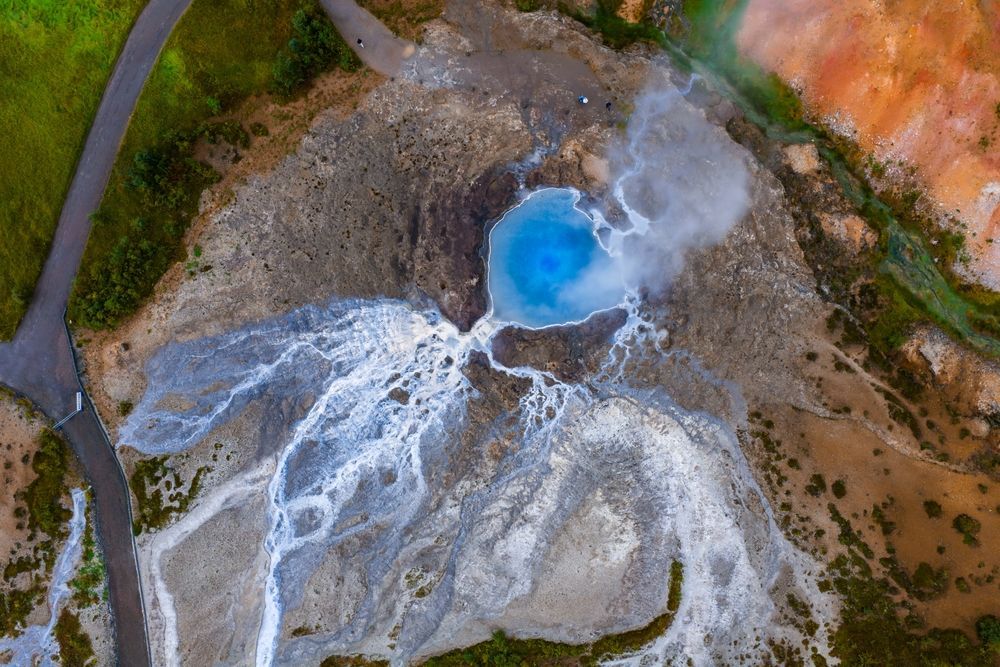
The mineral pools around Strokkur hold their colour best under overcast light rather than direct sun.
Þingvellir: Rift Valley, Waterfall and Church
Þingvellir gives you more compositions per hour than anywhere else on the loop, and almost none of them are the postcard shot. Give it 90 minutes rather than the 40 a coach allows.
It also carries the history. The Alþingi assembly met on this ground from about 930 until 1798 according to Þingvellir National Park's own account, which is worth knowing when you are photographing what looks like an empty field.
Almannagjá
The gorge is the signature image: a wall of North American plate on one side, the valley opening out on the other, and a path running between them. Shoot from the Hakið viewpoint at the top for the wide context, then from inside the gorge looking back for compression and depth.
Early morning is the only time it is empty. By 10am there is a continuous line of people on the path, which either ruins the shot or makes it, depending on whether you want scale.
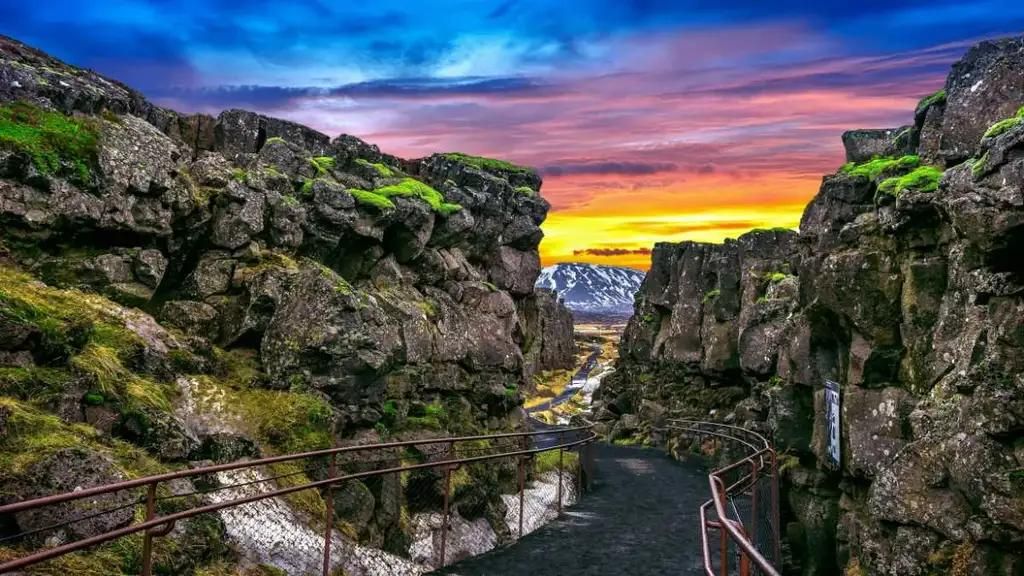
Late light along Almannagjá picks out the layers in the basalt wall that flat midday sun flattens out.
Öxarárfoss
Öxarárfoss is a 15-minute walk from the upper car park, dropping over stacked basalt into a boulder field. It is small, which means you can fill the frame without a long lens, and the boulders give you foreground.
In winter it part-freezes into a wall of ice with a dark channel running through it. That version is better than the summer one, and the boardwalk to it stays open in most conditions.
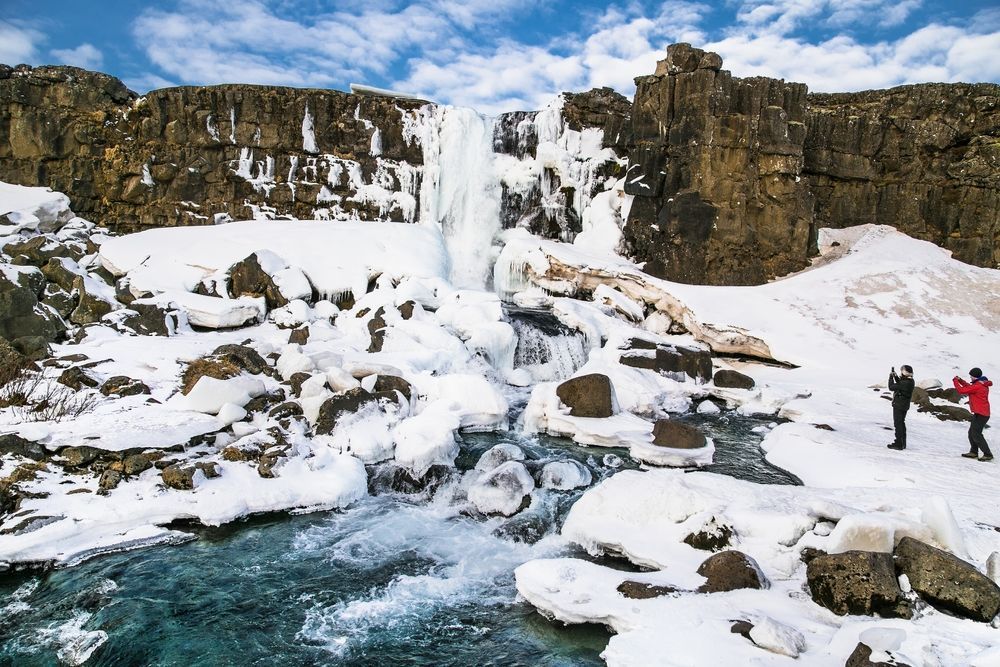
Öxarárfoss in February, when the falls freeze around a narrow channel of moving water.
The church and the lake
Þingvallakirkja, the small white church with the black roof, sits on the valley floor with Þingvallavatn behind it. Shoot it from the east in the evening with the lake as a backdrop, or from the slope above for the classic wide.
Þingvallavatn is Iceland's largest natural lake and it goes glass-flat on still mornings. That is your reflection shot, and it is gone the moment the wind picks up. Our Þingvellir guide maps which of the three car parks puts you closest to each feature.
Silfra
The Silfra fissure is filled with filtered glacial meltwater and the visibility runs past 100 metres. From above, the boardwalk and entry steps give you a clean graphic composition of blue water between black rock walls.
Underwater you need a housing and a snorkelling booking. Parking at Þingvellir costs 1,000 ISK for a car under the park's published rates, and the fee covers all three car parks for the day.
Kerið Crater
Kerið is the most colour-saturated stop on the loop: a red and black scoria rim above a blue-green lake, about 55 metres deep and 170 metres wide.
The rim walk at Kerið crater takes 20 minutes and gives you three usable angles. The north end puts the lake against the far wall, the east side gives you the steepest colour contrast, and the steps down to the water let you shoot up at the rim for scale.
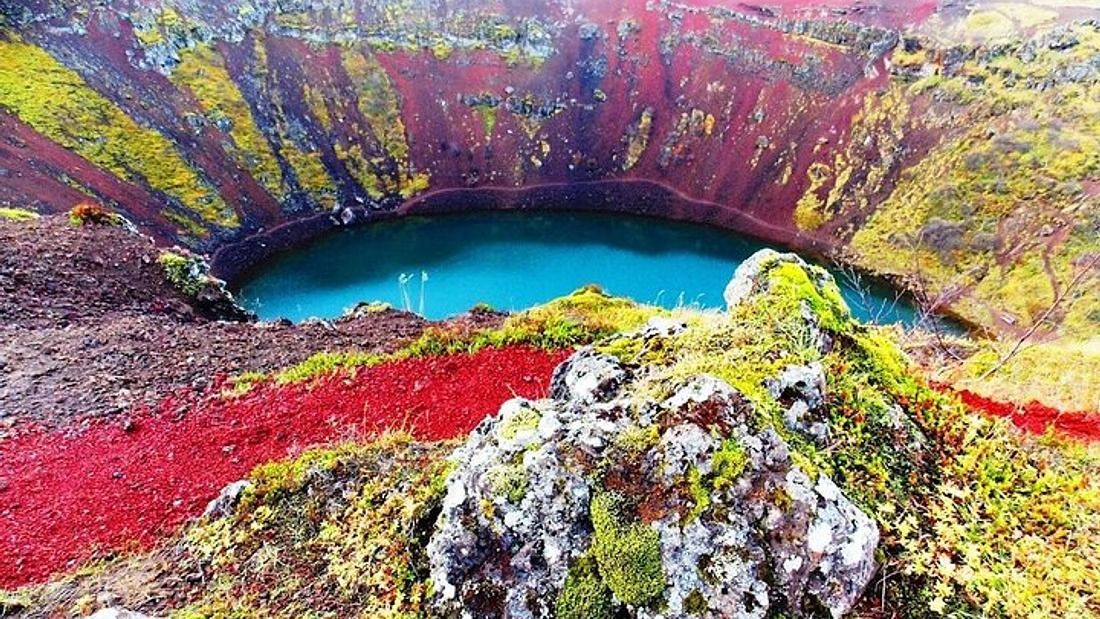
Kerið's red scoria reads strongest under soft overcast light, which stops the rim clipping to orange.
Overcast light suits it better than sun. Direct light blows out the red rim and flattens the lake, while a grey sky holds the colour separation that makes the picture work.
Lesser-Known Spots Worth the Detour
Four stops on the same roads deliver more per photograph than the headline sites, mostly because nobody is standing in them.
- Faxi, a wide low waterfall on the Tungufljót with a salmon ladder on the right bank. Ten minutes off Route 35, and you will often have it alone.
- Brúarfoss, reached on a 45-minute walk from a small car park, with water the colour of glacier milk running over black steps.
- The lupine fields along Route 35 in late June, which give you a purple foreground for almost any background.
- Efstidalur, a working dairy where the cowshed window looks into the barn. Not landscape, and a better picture than most landscapes.
Þingvallavatn's shoreline at Vellankatla is the fifth, if you have an hour spare and a wide lens.
Best Light and Timing by Season
The route runs north to northeast out of Reykjavík, which means the three main sites face broadly south and west. That matters more than any tip about golden hour.
Summer and the midnight sun
From late May to early August the sun barely sets, and the light between 9pm and 1am is the best of the year. Gullfoss at 11pm in June has warm sidelight, empty paths and a rainbow if the wind cooperates.
The trade-off is midday. Between 10am and 4pm in July the light is high, hard and unhelpful, and every car park is full.
Winter's low sun and blue hour
From November to February the sun stays low all day, so you get golden-hour light for hours rather than minutes. Reykjavík's shortest days run about four hours of usable light, roughly 11:20am to 3:30pm, and the whole of it is worth shooting.
Blue hour is long and generous in winter, and the frozen spray at Gullfoss photographs better then than in daylight. Cold drains batteries fast, so carry spares in an inside pocket.
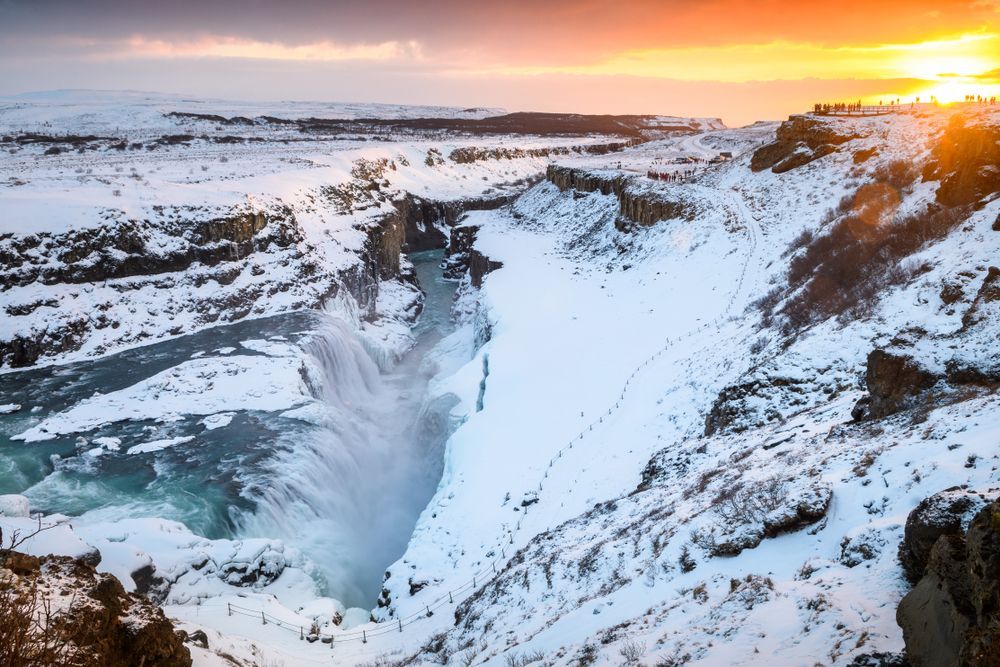
Winter sun never climbs far, so the light at Gullfoss stays low and warm through the middle of the day.
Shoulder seasons
September and October give you autumn colour at Þingvellir, thinner crowds, and the first aurora nights while the roads are still bare. April and May are the driest months on the route, with 84 mm and 82 mm at the nearest Met Office station, so a dry morning is more likely than in September.
If you want one recommendation, go in the third week of September. You get 12 hours of daylight, autumn colour, real sunsets and a chance of aurora on the same day, and our month-by-month guide to visiting the Golden Circle sets out the rest of the year.
Aurora on the Golden Circle
From late September to early April, the loop's stops are all far enough from Reykjavík's light dome to shoot aurora. Þingvellir is the best of them, with the lake for reflections and the rift walls for foreground.
Shoot at f/2.8, ISO 1600 to 3200, and 5 to 10 seconds. Longer than 10 seconds and the bands smear into a green wash, and our camera settings for the Northern Lights goes further into focusing in the dark.
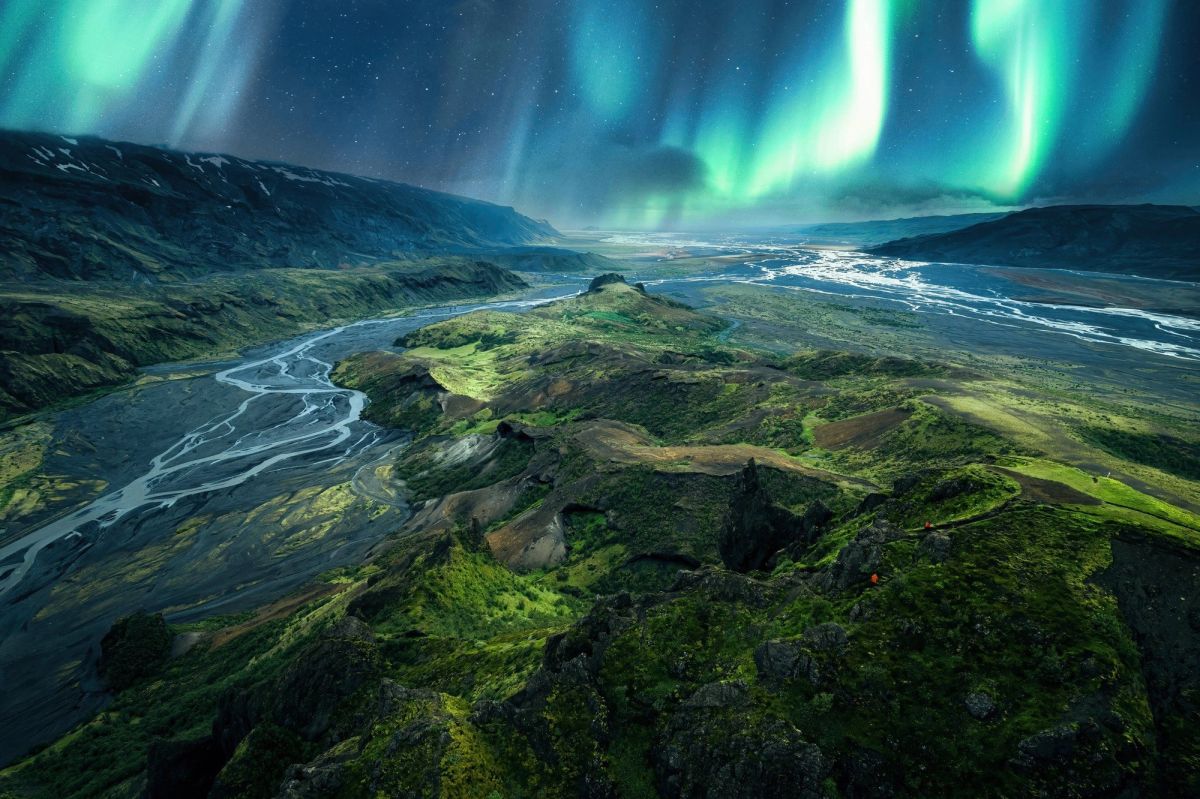
Aurora over the southern lowlands. Þingvellir sits far enough from the capital for dark skies on a clear night.
Gear That Earns Its Place
You do not need much, and what you do need is mostly about weather rather than optics.
Lenses
A 16 to 35mm covers most of the loop. Almannagjá, Gullfoss from the upper platform and the Kerið rim all want width.
Bring something longer if you have it. A 70 to 200mm isolates the top of the Strokkur column, compresses the canyon walls at Gullfoss and picks out details in the geothermal field that a wide lens loses.
Tripod and filters
A tripod matters most in winter, when the light is low all day, and for any long exposure at Gullfoss or Faxi. Carbon is worth it for the weight, and a hook for hanging your bag helps in wind.
Two filters do real work: a circular polariser for the wet rock and the rainbow, and a 6-stop neutral-density for silky water in daylight. Skip the rest.
Weather protection and batteries
Spray at Gullfoss and rain almost anywhere means a rain cover and two microfibre cloths, not one. A cheap shower cap over the camera works better than most purpose-built covers.
Cold is the other battery killer. At the Hjarðarland station near Geysir, Met Office monthly data puts January's average daily low at 4.3°C below zero, and a mirrorless body will lose a bar per hour at that temperature.
Drones: Where You Can and Cannot Fly
This is the part that catches visitors out, because the rules tightened. Flying a drone in Iceland's protected areas requires a permit, and the official permit process for protected areas is where you apply.
In practice, recreational permits are not granted at the main Golden Circle sites. Treat Gullfoss, the Geysir field and Þingvellir National Park as no-fly for a holiday drone, whatever an older blog post tells you.
Operator registration is handled through the Icelandic Transport Authority's Flydrone portal, and it applies to almost any drone with a camera. Registering does not give you access to the protected sites, which is the confusion most people arrive with.
There is still plenty of legal airspace on the route. Farmland along Route 35, the lupine fields in June and the open country around Laugarvatn are all outside the protected boundaries, though you still need landowner permission and you still cannot fly over people.
Etiquette and Safety at the Stops
The rope lines at Geysir exist because the crust is thin and the water underneath sits between 80 and 100 degrees Celsius. No photograph is worth stepping over one.
Moss at Þingvellir takes decades to recover from a footprint, and the reason the boardwalks exist is that the previous generation of photographers walked wherever they liked. Stay on the surfaced paths.
At Gullfoss the rock is slick with spray year-round and the drop is unfenced in places. Set the tripod behind the barrier and use a longer lens rather than moving forward.
Finally, be quick at the busy spots. Standing in the single best position at Strokkur for 20 minutes with a tripod is legal and rude, and there is always another eruption in five minutes.
A One-Day Photo Route
If you are driving yourself and you want the best light at each stop, run the loop backwards.
- 07:30 leave Reykjavík, arriving Gullfoss around 09:15 with the car park nearly empty
- 09:15 to 10:30 Gullfoss, both viewpoints, long and fast exposures
- 10:45 to 11:45 Geysir, upper pools first, then Strokkur from the upwind side
- 12:15 lunch at Friðheimar or Efstidalur
- 13:30 Faxi or Brúarfoss, depending on how much walking you want
- 15:00 Kerið in soft afternoon light
- 16:30 Þingvellir, Öxarárfoss then Almannagjá as the light drops
- 18:30 Þingvallakirkja and the lake at blue hour
In winter, compress that into 10:30am to 4:30pm and cut two stops. In June, shift the whole thing four hours later and finish at Gullfoss near midnight.
Plan the Day Around the Light
Golden Circle photography rewards an early start and a slow pace, which is exactly what a fixed coach schedule cannot give you. Our private Golden Circle tour in a Tesla runs to your timings rather than ours, so you can be at Gullfoss before the first coach or at Þingvellir for blue hour.
Tell us which shots you are after when you book and the driver will build the day around the light.
Compare Golden Circle Tours
Check each selected product for its current operator, guide, itinerary, meeting point, and terms.
View Our Tours

