
Can You Go Snowmobiling on the Golden Circle?
Yes. Several full-day tours pair the classic loop with an hour on Langjökull, the ice cap that sits just north of the route, and the combination has become the most popular add-on after the lagoons.
A typical day runs 10 to 11 hours: Þingvellir, Geysir and Gullfoss in the morning, then a transfer up to a glacier base camp for the ride, then back to Reykjavík in the evening. You are on the ice for about an hour and in a vehicle for most of the rest.
The honest framing is that this is a long day with one very good hour in it. If that hour is what you came to Iceland for, it earns its place easily.
Where the Snowmobiling Happens
Langjökull is Iceland's second-largest ice cap, covering roughly 950 square kilometres north of the Golden Circle. The ice reaches around 580 metres thick in places, and the highest ground on it sits near 1,450 metres above sea level.
Tours use the southwestern edge, reached from Gullfoss up Route 35 towards Kjölur and then onto the glacier road. The base camp sits at roughly 1,200 metres, which is why the weather up there is different weather from the weather at Gullfoss.
Getting to the ice
You do not drive yourself to the glacier. The last stretch is a rough highland track and then snow, so tours transfer you into a super jeep or a purpose-built glacier truck at a mountain base above Gullfoss waterfall.
That transfer takes 30 to 45 minutes and is part of the experience. The trucks run on tyres taller than most people, deflated to a few PSI so they float on snow rather than sink into it.
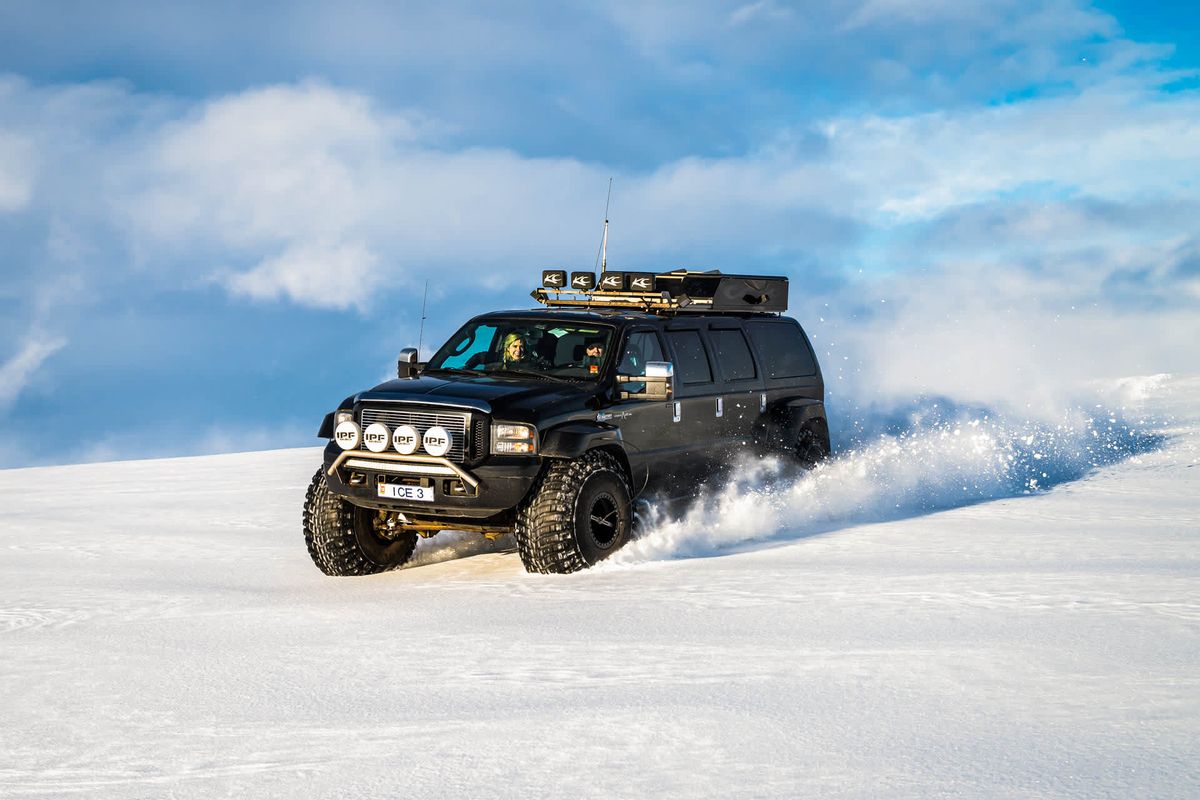
Glacier trucks run their tyres deflated so the weight spreads across the snow rather than cutting into it.
The base camp
The camp is a cluster of huts and a fleet of machines parked in rows. You get a safety briefing, an overall, a helmet, gloves and boots, then a demonstration of the throttle and brake.
Nobody sets off until the guide has checked visors and counted riders. Groups run in a single file line with a guide leading and a second sweeping behind, and the route sticks to a marked track that avoids crevasse zones.
What the Ride Is Actually Like
The riding hour is easier than most people expect and colder than most people expect.
Machines are automatic. You squeeze a thumb throttle to go and a lever to brake, and there is no gear changing, no clutch, and no balance skill required beyond leaning into turns.
Speed is moderate and controlled. On a good day you will cruise at 30 to 50 kilometres per hour with the guide setting the pace, and the group stops two or three times for photographs and to regroup.
What makes it memorable is the emptiness. Once you are ten minutes from base camp there is white in every direction, no fixed landmarks, and a horizon that dissolves into cloud, which is a genuinely disorienting thing to stand in.
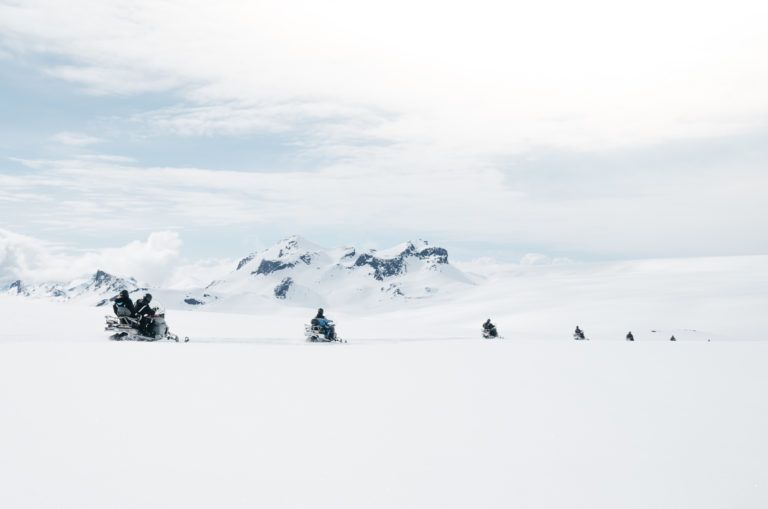
Groups ride in a single line behind a guide, on a marked route that avoids the crevasse fields.
Riding solo or two to a machine
Most tours price a snowmobile for two riders and charge a single supplement if you want one to yourself. Riding two-up is sociable, and you can swap halfway.
Riding solo gives you full control and a better sense of the machine. If you are travelling as a couple and only one of you wants to drive, two-up is the obvious answer.
Do You Need a Licence?
Yes, if you want to drive. You need a valid driving licence and you must have the physical card with you, since operators check it at the base camp and a photo on your phone is not accepted.
Passengers do not need a licence. That is how travellers without one still join: they ride behind someone who has it.
Minimum age for driving is usually 17 or 18 depending on operator, and children as young as 6 to 8 can ride as passengers with an adult, though age limits vary and are worth confirming when you book.
International licences are fine, and an International Driving Permit is not normally needed for a snowmobile. Bring the licence anyway if you have both.
Timing: How the Day Fits Together
The combination works because the glacier road leaves from just above Gullfoss, so the detour is short in distance and long in altitude.
- 08:00 pickup in Reykjavík
- 09:30 Þingvellir, about 40 minutes
- 11:00 Geysir, about 45 minutes including a coffee
- 12:15 Gullfoss, about 45 minutes at the viewpoints
- 13:15 transfer to the mountain base, change into overalls
- 14:00 glacier truck up to base camp
- 15:00 snowmobiling, roughly one hour on the ice
- 16:30 back down, hot drink, return transfer
- 18:30 to 19:00 back in Reykjavík
Some operators reverse it and do the glacier first, which is worth asking about in winter, since it puts the ride in the brightest part of the day.
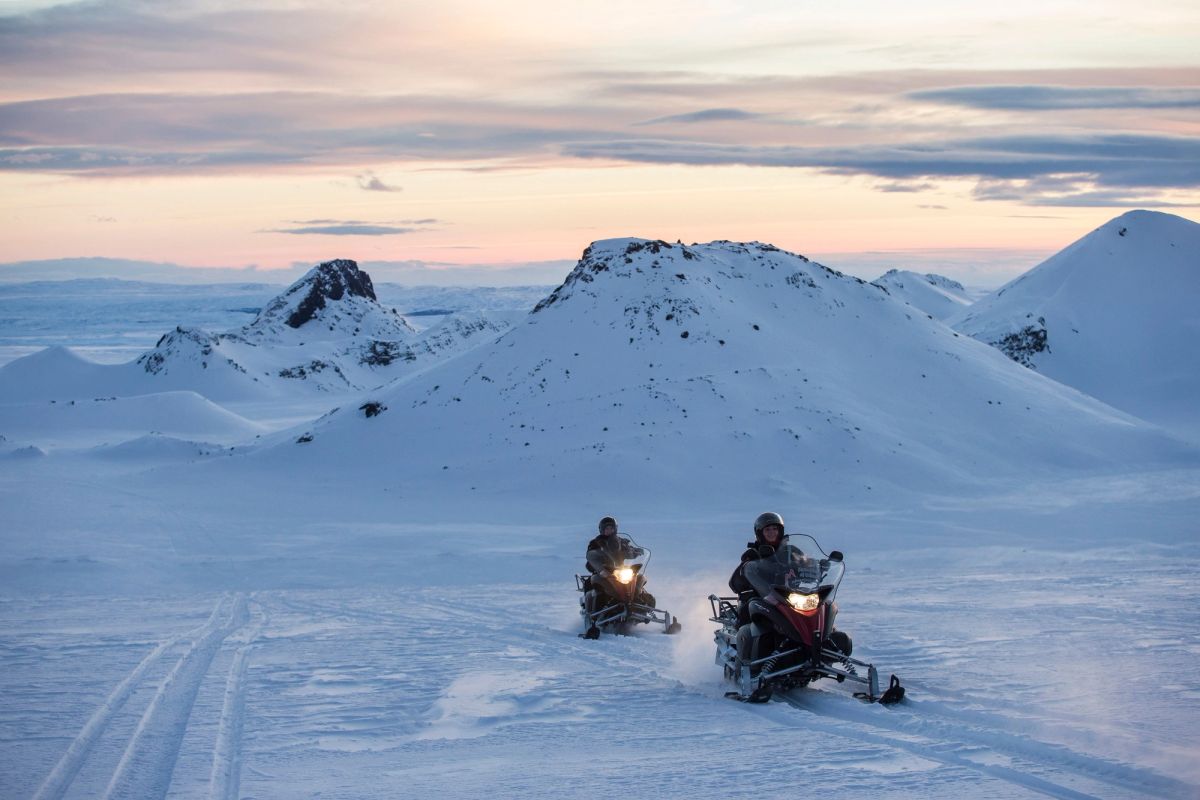
Late afternoon light on Langjökull. In midwinter the ride is often the last daylight activity of the day.
What You See Before the Glacier
The sightseeing half is the standard loop, and on a combo day it runs to a tighter clock than a normal tour, so it helps to know what to prioritise at each stop.
At Þingvellir you get about 40 minutes, which covers the Hakið viewpoint and the walk part-way down Almannagjá. The site is where the Alþingi assembly met from around 930 until 1798 according to Þingvellir National Park, and the guide will usually tell that story on the walk rather than at a stop.
Geysir gets 45 minutes, which is two or three Strokkur eruptions and a coffee. Skip the shop if you want to walk the upper pools, because you cannot do both.
Gullfoss gets 45 minutes. The Environment Agency of Iceland records the upper fall at 11 metres and the lower at 20, with average flow of 109 cubic metres per second, and in winter the lower path is usually closed with ice so the upper platform is the whole stop.
None of that is short-changed by the glacier add-on. What you lose is the extra stop, so Kerið, Friðheimar and Faxi all drop off a snowmobile day.
Photographing on the Ice
Bring something you can operate with gloves on. You will be stopped for five minutes at a time in wind, and fiddling with small buttons in a helmet is how cameras end up in the snow.
Snow fools every meter. Shoot a stop or two over what the camera suggests, otherwise the ice comes out grey rather than white.
A phone in a chest pocket beats a camera around your neck. Machines vibrate, straps swing, and there is nowhere to put a bag while you ride.
Ask the guide before you stop. Pulling out of the line to take a picture is the one thing that genuinely annoys them, and there are scheduled photo stops built into every route.
What to Wear
Operators provide the outer layer: a windproof and waterproof overall, a helmet with a visor, thick gloves and often boots. What you wear underneath is your job.
Wear a thermal base layer top and bottom, a fleece or light down mid-layer, and thick wool socks. Skip cotton, which holds sweat from the walk around Gullfoss and then chills you on the ice.
Add a thin hat or balaclava that fits under a helmet, plus a buff for your neck. Bring ski goggles if you own them, since the provided visor fogs in wet snow and goggles handle it better.
Sunglasses matter more than people think. Glacier glare on a clear day is severe, and sunburn at 1,200 metres on reflective snow catches out visitors in June.
The temperature you are actually dressing for
The glacier runs colder than the lowland stops by roughly 6 to 8°C, on top of the wind. At the nearest Met Office station in the valley, monthly climate data puts January's average daily low at 4.3°C below zero and mean wind above 5 metres per second.
Add altitude and the wind of riding at 40 kilometres per hour, and the felt temperature on the ice can sit near 20 below in midwinter. In July the base camp still hovers around freezing.
What the Combo Costs
Prices are in Icelandic krónur and cover the full day from Reykjavík.
- Golden Circle and Langjökull snowmobiling super jeep tour, 10 to 11 hours: 63,188 ISK per person
- Snowmobile tour departing from Gullfoss, without the loop: a shorter and cheaper option if you are self-driving
- Standard Golden Circle coach day for comparison: 13,152 ISK per person
- Single-rider supplement: charged separately by most operators
- Lunch on the route: 2,500 to 4,000 ISK a head, not usually included
The gap between 13,152 and 63,188 is the glacier hour, the specialist vehicles and the gear. Whether that is good value depends entirely on how much you want to ride a snowmobile across an ice cap.
If you are driving yourself, booking a snowmobile tour that starts at Gullfoss is the cheaper route. You do the loop at your own pace and meet the glacier operator at the mountain base.
Can You Snowmobile Year-Round?
Yes. Langjökull holds permanent ice and snow, so tours run in every month, and a July departure is only slightly less snowy than a February one.
Summer gives you long light, a warmer base camp and the odd melt pool on the surface. Winter gives you deeper snow, low sun and a real chance of aurora on the drive home, and our guide to the Golden Circle in winter covers what else changes on the loop.
What stops a departure is weather rather than season. High wind, whiteout and heavy snowfall all cancel rides, and operators call it off rather than gamble, so keep a flexible day in your plan.
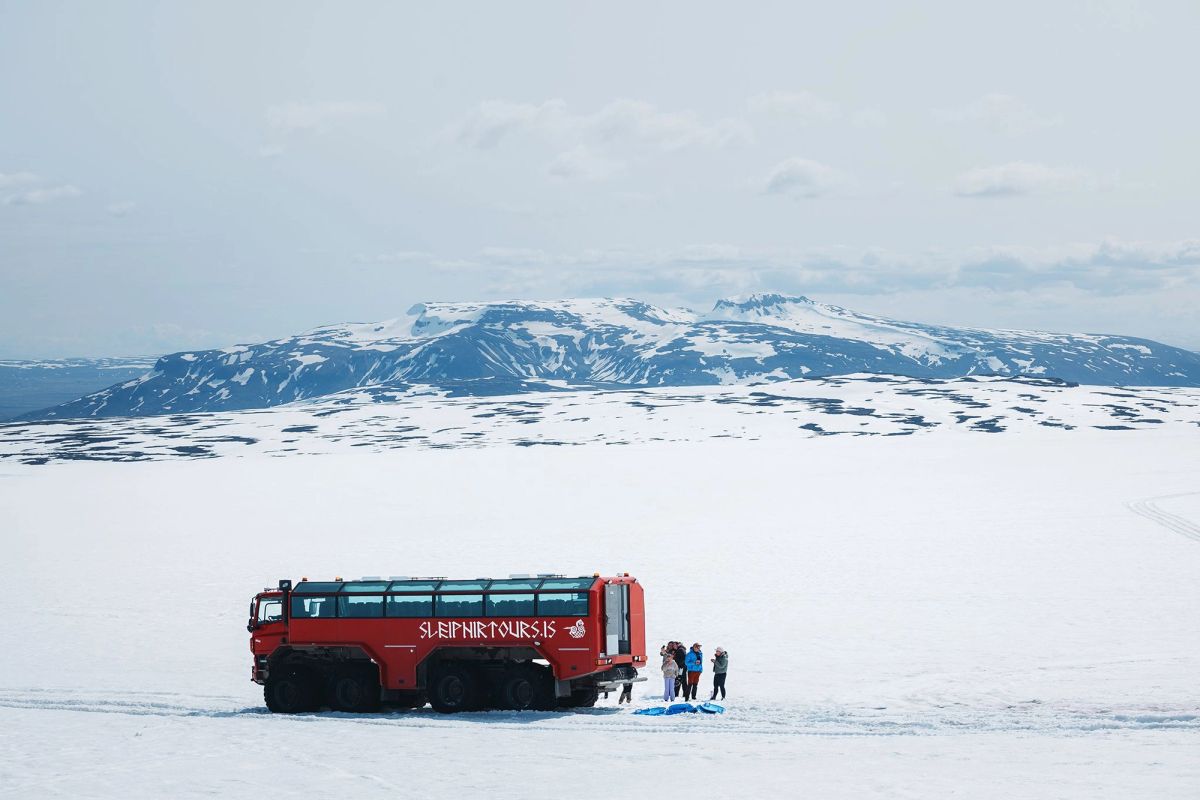
Whiteout and high wind cancel more departures than cold does, in any month of the year.
Safety on the Glacier
Langjökull is a working glacier with crevasses, and everything about the tour structure exists because of that.
You stay on the marked route. Guides know where the crevasse fields sit and the track is repositioned as conditions change, which is the single reason nobody drives themselves up there.
Keep your distance in the line and do not overtake. The most common incident on these tours is a rider bunching up and clipping the machine in front on a turn.
Tell the guide if you are cold or uncomfortable. Stopping to warm up is normal and everybody would rather do that than deal with someone who pushed through.
For the wider picture on Icelandic conditions, SafeTravel is the national safety service and the place to check alerts before any highland activity.
Alternatives if Snowmobiling Is Not for You
Three other ways to get onto or into Langjökull work from the same road.
The Into the Glacier ice tunnel takes you inside the ice cap through a man-made tunnel at around 1,260 metres, which suits anyone who wants the glacier without driving anything.
A monster truck trip onto Langjökull covers the same ground in a heated vehicle with big windows, which works well for families and for anyone who does not want an hour in the wind.
A super jeep loop of the Golden Circle with a glacier section adds the highland scenery without the ride. It is the middle option on both cost and effort.
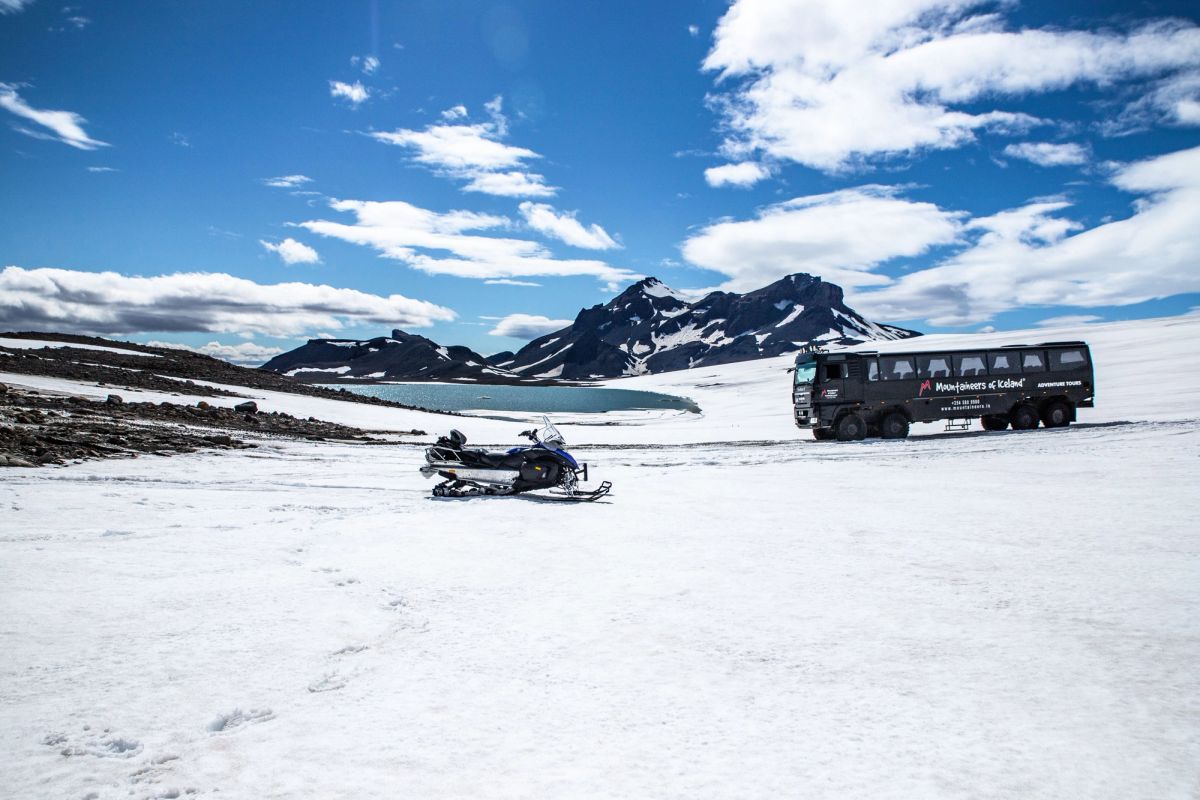
From the southwestern edge of Langjökull you look back down over the highland lakes towards the Golden Circle.
Is It Worth It?
For an active traveller with one spare day and the budget, yes. You get the three classic sites and an hour on an ice cap, and the contrast between a geothermal field at 11am and a glacier at 3pm is hard to beat anywhere.
It is not worth it if you want a relaxed day, if you dislike the cold, or if your group includes small children. The travel-to-activity ratio is high and the day is long.
The version that satisfies most people is the one where they knew what they were buying: three sightseeing stops, a lot of driving, and one very memorable hour. Go in with that expectation, and it delivers.
Book the Glacier Day
If a snowmobile hour on an ice cap is the part of Iceland you have been picturing, the full-day combination is the simplest way to get it without hiring a super jeep yourself.
Our Golden Circle and snowmobiling super jeep tour covers the three main stops and the glacier ride in 10 to 11 hours from Reykjavík, with all the overalls, helmets and gloves included. Bring your physical driving licence if you want to drive, and keep a spare day free in case the mountain weather has other plans.
Compare Golden Circle Tours
Check each selected product for its current operator, guide, itinerary, meeting point, and terms.
View Our Tours

