
Why Look Beyond the Lagoons?
Because the famous ones are not natural. The Blue Lagoon formed in the outflow of a geothermal power station in the 1970s, and Sky Lagoon was built in 2021.
Both are genuinely good and both cost 14,990 ISK or more. The country is full of pools that cost nothing.
What you trade is comfort. Natural springs have no lockers, often no changing facilities beyond a wooden screen, and no guarantee the water is the temperature you hoped for.
What you gain is a hot pool in an empty valley with nobody selling you anything.
How They Form
Worth understanding, because it explains the variability.
Iceland sits on the Mid-Atlantic Ridge, where magma rises close enough to the surface to heat groundwater directly.
That water surfaces at whatever temperature the rock gave it, which ranges from pleasantly warm to genuinely boiling. Geothermal generation across Iceland runs to 5,916 GWh a year according to the National Energy Authority, from the same heat.
Bathable springs are the ones where hot water mixes with cold surface water in usable proportions. That mixing is why temperature varies along a stream.
Springs that have not mixed are lethal. The pools at Geysir sit at boiling point, and the whole field is a protected area managed by the Environment Agency of Iceland.
Reykjadalur: The Best Accessible One
The one most visitors do, and the one worth the effort.
A geothermal stream mixes with cold meltwater above Hveragerði to produce a river warm enough to sit in.
Getting there means a hike of about 3 kilometres each way with roughly 340 metres of climb, taking 45 to 75 minutes up.
The water is hot at the top and cold at the bottom, so you walk upstream until it feels right and sit down. Ten metres either way changes the temperature noticeably.
A boardwalk marks the bathing stretch with wooden changing screens. Parking is charged through an app and the hike itself is free.
Our guide to the Reykjadalur hike covers the route and what to bring.
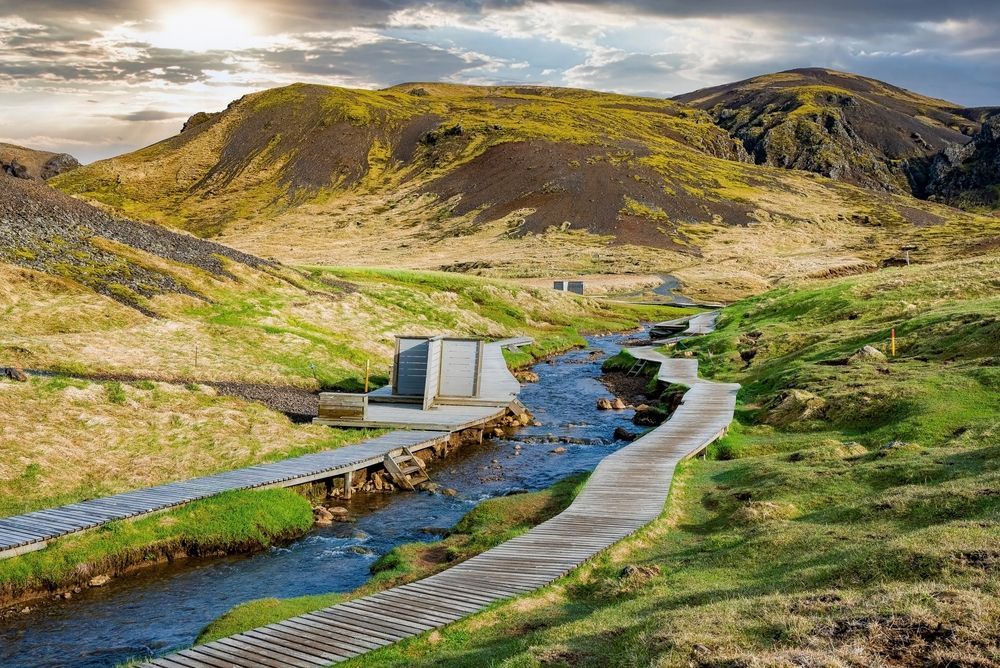
At Reykjadalur you walk upstream until the temperature is right, which is the whole technique.
Hrunalaug: The Small One
Near Flúðir on the Golden Circle, and it is tiny.
A stone-walled pool on private farmland with a rustic stone changing hut, holding perhaps six people at a squeeze.
The landowner charges a small fee. Pay it. Access here has been threatened repeatedly by visitors who did not.
It is genuinely beautiful and genuinely small, which means arriving to find it full is a real possibility.
Ten minutes from Flúðir, which puts it within reach of a Golden Circle day. Our page on Flúðir covers what else is in the village.
Landmannalaugar: The Highland One
The most famous free hot spring in the country and the hardest to reach.
A natural pool forms where a hot stream meets a cold river in the highlands, surrounded by rhyolite mountains in improbable colours.
Access is via F208, a highland road requiring a 4x4 and open only from roughly June to September. Our guide to Iceland's F-roads covers what that means.
Bus services run from Reykjavík in summer, which is how most visitors without a highland vehicle get there.
It is a full day from Reykjavík at minimum, and it deserves an overnight.
Other Wild Springs Worth Knowing
Four more, in decreasing order of accessibility.
Seljavallalaug on the south coast is a swimming pool built into a hillside in 1923, fed by a warm spring, reached by a 20 minute walk. It is not cleaned often and it is atmospheric.
Hveravellir sits between Langjökull and Hofsjökull on the F35 highland route, with a small hot pool beside a geothermal field.
Grettislaug in the north is a stone pool near Sauðárkrókur with a small fee and a good view.
Hoffell in the east has concrete tubs on a farm near Höfn with a view of the glacier.
Most of these are seasonal, and most of them are reached by roads that need checking at umferdin.is before you set out.
The Paid Middle Ground
Between wild springs and big lagoons, three options on the Golden Circle.
The Secret Lagoon at Flúðir is Iceland's oldest swimming pool, built in 1891, at 4,500 ISK for adults and 260 ISK for children under 15.
Laugarvatn Fontana has steam rooms built over a live hot spring and steps into the lake for a cold plunge.
Municipal swimming pools are the real answer for value. Every Icelandic town has one, they cost a few hundred krónur, and Reykjavík City lists the ones in the capital area with their hours.
They are also where Icelanders actually go, which makes them the most authentic soak on offer as well as the cheapest.
Our comparison of Fontana and the Secret Lagoon covers the choice between the two.
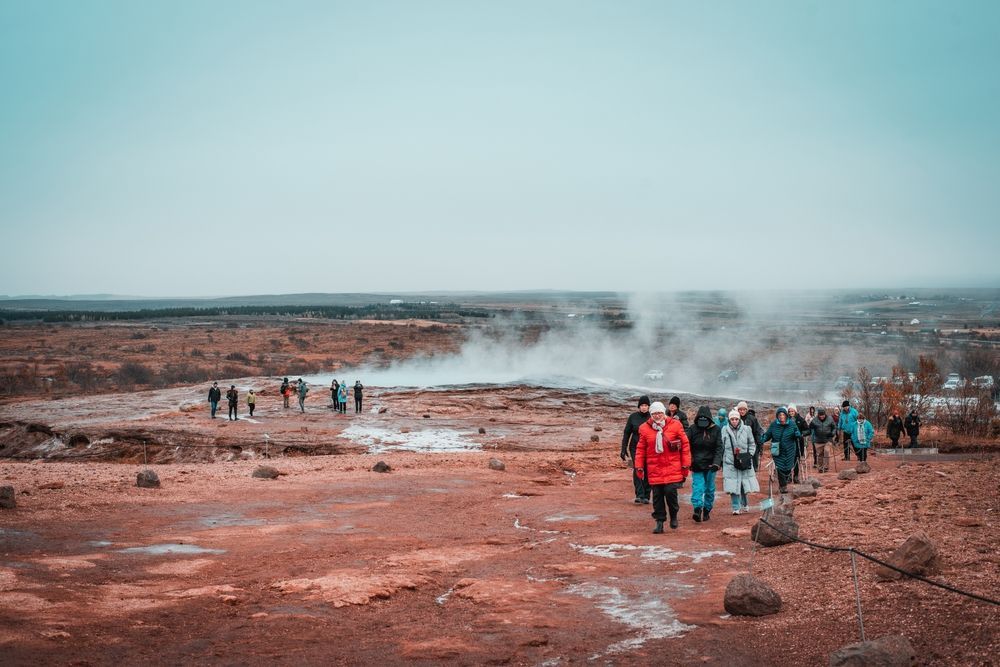
Unmixed geothermal water reaches boiling point. Bathable springs are the ones where it has met cold water.
Etiquette and Safety
Seven rules, and the first two are not negotiable.
Shower without a swimsuit before entering any managed pool. This is mandatory in Iceland, it is checked, and it is the biggest culture shock for visitors.
At wild springs there is nobody to check, and rinsing off first is still the expectation.
Never use soap or shampoo in a natural pool. It kills the algae and ruins the water for everyone.
Take everything out that you brought in. There are no bins at wild springs.
Test the temperature with a hand before getting in, and remember that geothermal water can be at boiling point where it surfaces.
Do not put your head under. Geothermal surface water can carry bacteria.
Respect private land. Several springs sit on farms, and access depends entirely on visitors behaving.
What to Bring
Six things for a wild spring visit.
Swimwear, worn under your clothes if there is no changing hut.
A quick-dry towel rather than a hotel bath sheet.
Flip-flops for stony ground and slippery edges.
A dry bag for the wet swimsuit afterwards.
Warm layers and a windproof shell for the moment you get out.
Traction spikes between November and March, since the walk in ices like everything else.
Which Should You Choose?
Four answers, depending on what you actually want.
For the best wild experience within reach of Reykjavík, hike Reykjadalur. Three to four hours and the walk is half of it.
For a soak on a Golden Circle day without a hike, the Secret Lagoon at Flúðir.
For the highlands and the colours, Landmannalaugar in summer, with a full day set aside.
For value and an authentically Icelandic evening, any municipal swimming pool.
The one thing not to do is drive a long way to a wild spring you have seen one photograph of. Many are small, some are busy, and a few are barely warm.
End a Golden Circle Day in Hot Water
The Golden Circle runs through the most geothermally active part of the country, which means a hot soak is never more than half an hour from wherever the day finishes. Our small-group Golden Circle tour with Kerið and Friðheimar covers the main sites, and we can advise on adding a bathing stop at the end. Tell us your dates and we will work out the timings.
Compare Golden Circle Tours
Check each selected product for its current operator, guide, itinerary, meeting point, and terms.
View Our Tours