
What Are F-Roads in Iceland?
Mountain roads through the interior highlands, marked with an F before the route number. F35, F26 and F208 are all F-roads.
They are unsurfaced tracks rather than roads: gravel, loose stone, steep gradients, potholes and in many cases unbridged rivers.
Driving one legally requires a four-wheel-drive vehicle. A two-wheel-drive car on an F-road is prohibited and invalidates your rental insurance entirely.
They are seasonal, generally opening between early June and early July and closing between late August and mid-October, depending entirely on snow.
The 4x4 Requirement
Not a suggestion, and the consequences of ignoring it are financial rather than legal in most cases.
Icelandic law restricts F-roads to four-wheel-drive vehicles. Rental agreements say the same thing in bolder type.
Taking a 2WD car onto an F-road voids the rental insurance completely. Any damage, from a stone chip to a total loss, becomes your bill.
Rental companies know. Many fit GPS trackers and all of them can tell from the damage what happened.
A small crossover with all-wheel drive is not automatically enough. Some F-roads need genuine ground clearance rather than badge engineering, and the rental company will tell you which of their vehicles are permitted where.
If your itinerary includes any F-road, book the right car from the start rather than hoping.
When They Open
Later than most visitors expect, and it varies by two to four weeks each year.
The general pattern is mid-June to late September, with the easier routes opening first.
A heavy winter pushes opening dates into July. A mild one brings them forward into late May for the lowest routes.
Nothing opens on a schedule. The Icelandic Road and Coastal Administration opens each route when it has been assessed, and that decision comes from snow depth and river levels rather than a calendar.
Closures happen mid-season too, when rain raises the rivers or snow returns.
Do not plan a highland itinerary that only works if a specific route is open. Have a coastal alternative.
Current status for every route is published at umferdin.is, updated continuously through the season and worth checking on the morning of any highland drive.
River Crossings
The part that separates F-roads from rough gravel, and the part that costs people money.
Many F-roads cross rivers without bridges. You drive through, and the depth changes hour to hour with glacial melt and rainfall.
Rental insurance does not cover water damage. Not the standard cover, not the premium cover, not the gravel protection. If you drown the engine, you pay for it.
Assess every crossing on foot before driving it. Walk the line you intend to drive if the water is shallow enough to do so safely.
Cross at the widest and shallowest point, which is rarely where the track enters. Drive slowly and steadily in low gear without stopping.
Never cross alone if you can avoid it, and never cross a river you are not confident about. Wait for another vehicle or turn back.
Afternoon crossings are deeper than morning ones in summer, because glacial melt peaks with the day's heat.
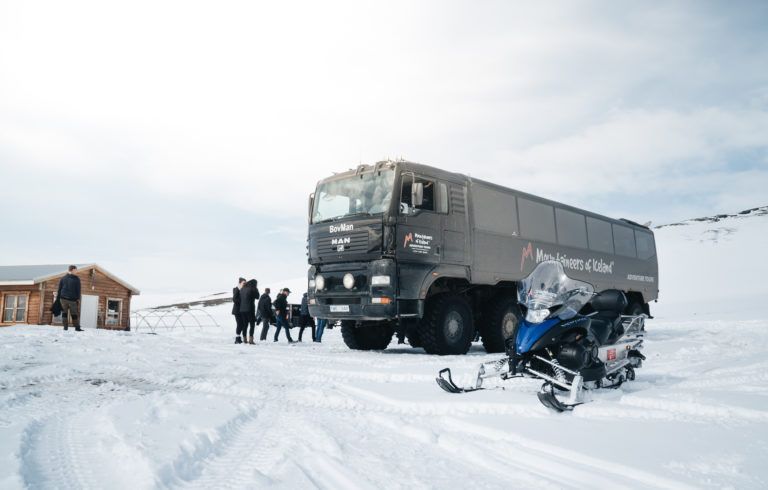
Highland operators use vehicles built for the terrain, which is why guided access exists at all.
The Main F-Roads
Six routes cover most highland travel, and they vary considerably in difficulty.
F35, the Kjölur route, runs north from near Gullfoss between Langjökull and Hofsjökull to the north of the country. It has no major unbridged rivers and is the gentlest of the highland crossings.
F26, Sprengisandur, is the longest and most remote crossing, running through the centre of the island with several river crossings.
F208 leads to Landmannalaugar, and the northern approach is considerably easier than the southern one.
F206 reaches Laki and its crater row, with genuine river crossings.
F88 and F894 lead to Askja in the north-east, and both require experience.
F249 to Þórsmörk is the one route rental companies almost universally prohibit, because the Krossá river is unpredictable and has claimed a large number of hire cars.
The Golden Circle Connection
Relevant, since F35 starts where the Golden Circle finishes.
Route 35 runs past Gullfoss and becomes F35 shortly afterwards, heading north into the highlands towards Hveravellir and eventually Akureyri.
That means the tarmac ends about ten minutes beyond the falls. Plenty of visitors have driven up it by accident in a hire car.
The Langjökull ice tunnel and the snowmobile bases are reached from this direction, and every operator uses purpose-built vehicles rather than expecting you to drive up.
Guided transfers are the only sensible way onto the glacier without your own highland vehicle, and they collect from the tarmac.
If you are self-driving the Golden Circle, turn round at Gullfoss unless you are specifically equipped.
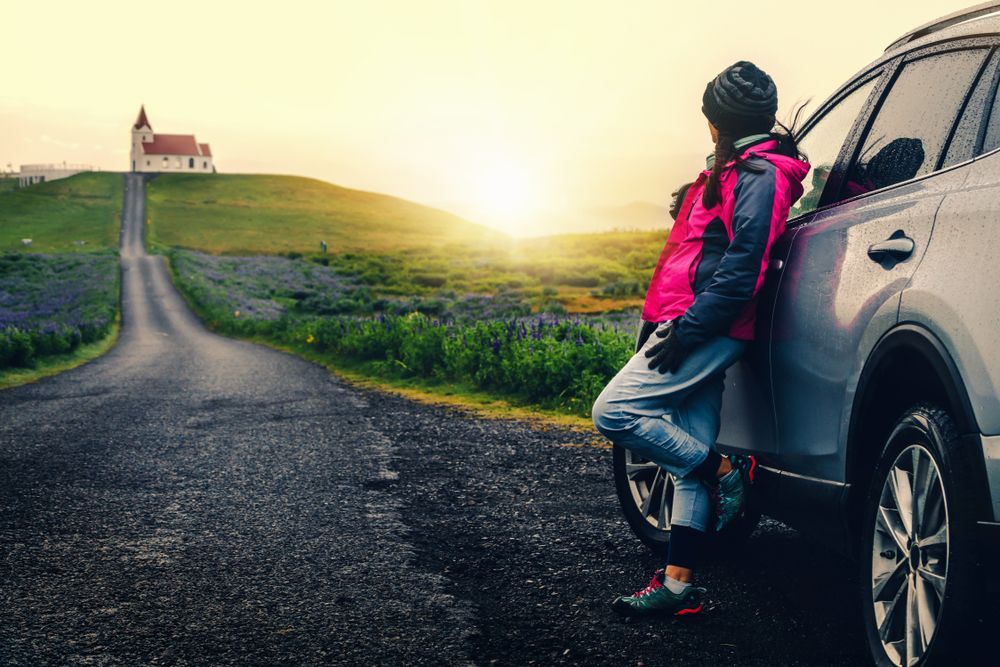
The tarmac ends about ten minutes past Gullfoss, and plenty of hire cars have found that out the hard way.
Practical F-Road Driving
Seven points, and none of them is optional.
Reduce your speed. The advisory limit on gravel is 80 km/h and the realistic speed on an F-road is 30 to 50.
Slow down further where the surface changes. Loose gravel on a bend is what puts hire cars in ditches.
Fill the tank before you leave the ring road. There is no fuel in the highlands.
Carry water, food and warm clothing. A breakdown in the interior means waiting.
Tell someone your route. File a travel plan with SafeTravel, which is run by the Icelandic Association for Search and Rescue.
Expect no phone signal. Download offline maps before you leave the coast.
Never drive off the track. Off-road driving is illegal in Iceland, carries heavy fines, and damages ground that takes decades to recover.
Should You Drive Them at All?
An honest answer, because the highlands are genuinely worth seeing.
If you have highland or off-road driving experience, a properly equipped 4x4 and time to turn back, the F-roads offer the emptiest landscape in Europe.
If you have neither the experience nor the vehicle, take a guided highland tour instead. Operators run modified super jeeps that cross rivers a hire car cannot.
If you are on a short trip, skip them entirely. The southwest, the south coast and the Golden Circle are all on tarmac and they are what most people came for.
The mistake is treating an F-road as a shortcut. F35 looks like a direct route north on a map and it is a serious drive.
Our guide to Icelandic road conditions and weather covers the checking routine for any Icelandic drive.
That routine matters on tarmac too, since Route 1 and the Golden Circle roads close in storms as readily as anything else.
Our page on Langjökull covers the glacier that F35 runs past.
The Short Version
F means mountain road, 4x4 only, and it is a legal requirement rather than advice.
They open roughly mid-June to late September, and the dates move every year.
Rivers are unbridged and water damage is never covered by insurance.
Check the road administration's live status before every highland drive and file a plan with SafeTravel.
If in doubt, turn back. The highlands will still be there.
Reach the Highlands Without the Risk
The glacier and the highland edge north of Gullfoss are genuinely worth seeing and genuinely not a hire car proposition, which is why every operator up there drives modified vehicles. Our Golden Circle and snowmobile tour covers the three main sites and the transfer onto the ice in one day, with no F-road driving of your own. Tell us your dates and we will confirm what fits.
Compare Golden Circle Tours
Check each selected product for its current operator, guide, itinerary, meeting point, and terms.
View Our Tours

