
Diving or Snorkelling: The Short Answer
Snorkel unless you are already a certified drysuit diver. Snorkelling needs no certification, costs less and shows you the part of Silfra that people actually photograph.
Diving requires an Autonomous Diver or Open Water qualification plus a dry suit certificate, according to Þingvellir National Park. Operators also want recent logged drysuit dives.
Both float you through the same rift at the same 2 to 4°C. Diving adds depth and a longer time in the water, and it does not add much to the view.
What Silfra Is
A water-filled fissure inside Þingvellir National Park, and the clearest freshwater you are likely to swim in.
The water is meltwater from Langjökull that has spent decades filtering through porous lava before it surfaces here. That filtration is why visibility runs beyond 100 metres.
The fissure sits in the rift that separates the North American plate from the Hreppar microplate, which is the honest version of the "between two continents" claim.
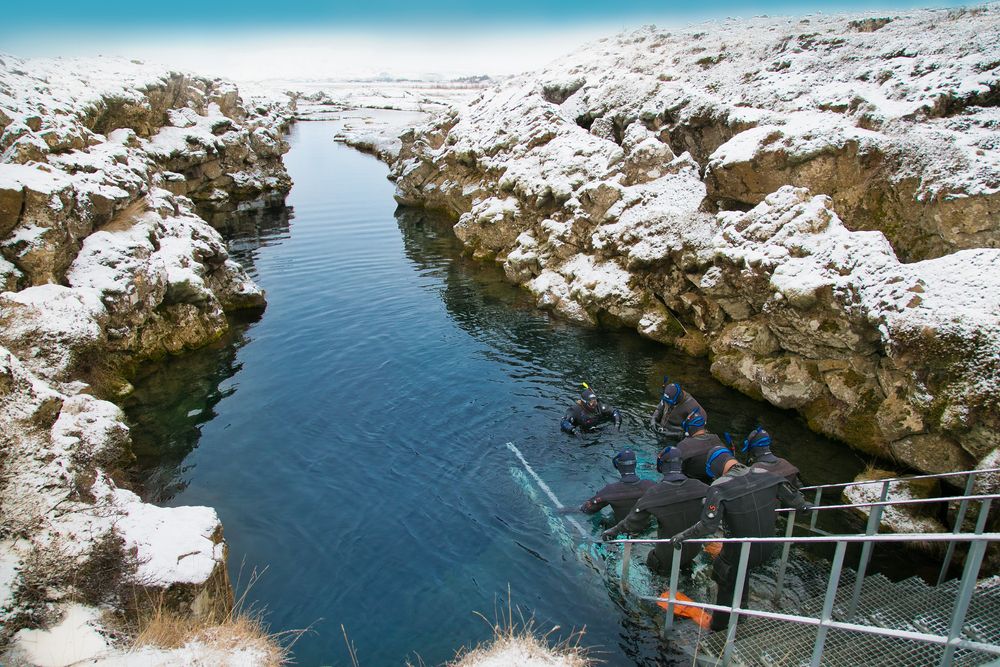
Temperature holds at 2 to 4°C year-round. It never freezes, because the water is spring-fed rather than surface-fed, which is why tours run in January.
Our page on Silfra covers the site and the booking requirements.
Snorkelling in Silfra
The option almost everyone takes, and the one we would recommend to a friend.
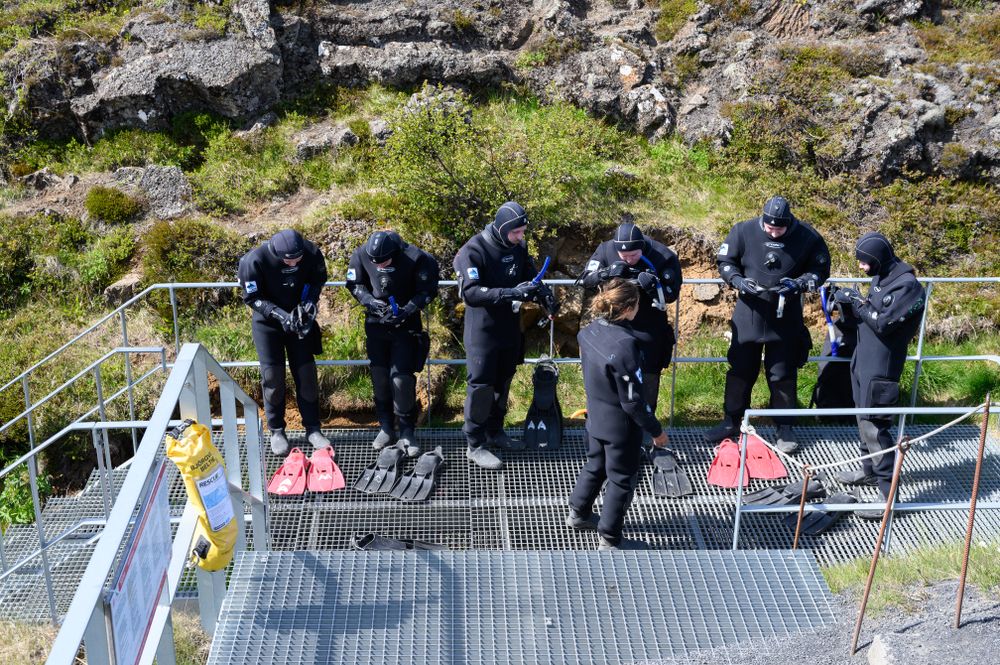
You wear a drysuit over thermal undergarments, with a hood and gloves. Only your face and hands touch the water, and the face stops registering the cold after about a minute.
The route drifts with a slow current through four sections, including the narrow Silfra Hall and the Big Crack where the walls close to within arm's reach on both sides.
Time in the water is around 30 to 40 minutes. The whole tour, including the briefing and getting into the suit, runs 2.5 to 3 hours.
Requirements are modest: be able to swim, be comfortable in water, and meet the operator's minimum age, typically 12, and height and weight limits for the suits.
You float on the surface looking down, which is where the light is and where the visibility is at its most dramatic.
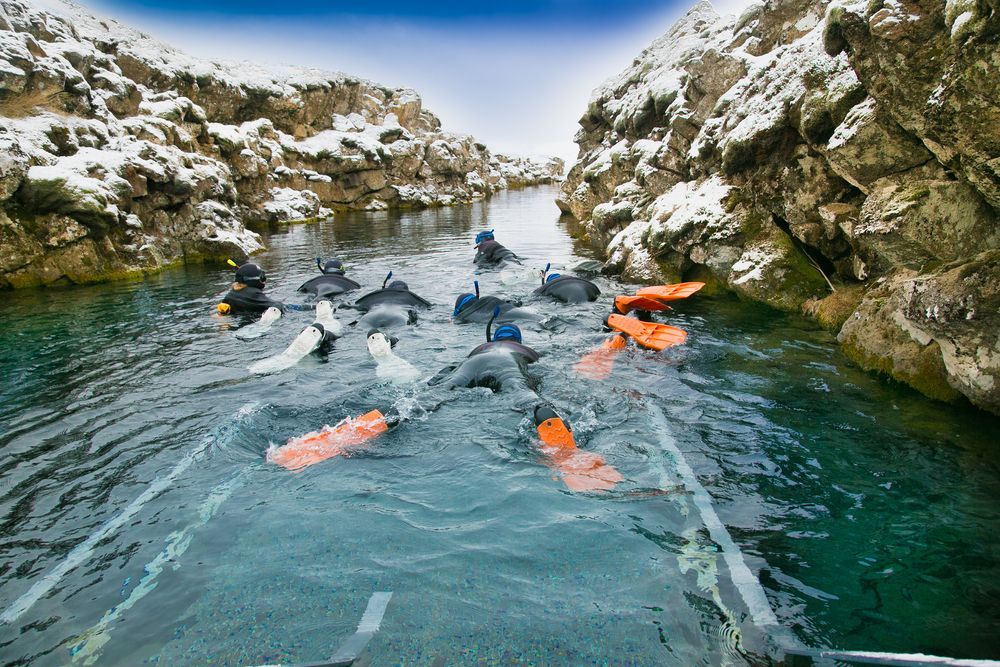
Snorkellers drift on the surface, which is where the light and the visibility are best.
Diving in Silfra
The option for people who already dive, and it is a genuinely good dive.
Certification is the gate. You need an Autonomous Diver or Open Water qualification and a dry suit certificate, or an equivalent logbook showing recent drysuit dives, usually ten within the last two years.
Operators check this properly. Turning up with an Open Water card and no drysuit experience means being turned away.
The park caps depth at 18 metres, and going deeper is prohibited. Entering caves or overhead environments is also prohibited.
Diving lets you drop into the fissure walls and see the structure from inside rather than from above, and the sense of scale is different.
Dive time is around 30 to 40 minutes per dive, with two dives on most tours, and the whole day runs four to five hours.
The Rules Either Way
Four park rules that apply to both, and they are enforced.
You must always dive or snorkel with a buddy. Entering Silfra alone is prohibited.
A drysuit is required for both activities, along with a hood, gloves and neoprene footwear.
You must confirm you are in full mental and physical health when booking. Operators ask about heart conditions, asthma and recent surgery.
All tours run through licensed operators. There is no option to turn up with your own kit and get in.
The park is protected under Act No. 47/2004 and covers 22,788.7 hectares according to the Environment Agency of Iceland, and Silfra is one of its most closely managed sites.
The Cold, Honestly
The part people worry about most and the part that matters least.
The water is 2 to 4°C, which sounds worse than it feels through a drysuit. Your body stays dry and insulated throughout.
Your face is the exposed part. The first thirty seconds are a shock, and then it settles.
Hands in wet gloves get cold towards the end of a snorkel, which is the main reason sessions run 30 to 40 minutes rather than an hour.
The air temperature at the car park is the harder part in winter. Getting changed in a February wind is the least pleasant twenty minutes of the day.
Operators plan around it, with heated vehicles and hot chocolate at the end, which is more useful than it sounds.
Winter road access decides whether the day happens at all, and live status for Route 36 is published at umferdin.is.
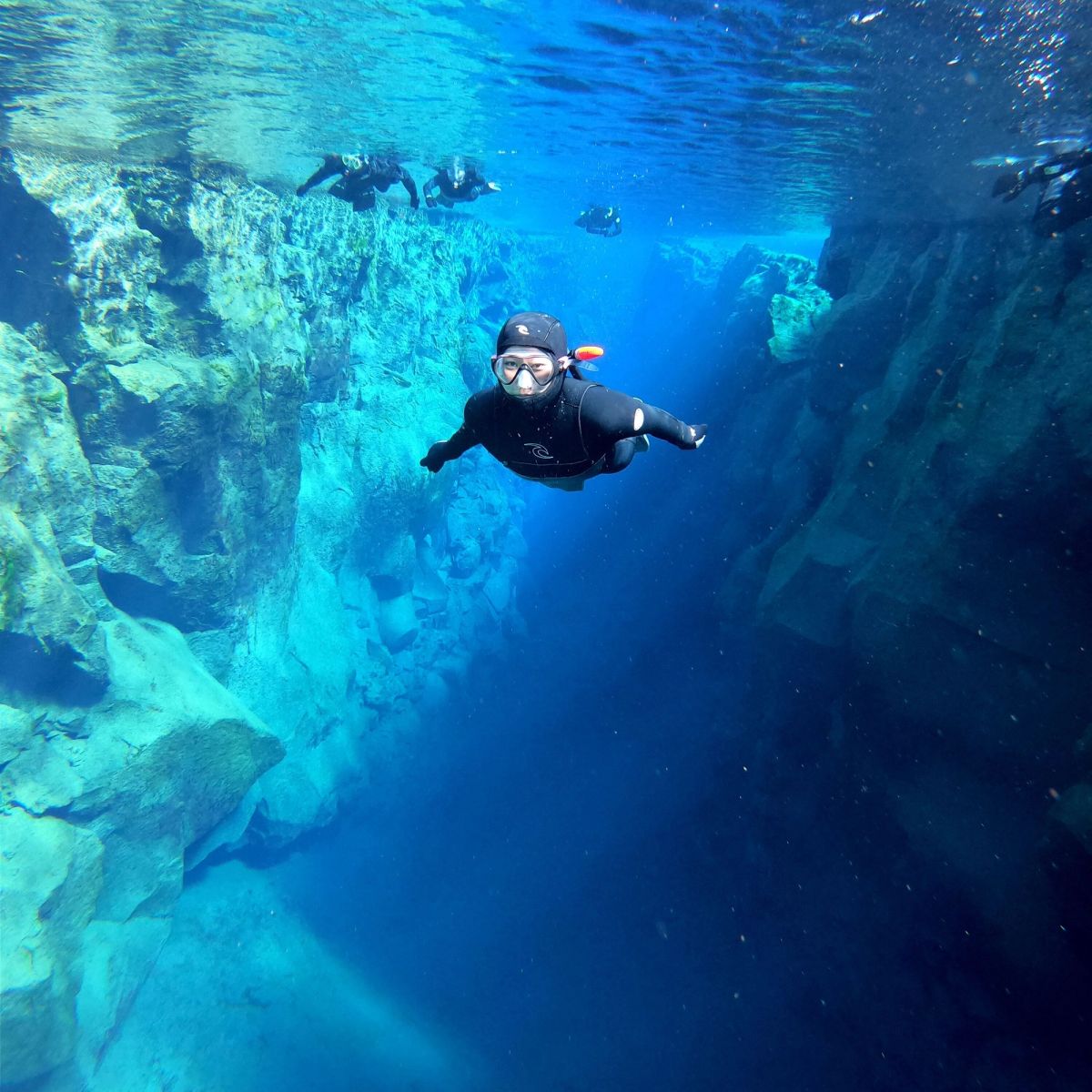
Depth adds structure and scale. It does not add much colour, since there is very little life down there.
What You Actually See
Similar from both, with one real difference.
Visibility beyond 100 metres, which is the headline and it delivers. On a clear day you can see the far end of a section before you enter it.
Rock walls in blue and green, with the colour coming from the water depth and the moss rather than from anything living.
Very little wildlife. Silfra has almost no fish and no plant life beyond algae, because the water is cold, mineral-poor and fast-moving.
The Big Crack, where you can touch both walls, is the moment everyone remembers, and it is reachable from the surface.
Divers get the vertical dimension: the fissure walls dropping away, the sense of being inside a crack rather than above one.
Above the water, the same rift runs the length of the valley, and our guide to walking between the tectonic plates covers the dry version.
Cost and Time
The practical comparison, and it favours snorkelling on both counts.
Snorkelling runs 2.5 to 3 hours in total and costs less than half what diving does.
Diving runs four to five hours with two dives, and the price reflects the equipment, the ratios and the qualification checks.
Both need booking ahead, particularly in summer when the slots fill weeks in advance.
Both fit into a Golden Circle day, though adding either turns an eight hour day into a ten or eleven hour one.
Parking at Þingvellir is 1,000 ISK for a car and covers the day, and our guide to Þingvellir parking explains the system.
Neither activity includes park parking in the tour price unless the operator drives you, which is worth checking at booking.
Which Should You Choose?
Four situations with a clear answer.
Choose snorkelling if you are not a certified drysuit diver. There is no route around the certification and no reason to feel short-changed.
Choose snorkelling if you are short on time or travelling with a group of mixed experience.
Choose diving if you already hold the qualifications and want the fissure from inside rather than above.
Choose diving if you have snorkelled Silfra before and want a different version of it.
The one thing not to do is book diving hoping the certification check will be relaxed. It will not be.
Either way, the fissure sits inside Þingvellir National Park, so the rest of the site is a short walk from where you get changed.
Add It to a Golden Circle Day
Silfra sits inside Þingvellir, which is the first stop on the standard Golden Circle loop, so it slots into a day you were already planning rather than needing one of its own. Our Golden Circle and Silfra snorkelling tour covers the fissure, the three main sites and lunch in a greenhouse. Tell us your dates and we will confirm what fits.
Compare Golden Circle Tours
Check each selected product for its current operator, guide, itinerary, meeting point, and terms.
View Our Tours
