
Who Saved Gullfoss Waterfall?
Sigríður Tómasdóttir, a farmer's daughter from Brattholt, the farm directly above the falls. Between 1907 and the early 1920s she fought a lease that would have allowed a hydroelectric dam on the Hvítá river, submerging Gullfoss entirely.
She spent her own savings on a lawyer, made repeated 120 kilometre journeys to Reykjavík on foot, and at the lowest point threatened to throw herself into the falls rather than watch them destroyed.
The dam was never built. Gullfoss passed to the Icelandic state and was made a permanent conservation site in 1979, and Sigríður is remembered as Iceland's first environmentalist.
What Is Gullfoss?
Gullfoss means golden falls, and it is the third stop on the Golden Circle route.
The waterfall sits on the Hvítá, a glacial river fed by Langjökull, roughly 115 kilometres from Reykjavík. The drive takes about an hour and a half.
The water falls in two stages, 11 metres then 20 metres, before turning sharply into a canyon 70 metres deep and about 2.5 kilometres long. That right-angle turn is what makes the falls look as though the river is disappearing into the ground.
Average flow is around 109 cubic metres per second, rising to about 130 in summer, and floods have pushed it past 2,000 according to the Environment Agency of Iceland.
Who Was Sigridur Tomasdottir?
Born in 1871 at Brattholt and one of several daughters of the farmer Tómas Tómasson, who owned the land the falls sit on.
She grew up walking the canyon rim. Long before the road existed she and her sisters cut the first path down towards the falls by hand, so that visitors arriving on horseback could reach the viewpoints.
She guided those early visitors herself. That matters to the story, because she knew Gullfoss as a working landscape rather than as scenery, and she understood exactly what a reservoir would cover.
She never married and never left Brattholt. She died in 1957, aged 86.
The Gullfoss visitor site still sits on land her family farmed, and the farmhouse is visible across the canyon from the upper viewpoint.
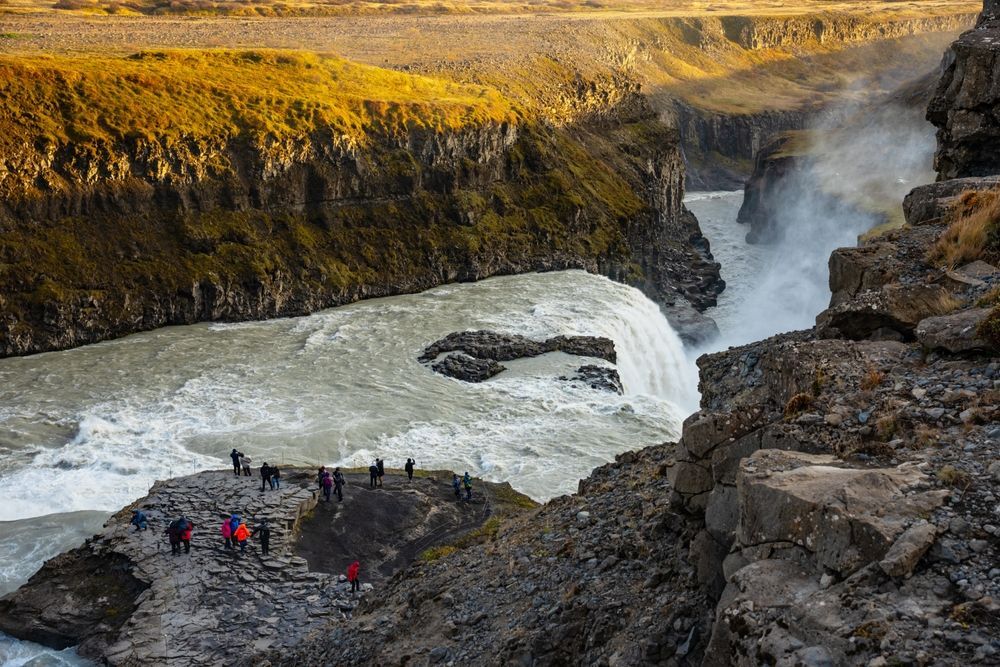
The paths Sigríður and her sisters cut by hand became the route visitors still walk today.
The Plan to Dam Gullfoss
Iceland at the turn of the twentieth century was poor, largely rural and short of power, and its waterfalls looked like the answer.
In 1907 an English businessman offered to buy Gullfoss from Tómas Tómasson. He refused to sell, then leased the falls instead, which he appears to have understood as a smaller concession than it was.
The lease allowed the construction of a hydroelectric dam across the Hvítá. Building it would have flooded the canyon and reduced the falls to a controlled outflow.
Foreign investors bought waterfall rights across Iceland in this period, and the pattern was consistent: a farmer signs a lease he does not fully grasp, and the landscape changes permanently.
The country's power ambitions were real, and they were realised elsewhere. Hydropower now produces 14,195 GWh a year in Iceland against 5,916 from geothermal, according to the National Energy Authority, so the case the investors made was not a foolish one.
Sigríður recognised what her father had signed before almost anyone else did.
The Campaign to Save the Falls
She fought it for well over a decade, and the fight was as much physical as legal.
She hired the Reykjavík lawyer Sveinn Björnsson with her own money, which for an unmarried farm daughter meant her entire savings. He later became Iceland's first president in 1944.
The journey to Reykjavík was 120 kilometres each way, across unbridged rivers and rough country, and she made it repeatedly. The accounts that she walked part of it barefoot are the detail most Icelanders remember.
When the case appeared lost, she declared she would throw herself into Gullfoss if construction began. Whether or not she meant it, the threat reached the newspapers and turned a contract dispute into a national argument.
The court case itself did not go her way. What changed the outcome was public opinion, which by then had moved decisively against the scheme.
How Gullfoss Was Protected
The ending is less dramatic than the campaign, and it turned on money rather than justice.
Payments on the lease stopped during the First World War, and the contract was cancelled for non-payment. The dam was never begun.
Gullfoss was later sold to the Icelandic state, which removed any prospect of another private lease.
In 1979 the falls and the surrounding area were formally protected, with the Environment Agency managing the site. That protection is permanent and covers the canyon as well as the waterfall.
The Hvítá still runs unregulated past Brattholt, which is the only measure of the campaign that really counts.
Her Legacy Today
Sigríður is treated in Iceland as the country's first conservationist, and the framing is fair.
Her argument was not that the dam was unprofitable. It was that some landscapes should not be converted into anything, which was an unusual position in 1910 and is now the basis of Icelandic protected-area policy.
Nature conservation in Iceland grew from cases like this one, and Gullfoss is the case everyone cites.
She is also, more simply, the reason the Golden Circle exists in its present form. Without the falls there is no golden circle to drive.
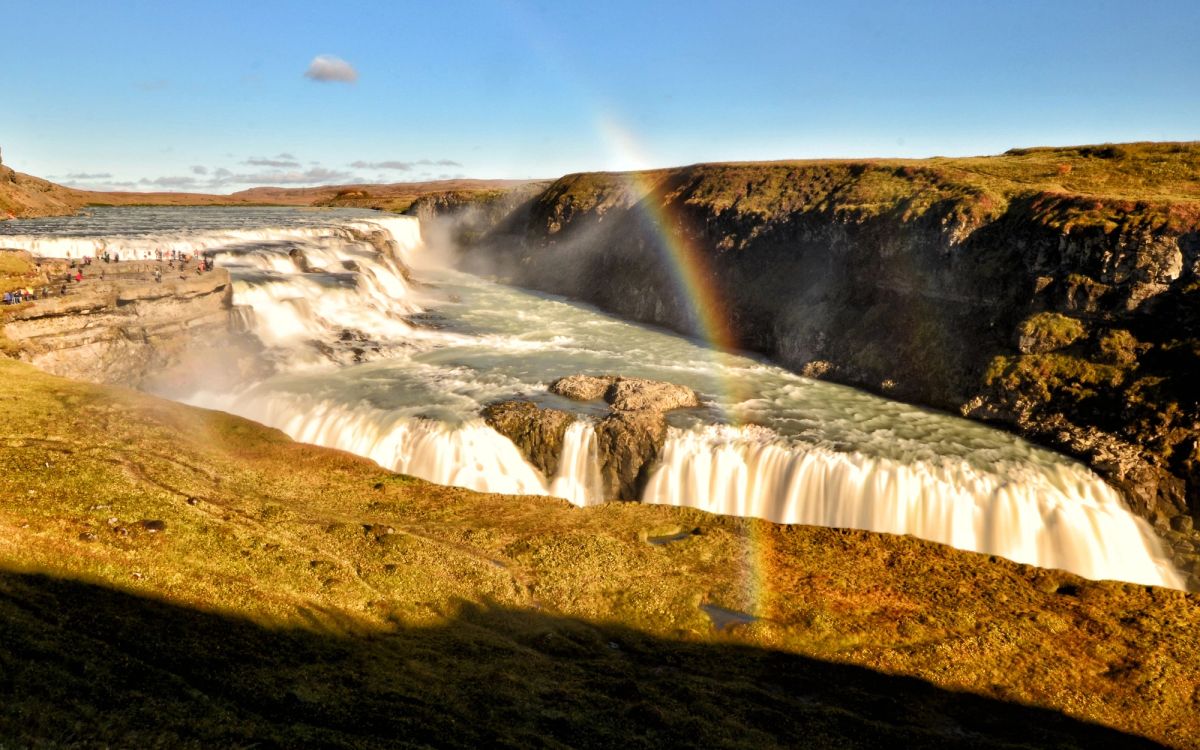
Sun and spray produce rainbows over the lower tier through the middle of the day.
Seeing the Sigridur Memorial
The memorial is easy to miss, which is a shame, because it takes two minutes to find.
A stone bearing her portrait in relief stands on the slope above the upper car park, close to the visitor centre. It was carved by the sculptor Ríkarður Jónsson, whose work also fills a museum in Djúpivogur.
From the upper viewpoint the memorial faces out over the canyon towards Brattholt, which is the farm she was defending.
Allow 45 minutes to an hour at Gullfoss overall. That covers the upper viewpoint, the path down to the lower platform beside the first tier, the memorial and the visitor centre.
The lower path closes in ice and high water, and it gets thoroughly soaked in spray on a windy day, so waterproofs are worth having.
Our classic Golden Circle tour allows time at both viewpoints rather than the fifteen minutes larger coaches manage.
Visiting Gullfoss Today
A few practical points, since the site has changed since Sigríður's paths.
Entry is free and there is no charge for parking, which is unusual among major Icelandic sites.
The visitor centre has a café, toilets and a shop, and it is the last reliable stop before the highland road north.
Gullfoss sits at the far end of the Golden Circle from Reykjavík, so most itineraries reach it after Þingvellir and Geysir. Our guide to what the Golden Circle covers sets out the full loop.
Summer brings the crowds, and the upper viewpoint is busiest between eleven and three when the coach itineraries converge. Arriving before ten or after four changes the experience considerably.
Winter transforms the canyon, with ice forming along the rim and the spray freezing on the railings. Access to the lower path is often closed then, and our guide to Gullfoss in winter covers what the site is like in the cold months.
Daylight is the other winter constraint. In late December the sun clears the horizon for barely four hours, so a Golden Circle day starts and finishes in the dark.
Road conditions on Route 35 are published by SafeTravel and worth checking between October and April, since this is the last stretch before the highlands.
Stand Where She Stood
Gullfoss is the reason the Golden Circle carries its name, and the story above the canyon is what makes the viewpoint worth more than a photograph. Our small-group Golden Circle tour with Kerið and Friðheimar keeps groups under twenty and gives you enough time at Gullfoss to walk down to the lower platform and find the memorial. Ask your guide about Brattholt and you will get the longer version of the story.
Compare Golden Circle Tours
Check each selected product for its current operator, guide, itinerary, meeting point, and terms.
View Our Tours

