Golden Circle Day Tours
Can you see the Northern Lights from Reykjavik?

Can you see the Northern Lights from Reykjavik?

Yes — you can see the aurora from Reykjavik on strong, clear nights. Best city spots, KP index, timing, and why a tour reaches darker skies. Honest guide.

Yes — you can see the Northern Lights from inside Reykjavik on a strong, clear night, and Grótta lighthouse (about 15 minutes from the centre) is the go-to city spot. But streetlights wash out faint aurora, so driving 30–100 km to dark countryside dramatically improves your odds.

Key takeaways

  • Reykjavik sits under the auroral oval — a KP index of just 2 or higher can produce visible aurora, not the KP 7 people expect.
  • Clear skies beat a high KP. On the vedur.is cloud map, you need a white (clear) patch, not green (cloud).
  • Grótta lighthouse (~15 min) is the best dark corner inside the city; Þingvellir (~45 min) and Reykjanes (~40–50 min) are far darker.
  • Season runs late August to mid-April, with peak darkness November–January and best viewing roughly 21:00–01:00.
  • Solar Cycle 25 reached its maximum in October 2024 (NOAA) — and the years around a solar maximum historically bring more frequent and stronger displays.
  • A tour reads the forecast for you and drives to the clear-sky gap — often the difference between seeing the lights and staring at cloud.

Can you actually see the aurora from inside the city?

Yes, but only strong displays punch through Reykjavik's light pollution. A bright, active aurora is visible even from downtown; a faint green glow that would be obvious in the countryside disappears against streetlights. Head to the city's darkest edge — Grótta lighthouse on the Seltjarnarnes peninsula, about 15 minutes from the centre — where you face north over open sea with your back to the city glow. Let your eyes adjust for 15–20 minutes and check the vedur.is aurora forecast first: it gives a 0–9 activity number for around midnight plus a cloud map.

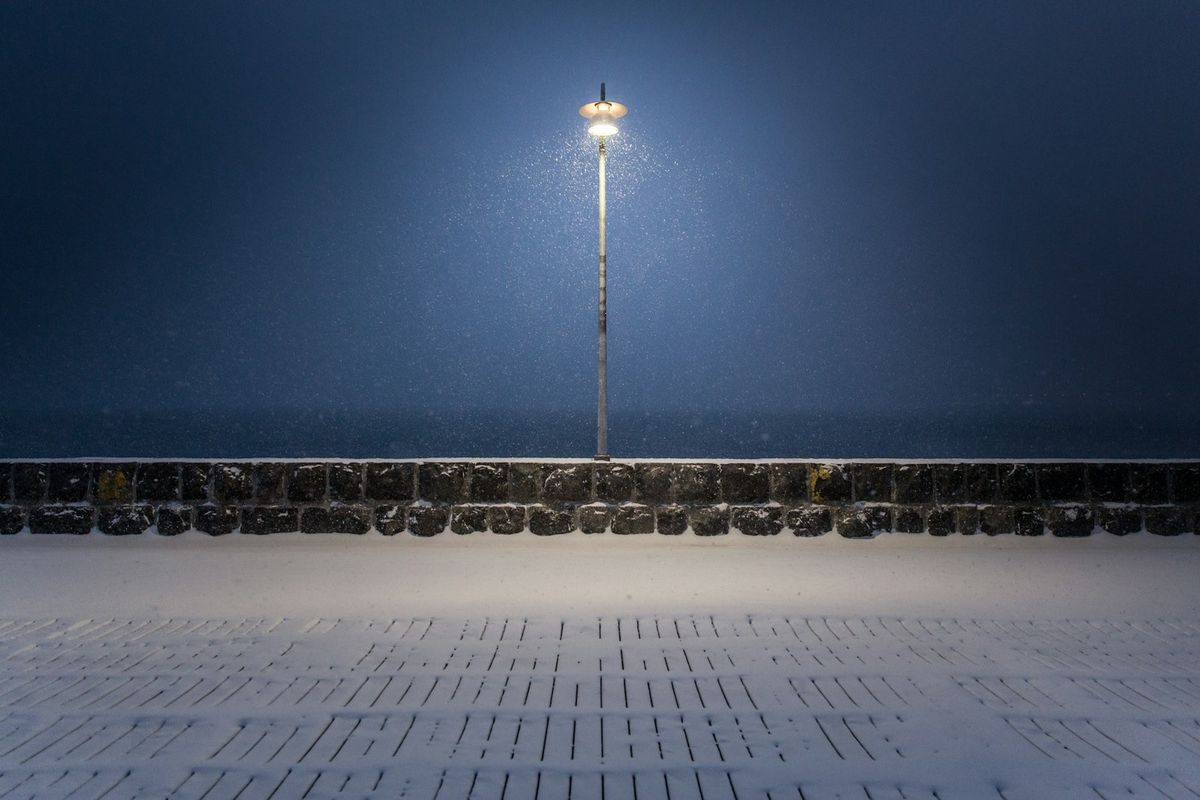
A street light on a snowy Reykjavik waterfront at night, where city light washes out the faint aurora

Where are the best dark-sky spots near Reykjavik?

Grótta is the easiest if you have no car. For genuinely dark skies, drive 30–100 km out — Þingvellir National Park and the Reykjanes peninsula both escape the city dome. Wherever you go, the goal is a white (clear) patch on the cloud map and an unobstructed view to the north.

Dark-sky aurora spots near Reykjavik
SpotDrive from centreNotes
Grótta lighthouse~15 minDarkest spot inside the city; faces north over the sea. Reachable without a car.
Þingvellir National Park~45 minGenuinely dark skies, wide open horizons; UNESCO site on the Golden Circle.
Reykjanes peninsula~40–50 minLava fields and coastline with minimal light pollution; flexible if cloud sits over one area.

When is the best time to see the Northern Lights from Reykjavik?

Aurora season runs late August to mid-April, when nights are dark enough. Peak darkness is November–January, and the best hours are roughly 21:00–01:00. Summer is out — the sky never gets fully dark. Solar Cycle 25 reached its maximum in October 2024 (NOAA), and the years around a solar maximum historically bring more frequent and stronger displays. See our best time to see the Northern Lights guide for a month-by-month breakdown.

What KP index do you need in Reykjavik?

Because Iceland sits directly under the auroral oval, a KP index of 2 or higher is enough to see the lights — you do not need KP 7. Clear skies matter far more than a high KP number. A KP 5 under thick cloud shows you nothing; a KP 2 under clear skies over Grótta or Þingvellir can be beautiful. On the vedur.is forecast, read the cloud map first (white = clear, green = cloud), then the activity number. A bright or full moon washes out only faint aurora, not strong displays.

Tour vs self-drive from Reykjavik: which is better?

Both work — the honest trade-off is convenience and skill versus cost. Self-drive gives you total freedom and is cheaper if you already have a rental car, but you have to read the aurora and cloud forecasts yourself, pick the right spot, and drive dark rural roads (often icy in winter) after a long day.

A guided tour exists to solve exactly that. Our guides check the real-time aurora and cloud forecasts every evening and drive 30–100 km from Reykjavik to wherever the sky is clearest — chasing the gap in the clouds instead of gambling on one fixed spot. You watch the road; they watch the KP. Every Golden Circle Day Tours departure also includes evening hotel pickup (~21:00), free cancellation up to 24 hours before, and a free re-try — if the lights don't appear, you rebook any evening during your stay at no extra cost (a re-try, not a cash refund). Sightings are never guaranteed by anyone: they depend on solar activity plus clear skies.

Which tour is right for me?

  • Small-group minibus (max 19 guests) — hot chocolate and Icelandic snacks, free professional photos, and a guide who helps you dial in your camera or phone settings. The sweet spot for most travellers.
  • Private tour — your own vehicle and schedule, ideal for families or photographers who want to linger.
  • Large coach — the budget option (up to ~50 seats), same forecast-driven chase for less.

Still deciding? Compare them in which Northern Lights tour to choose, and see the full Northern Lights hub or the tour FAQ.

What should I bring, and how do I photograph it?

You stand still outside for 1–2 hours and temperatures can drop below −10°C, so wind chill is the real enemy. Dress in warm layers, windproof outer shell, hat, gloves, and insulated boots — see what to wear for the Northern Lights.

For a camera, shoot manual: aperture as wide as possible (~f/2.8), ISO 1600–3200, shutter 5–15 seconds (shorter when the aurora is moving), manual focus at infinity, on a tripod, in RAW. For a phone, use Night mode 10–30 seconds on a tripod or steady surface, the rear 1× lens, flash off, and the timer to avoid shake. Full walkthrough: Northern Lights photography settings.

Frequently Asked Questions