
Can You Do the Golden Circle and Silfra in One Day?
Yes, and the two fit together better than any other combination on the route, because Silfra is inside Þingvellir National Park, the first stop on the loop. A combined day runs 9 to 10 hours: a 30 to 40 minute snorkel, the rest of Þingvellir, then Geysir and Gullfoss.
The snorkel itself is shorter than people expect. You spend around 40 minutes in the water and about the same again getting into and out of a dry suit, so the whole Silfra element takes roughly two hours of your day.
That leaves plenty of room for the standard loop. What it does not leave room for is a leisurely lunch and four extra stops, so plan a focused day rather than an ambitious one.
What Silfra Actually Is
Silfra is a flooded crack in the lava field on the north shore of Þingvallavatn, Iceland's largest natural lake. The rock split as the ground pulled apart, and groundwater filled the gap. The whole valley has been on the UNESCO World Heritage List since 2004.
You float through connected sections with names: Silfra Big Crack, Silfra Hall, Silfra Cathedral and Silfra Lagoon. The Cathedral is the one people remember, a straight corridor about 100 metres long with walls dropping away on both sides.
Where the water comes from
The water is glacial meltwater from the Langjökull ice cap, roughly 50 kilometres north. It travels underground through porous lava for decades before surfacing at Silfra, and that journey is what filters it.
The result is water clean enough to drink while you are swimming in it, and guides encourage you to try. There are no plankton, no algae bloom and no silt in suspension, which is what gives the fissure its visibility of up to 100 metres.
Which tectonic plates are you actually between
Almost every article says Silfra sits between the North American and Eurasian plates. The park's own account is more precise: Þingvellir National Park's nature pages describe Silfra as a fissure separating the North American plate and the Hreppar microplate, a smaller block wedged between the two main plates.
That does not make the experience less remarkable. You are still floating in a rift that opens because Iceland is being pulled apart, and the walls on either side of you belong to different pieces of the earth's crust.
The rift widens by roughly two centimetres a year across the wider Þingvellir zone. Earthquakes crack the rock open in steps rather than smoothly, which is why the fissure has ledges, overhangs and sudden drops rather than parallel walls.
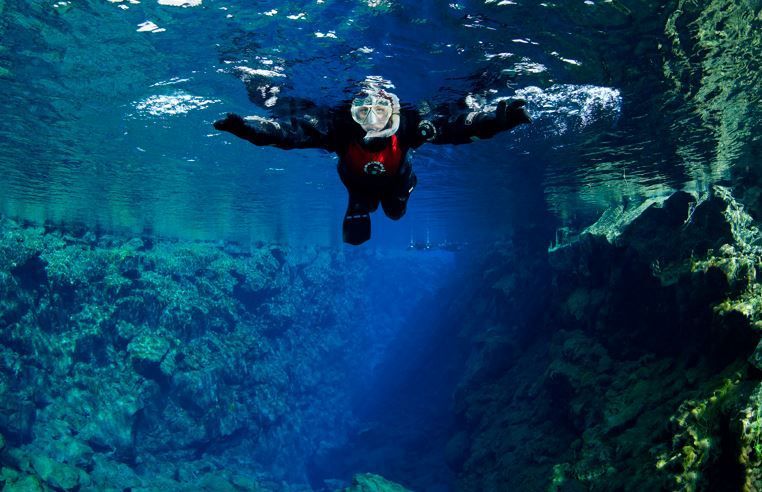
Visibility in Silfra reaches around 100 metres, which is what makes the walls look closer than they are.
What You Actually See Underwater
There is almost no life in Silfra, and that absence is the point. No fish to speak of, no kelp, no plankton clouding the water, which is exactly why you can see 100 metres down a corridor.
What you do see is rock and colour. The walls are basalt in browns, blacks and rust reds, cut into ledges and blocks by the earthquakes that opened the fissure, and the water turns them progressively bluer with depth.
The one living thing is troll hair, a bright green filamentous algae growing in tufts on the rock in the shallower sections. In the Cathedral it catches the light from above and glows against the dark stone.
Look up as well as down. The surface from below reads as a shifting mirror, and the split view where the mask sits half in and half out of the water is the shot everyone tries to get.
How Cold Is Silfra, Really?
The water sits at 2 to 4°C year-round, a figure Þingvellir National Park states in its diving rules. It does not warm up in July or freeze in January, because it arrives from underground at a constant temperature.
Your body stays dry and warm. The dry suit seals at the neck and wrists and traps air around thermal layers, so the cold only reaches the parts left exposed.
Those parts are your face and, to a lesser extent, your hands. The first 30 seconds of face-in-the-water is a shock, and then your skin adjusts and you stop noticing.
Most people finish comfortable and a few finish cold, usually the ones who wore cotton under the suit or arrived already chilled. If you run cold generally, wear an extra wool layer and eat before you go.
What the Session Actually Involves
A Silfra snorkel is a structured 2 to 2.5 hours, and only part of it is in the water.
Suiting up
You arrive at the car park, meet the guide and get fitted with a thermal undersuit, then the dry suit, hood, gloves, mask and fins. This takes 30 to 40 minutes for a group and involves being zipped, squeezed and told to wriggle.
The neck seal is tight by design. It has to be, because it is what keeps the water out, and guides adjust it rather than loosening it.
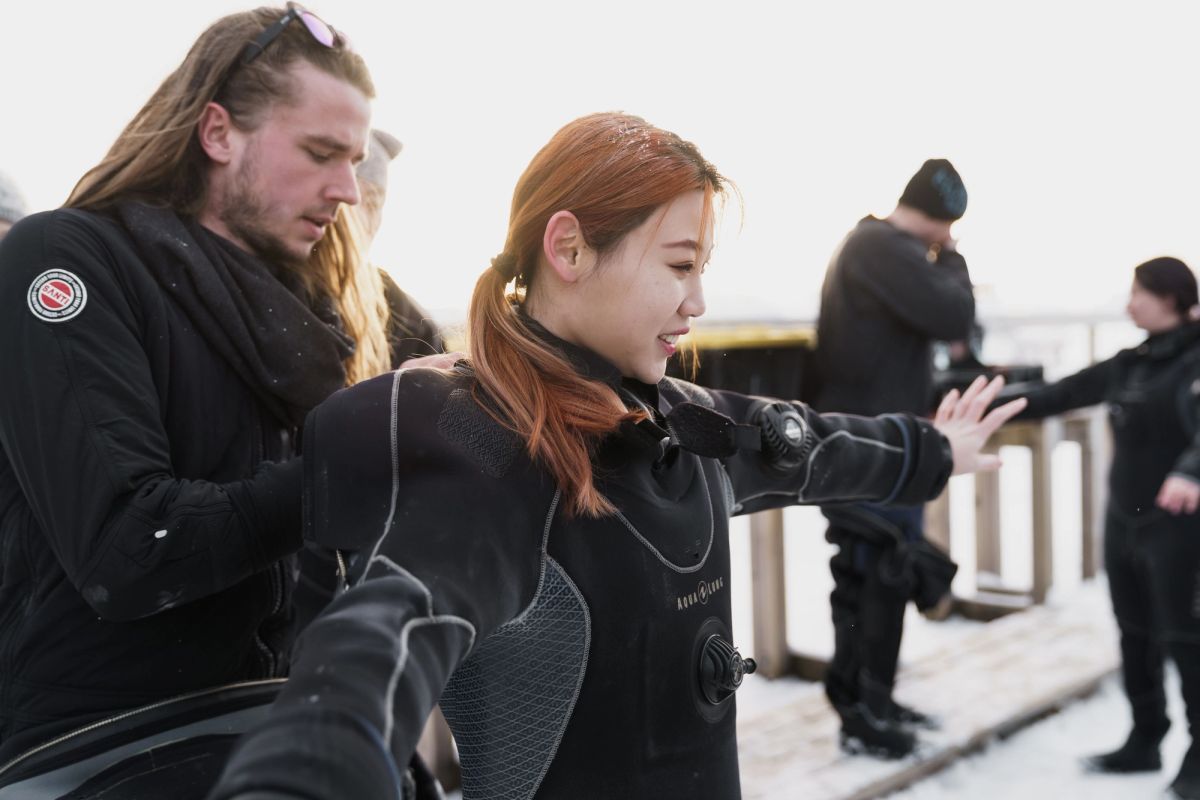
Getting into the dry suit takes longer than the swim, and the neck seal is deliberately snug.
In the water
You enter down a metal staircase into the Big Crack and float downstream with a gentle current doing most of the work. The route runs about 300 metres through the Silfra fissure to the Lagoon.
Snorkelling here means floating face-down and looking, rather than swimming. The dry suit makes you buoyant, your arms stay at your sides, and the guide leads from the front while a second guide follows.
Time in the water is 30 to 45 minutes depending on group speed and conditions. It feels shorter, and everyone says so afterwards.
Getting out
You exit up steps at the Lagoon and walk 200 metres back to the car park in your suit, which is the coldest part of the whole thing if there is wind. Hot chocolate and biscuits are standard at the end.
Then you peel out of the suit, which is easier than getting into it, and change into your own clothes. Bring a warm hat for afterwards, because your head will be wet.
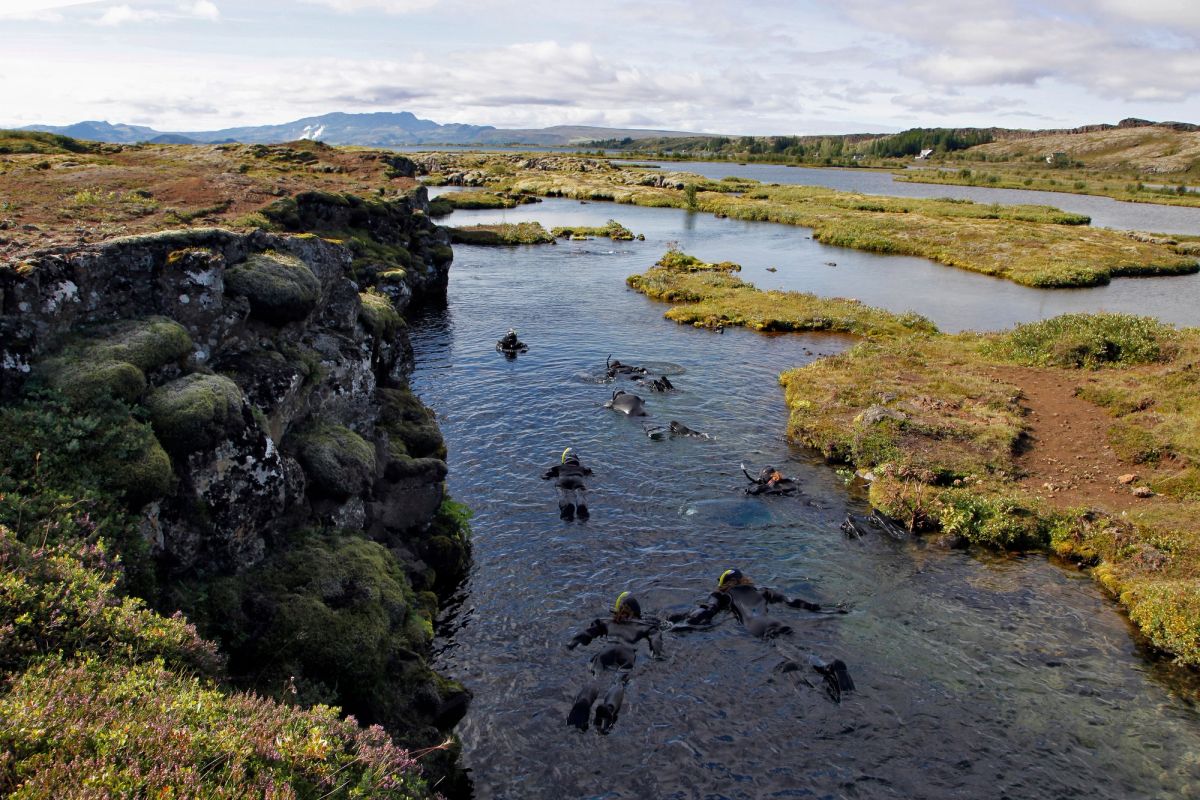
The exit steps at Silfra Lagoon, about 300 metres downstream from where you entered.
Requirements: Age, Size, Swimming and Health
Operators apply the same core rules, set by insurance and by the equipment rather than by preference.
- Minimum age is usually 12 to 14, and 16 for diving. Under-18s need a parent or guardian to sign.
- Height and weight limits exist because the dry suit has to seal. Roughly 145 cm to 200 cm and 45 kg to 120 kg is typical.
- You must be able to swim and be comfortable with your face in water. You do not need any snorkelling experience.
- A medical form asks about heart conditions, asthma, epilepsy, recent surgery and pregnancy. Answer it honestly rather than optimistically.
- Anyone over 45 with a history of heart or lung trouble may need a doctor's note, which takes time to arrange from abroad.
The one rule people forget is alcohol. Turning up hungover is a genuine problem in cold water, and operators will refuse anyone who has been drinking.
Diving vs Snorkelling at Silfra
Snorkelling suits almost everyone. Diving is a different booking with real prerequisites, and the park sets them out clearly.
Divers need a certification equivalent to Autonomous Diver or Open Water plus a dry suit certificate, or proof of 10 registered dry suit dives in the past two years. The maximum depth is 18 metres, entering caves or overhead environments is prohibited, and nobody may enter Silfra alone.
What you gain by diving is depth and the vertical scale of the walls. What you gain by snorkelling is the light, since the brightest, bluest part of Silfra is the top three metres, which is exactly where a snorkeller floats.
For a one-day Golden Circle combination, snorkelling is the right call. Diving takes longer, costs more and needs paperwork you probably do not have with you.
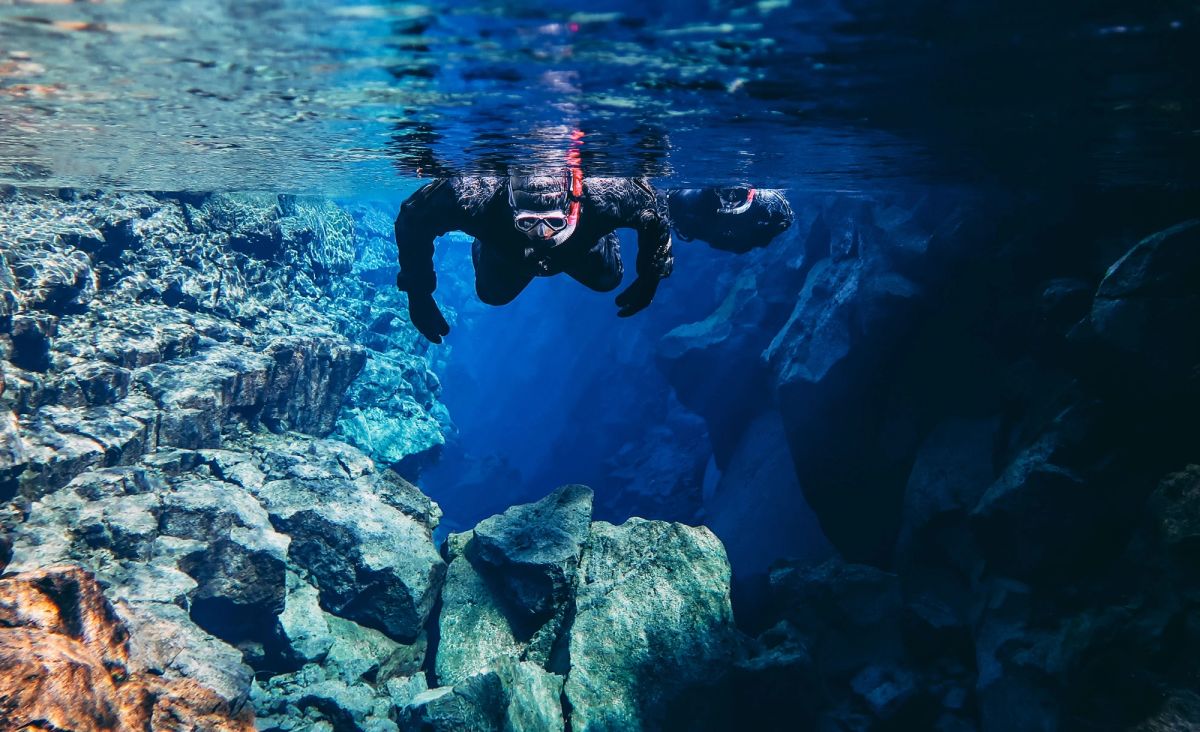
Diving reaches deeper into the fissure, though the strongest light and colour sit near the surface.
Fitting Silfra Into a Golden Circle Day
There are two workable versions, and one of them is much less stressful than the other.
The combined tour
A single booking that includes both is the simplest approach. The combined day runs 9 to 10 hours for 48,990 ISK with a maximum of 6 guests, covering the snorkel, the three main sites and lunch at the Friðheimar tomato farm.
Everything is timed by people who do it daily. Your snorkel slot, your drive times and the gear are all handled, and you are not the one watching a clock at Gullfoss.
Doing it yourself
Book a meet-on-location Silfra snorkelling slot, drive to Þingvellir, snorkel, then continue round the loop in your own car. This is cheaper and gives you control of the rest of the day.
Give yourself margin. Arrive 15 minutes before your slot and allow a full 2.5 hours at Silfra before you plan anything else.
Parking at Þingvellir costs 1,000 ISK for a car under the park's published rates, payable at the machine or online, and the fee covers all three car parks for the day.
Morning or afternoon slot
Take the morning slot if you can. You get the water at its quietest, you are dry and warm for the rest of the day, and Geysir and Gullfoss fall into the afternoon when a coach crowd is thinning.
An afternoon slot works in summer, when light runs late enough to do Gullfoss at 7pm. In December it does not work at all, because you would be driving the loop in the dark afterwards.
What to Wear and Bring
The gear is provided. What you wear underneath decides how the session feels.
Wear thermal base layers, top and bottom, in wool or synthetic. Add a fleece mid-layer and thick wool socks, and skip cotton entirely, since it holds moisture and stops insulating the moment you sweat inside the suit.
Bring a towel, a warm hat and a full change of clothes. Your hair will be wet, the car park is exposed, and you have a whole Golden Circle day still ahead of you.
Leave jewellery in the car. Rings and watches catch on the wrist seals, and long nails can tear them, which ends your session before it starts.
What Silfra Snorkelling Costs
Prices below are current, in Icelandic krónur, and cover the whole day where noted.
- Silfra snorkelling, meet on location: the cheapest option, and you drive yourself to Þingvellir
- Silfra snorkelling with Reykjavík pickup: adds transfer both ways
- Golden Circle with Silfra snorkelling and Friðheimar, 9 to 10 hours: 48,990 ISK per person, up to 6 guests
- Þingvellir parking if you self-drive: 1,000 ISK per car
- Underwater photos: usually included, and worth confirming when you book
Compare that with a standard Golden Circle coach day at 13,152 ISK and the snorkel is clearly the expensive part. It is also the part you will still be describing to people a year later.
Silfra in Summer and in Winter
The water does not change. Everything around it does.
Summer gives you long light, a warm walk back to the car park and green moss on the lava. It is also the busy season, and slots fill weeks ahead in July.
Winter gives you snow on the rim of the fissure, far fewer people, and a genuinely striking contrast between the blue water and the white lava field. The walk from the exit to the car park in a wet hood at 3°C below zero is the price.
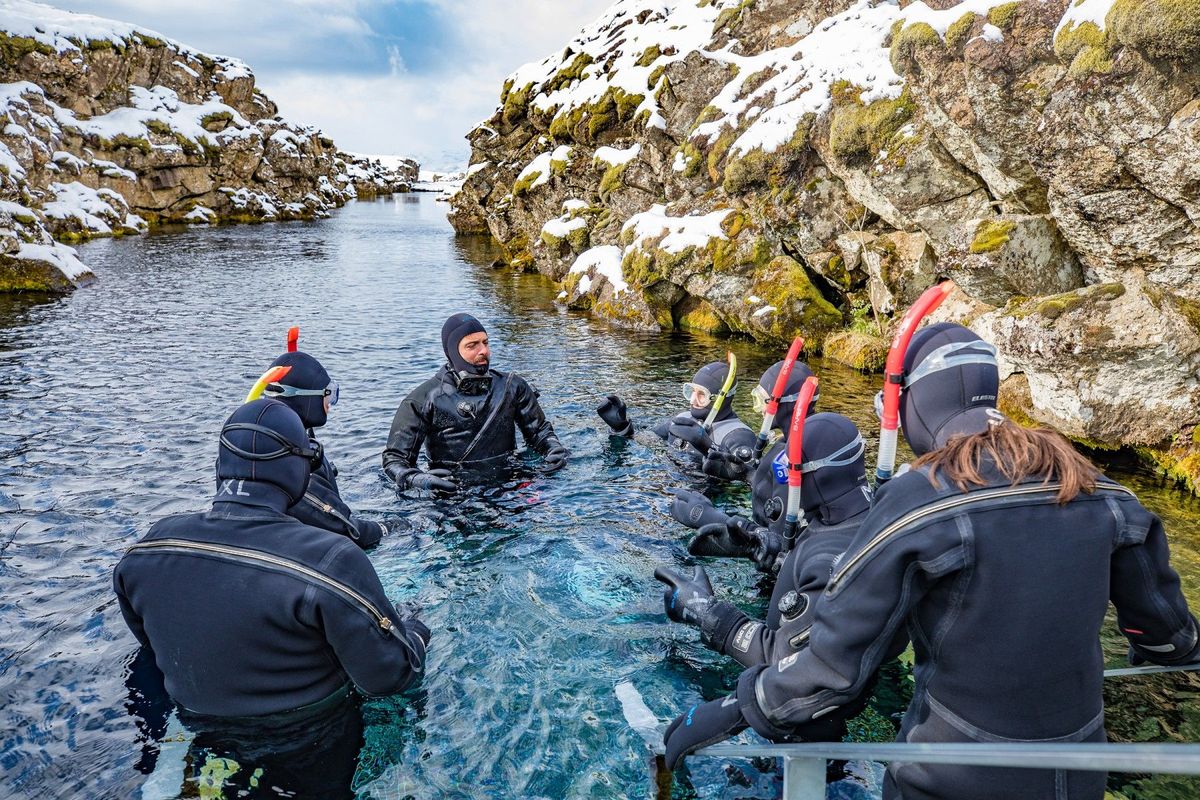
Winter sessions run all season. The water stays 2 to 4°C whatever the air is doing.
Weather cancels sessions occasionally. High wind makes the entry platform dangerous, and operators call it off rather than risk it, so keep a flexible half-day in your plan.
Safety and the Rules That Matter
The national park sets the rules and the operators enforce them, which is why the site has a good safety record despite being cold water in a remote-feeling valley.
You may never enter Silfra alone, and every group swims with a guide who counts heads at each section. Overhead environments are off limits, and the marked route avoids them entirely.
Fresh water is less buoyant than sea water, which matters if you have snorkelled in the Mediterranean and expect to bob. The dry suit compensates, and the guide will trim your buoyancy before you set off.
Stay off the moss on the walk in and out. The lava field either side of the path takes decades to recover, and the boardwalks exist for that reason as much as for your footing.
Mistakes People Make
Booking the snorkel for their last morning in Iceland. If wind cancels the session there is no second chance, and refunds do not buy the experience back.
Wearing cotton under the thermal layers. It absorbs the sweat you generate while suiting up, then chills you for the whole swim.
Skipping breakfast. Cold water burns energy fast, and an empty stomach is the most common reason someone gets cold halfway through.
Bringing a phone in a cheap waterproof pouch. The guide's camera is better, the photos are usually included, and pouches leak at the exact moment you would rather they did not.
Underestimating the walk. The 200 metres back from the Lagoon exit in a wet hood is the coldest part of the day, and a hat waiting in the car fixes it entirely.
Is Silfra Worth It?
For most people, yes. There are few places where you can float in water that clean, between walls that geology pulled apart, 45 minutes from a capital city.
It is worth less if you dislike cold water, get claustrophobic in tight gear, or are travelling with children under 12 who cannot join. In those cases the loop on its own is the better day.
If you are on the fence, the deciding question is whether you want an experience or a view. Silfra is the only stop on the Golden Circle where you are in the landscape rather than looking at it.
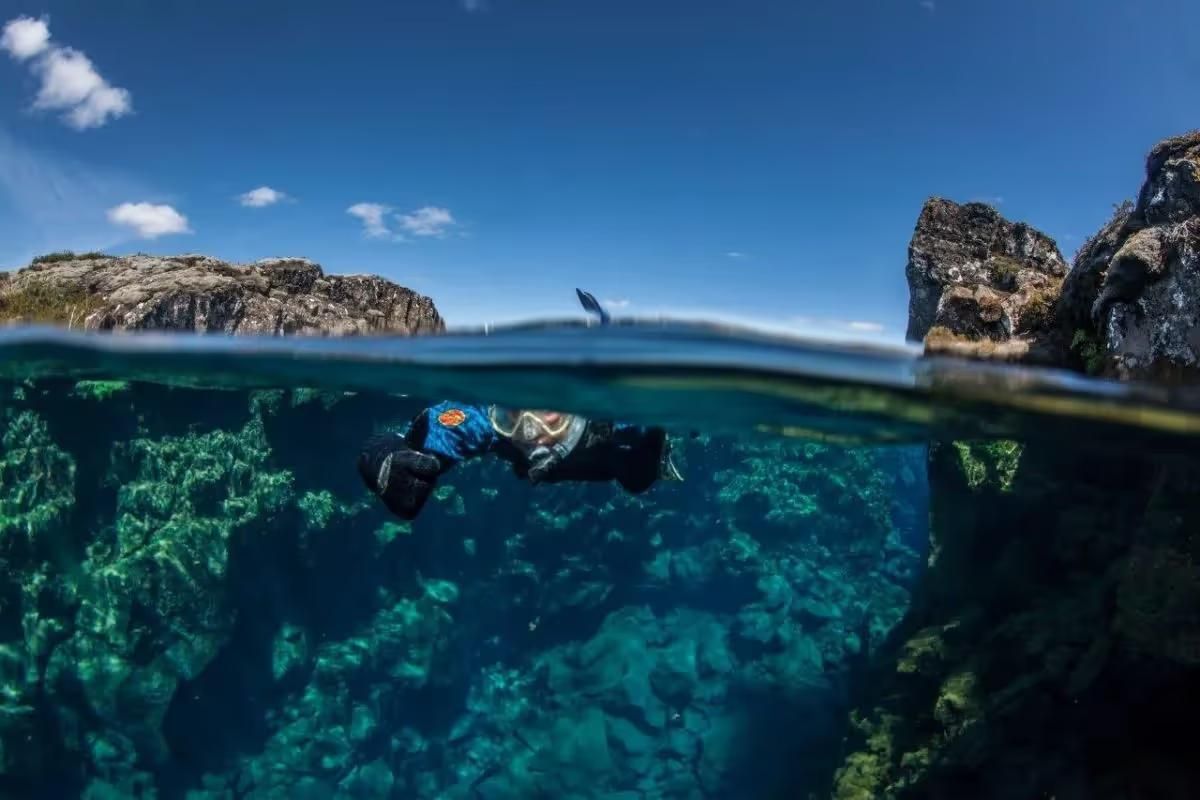
The surface line at Silfra, where the water is clear enough that the boundary is hard to see.
Book the Snorkel and the Loop Together
If you want both halves of this day without managing two bookings and a stopwatch, the combined departure is the easy answer. Our Golden Circle with Silfra snorkelling and the Friðheimar greenhouse keeps the group to six, includes all the dry suit gear, and still gets you to Gullfoss with time to walk both viewpoints.
Check the health and size requirements before you book, since those are the only things that cannot be sorted out on the day.
Compare Golden Circle Tours
Check each selected product for its current operator, guide, itinerary, meeting point, and terms.
View Our Tours

