
What Does Foss Mean in Icelandic?
Waterfall. That is the whole answer, and it unlocks a large part of the Icelandic map.
Gullfoss, Skógafoss, Seljalandsfoss, Dettifoss, Goðafoss, Öxarárfoss and dozens more all end in the same word. The bit in front tells you which waterfall.
The plural is fossar, which appears in names like Hraunfossar, the lava falls.
Pronouncing it is easy: foss rhymes with boss.
Why Iceland Has So Many
Three things combine, and they are all still happening.
Glaciers cover around a tenth of the country and produce enormous volumes of meltwater every summer.
Rainfall is high, particularly in the south, where September is the wettest month on the Golden Circle route at 147 mm according to Met Office climate data.
The geology does the rest. Layers of hard lava over softer sediment erode at different rates, which is exactly what produces a waterfall.
Iceland is also geologically young, so the rivers have not had time to smooth out their profiles. Our piece on how Gullfoss was formed explains the mechanism in detail.
The result is a country where a waterfall is rarely more than twenty minutes away.
How to Pronounce Icelandic Names
Six rules cover almost everything, and none of them is difficult.
Þ, called thorn, is the th in thing. Þingvellir starts like thing.
Ð, called eth, is the th in the. Goðafoss has that sound in the middle.
Double L is not an L sound. It comes out closer to a tl, which is why Þingvellir sounds like THING-vet-lir and Seljalandsfoss has a tl in it.
Á is an ow sound as in cow. Hvítá is roughly KVEE-tow.
Hv at the start is pronounced kv. Hvítá again, and Hveragerði.
Ö is the vowel in the English word bird, without the r. Öxarárfoss starts with it.
Nobody expects a visitor to get these right. Icelanders are used to it, and an attempt is appreciated more than an avoidance.
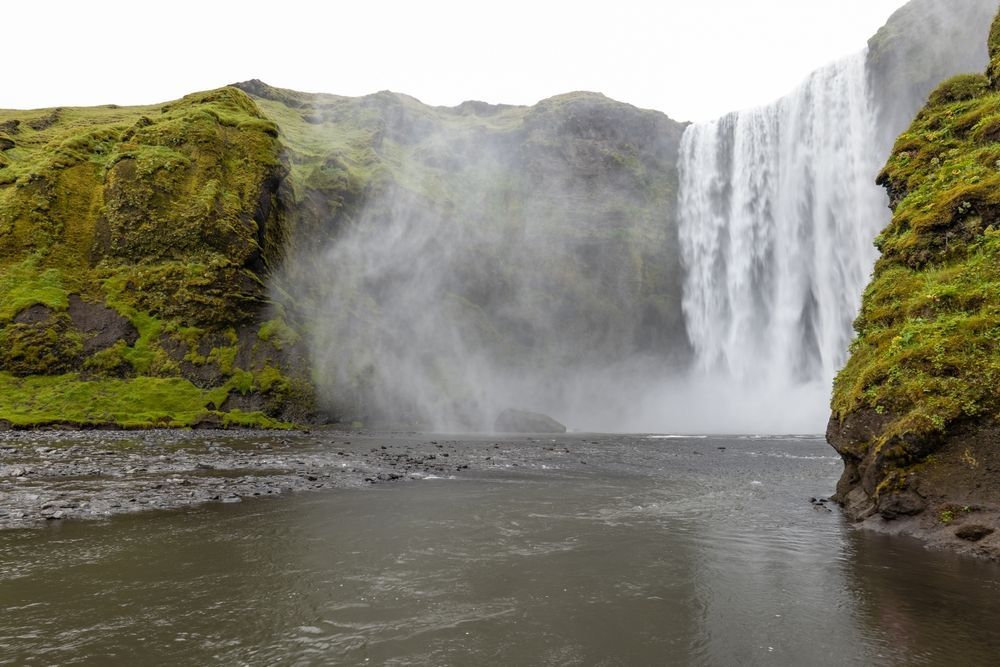
Skógafoss means forest falls, from skógur, and the trees are long gone.
What the Famous Names Mean
Ten waterfalls, and the names are more descriptive than poetic.
Gullfoss means golden falls, from the ochre cast the glacial sediment gives the water in low sun.
Skógafoss means forest falls, from skógur, though the forest that named it is long gone.
Seljalandsfoss takes its name from the Seljaland farm and river beside it, meaning something close to pasture land falls.
Goðafoss means waterfall of the gods, from the story that the lawspeaker threw his pagan idols into it after Iceland's conversion around the year 1000.
Dettifoss means the falling or collapsing one, which suits Europe's most powerful waterfall by volume.
Öxarárfoss is the falls of the Öxará, the axe river, inside Þingvellir National Park.
Brúarfoss means bridge falls, after a natural stone arch that once spanned the river.
Svartifoss means black falls, for the basalt columns behind it.
Háifoss means high falls, at 122 metres one of the tallest in the country.
Faxi means mane, describing water fanning across a wide ledge like a horse's mane in wind.
The Golden Circle Waterfalls
Four within an hour of each other, and they are genuinely different.
Gullfoss is the headline, dropping 11 metres then 20 into a canyon 70 metres deep, with an average flow of 109 cubic metres per second according to the Environment Agency of Iceland.
The canyon below it runs about 2.5 kilometres, and it records where the waterfall used to stand.
Öxarárfoss sits inside Þingvellir, dropping about 13 metres over the rift wall, reached by a short boardwalk. Our guide to Öxarárfoss covers the route.
Faxi is wide and low with a salmon ladder up one side and a car park at the edge, and almost no coach stops there.
Brúarfoss is the bluest water in the region, five minutes from a paid car park, and our guide to the Brúarfoss walk covers the access.
Together they cover the range: enormous, historic, quiet and colourful.
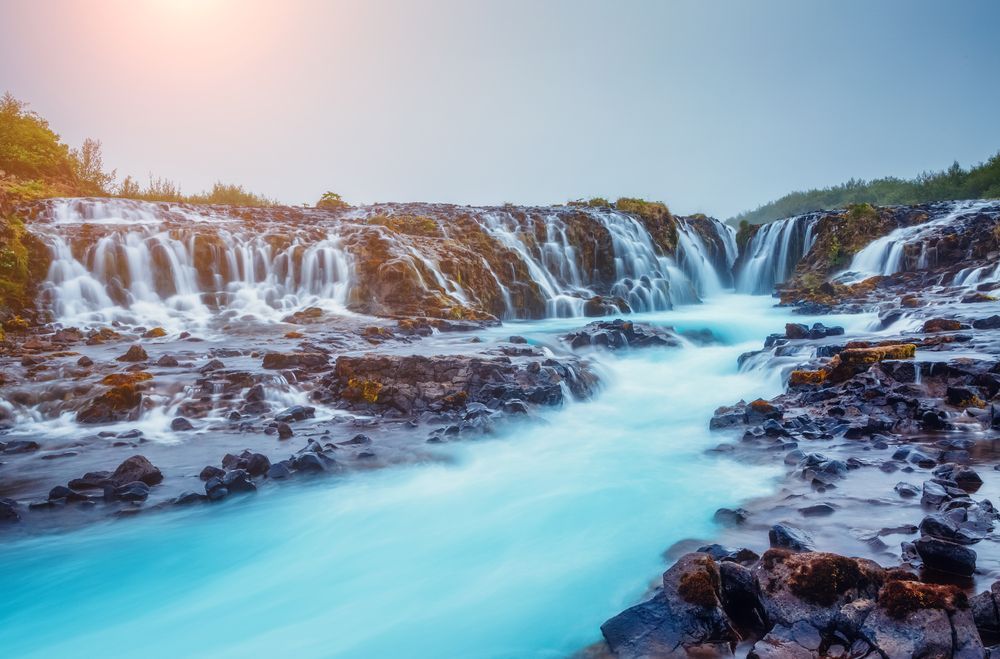
Brúarfoss means bridge falls, after a stone arch that no longer exists.
Visiting Waterfalls Safely
Six points, and the first two account for most incidents.
Stay behind the barriers. Wet basalt is extremely slippery and the edges are undercut in places.
Spray freezes in winter, turning paths and railings into ice. Traction spikes over your boots solve it and cost very little.
Never climb on rocks above or beside a fall. Icelandic rivers are cold, fast and unforgiving.
Wind at waterfalls is stronger than in the car park, because the water and the terrain funnel it.
Waterproofs matter more than a coat. Spray at Gullfoss and Skógafoss will soak you from the side.
Check road conditions before setting out at umferdin.is, particularly between October and April.
Photographing Them
Four practical points.
Overcast is better than bright sun. Flat light suits dark basalt and white water, and Iceland provides plenty of it.
Rainbows appear at Gullfoss and Skógafoss through the middle of the day when the sun is out, produced by spray rather than rain.
Bring a cloth. Spray on the front element ruins more Icelandic waterfall photographs than anything else.
Wide angles rarely convey scale. Putting a person in the frame does it better than any lens choice.
Beyond the Golden Circle
Five worth the drive, if you have the days.
Seljalandsfoss on the south coast, where a path runs behind the curtain of water.
Skógafoss, 30 minutes further, dropping 60 metres in a wide sheet with a staircase to the top.
Svartifoss in Skaftafell, framed by hexagonal basalt columns, reached by a 45 minute walk.
Dettifoss in the north-east, Europe's most powerful waterfall by volume and reached on a long drive.
Dynjandi in the Westfjords, a fan-shaped cascade dropping about 100 metres in steps, and worth the remote road it sits on.
Our guide to how many days you need in Iceland covers what each trip length reaches.
The Short Version
Foss means waterfall, fossar means waterfalls, and the word in front is the description.
Þ is th as in thing, ð is th as in the, and double L sounds like tl.
Four good waterfalls sit within an hour on the Golden Circle, and Gullfoss is the one everybody comes for.
Stay behind the barriers, bring waterproofs and put spikes in your bag between October and April.
See Four of Them in One Day
The Golden Circle has more waterfalls on it than most itineraries stop at, and the quiet ones are usually the ones people describe afterwards. Our small-group Golden Circle tour with Kerið and Friðheimar keeps groups under twenty and has the flexibility to add a short stop when the timing allows. Tell us your dates and we will find you a departure.
Compare Golden Circle Tours
Check each selected product for its current operator, guide, itinerary, meeting point, and terms.
View Our Tours