
Yes. The aurora season opens in September, once the nights have grown dark enough to reveal displays that have been happening invisibly all summer. From the first week of the month there is genuine darkness after about 10pm, and by the end of September it arrives closer to 8:30pm.
September also sits beside the autumn equinox, which historically brings more geomagnetically disturbed nights than the months either side. That combination of returning darkness and rising activity is why the season is generally said to start here.
The honest counterweight is weather. On measured averages, September is the cloudiest month of the entire aurora season on the Golden Circle, which is the part most September guides skip.
How Dark It Gets, Week by Week
Darkness is the variable that changes fastest in September, and it changes a lot.
In the first week, full darkness starts around 10:15pm and ends near 5am, giving roughly six usable hours. Early September is genuinely marginal, and the very first days of the month are better for a late sunset than an aurora.
By mid-September, darkness begins around 9:15pm and runs about eight hours.
By the last week, it starts near 8:30pm and gives close to ten hours. Late September is a proper aurora month.
The Icelandic Met Office aurora forecast publishes exact sunset, darkness and moon times for Reykjavík alongside its 0 to 9 activity number, so you can check the specific night rather than working from averages.
The Weather Reality
This is where September earns a more careful answer than most articles give it.
Averaging the Met Office's monthly station data for Hjarðarland, the nearest long-running station to the Golden Circle, across 1991 to 2020 gives September a mean cloud cover of 6.4 on the 0 to 8 okta scale. That is the cloudiest month in the whole aurora window, ahead of January and February at 6.2 and well behind November at 5.8.
September is also the wettest month on the route, with 147 mm of precipitation against 78 mm in June and 113 mm in November.
What you get in exchange is comfort. Average daily highs are 11.6°C and lows 4.5°C, with mean wind of 4.0 metres per second, which makes standing outside for two hours far easier than it is in January at 4.3 below and over 5 metres per second.
So September is the mildest month to watch from and the least likely to give you a clear sky. Both things are true.
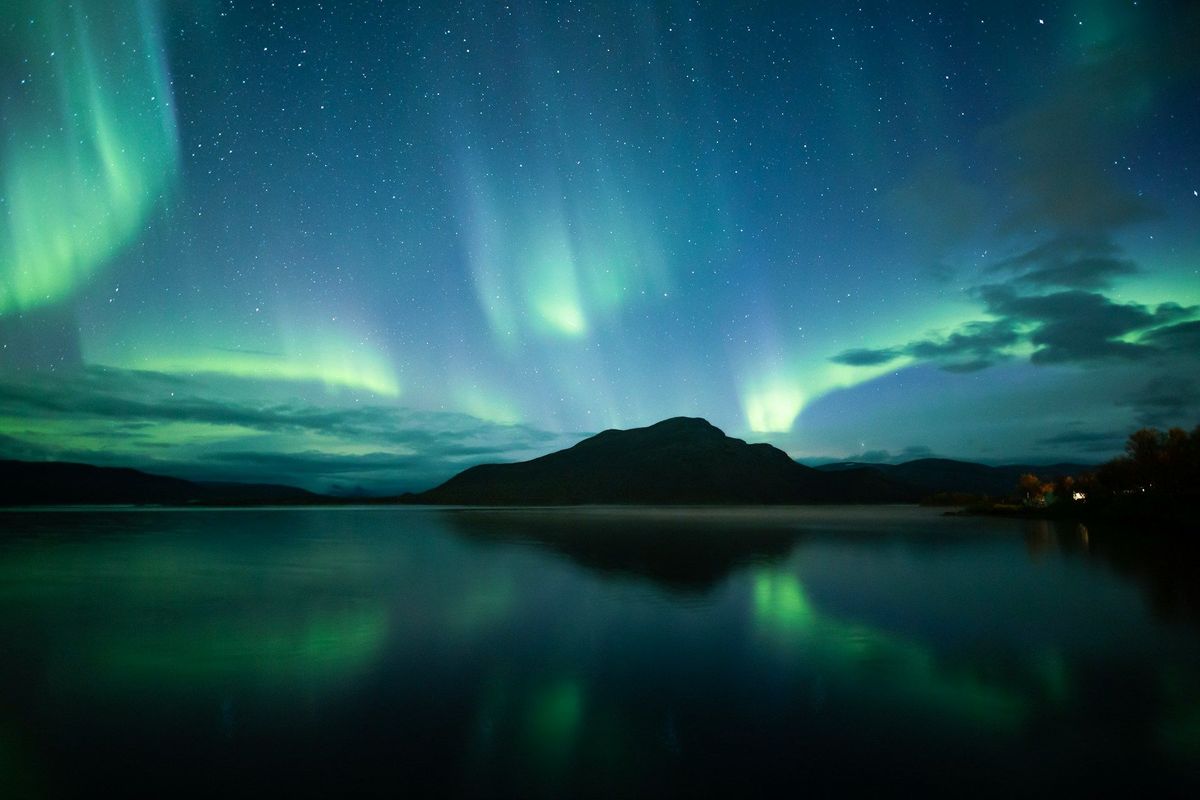
Still, mild September nights produce the best lake reflections of the season when the sky does clear.
The Equinox Effect
The September activity bump is real and it has a name.
It is called the Russell-McPherron effect. Around the equinoxes, Earth's magnetic field lines up more favourably with the solar wind's field, which makes it easier for energy to couple into the magnetosphere and trigger aurora.
The result is that geomagnetically disturbed nights cluster around late September and late March, historically at roughly twice the rate of the solstice months.
For scale, NOAA's storm scale counts around 1,700 minor G1 storms across an 11-year solar cycle, and Iceland does not need even that much, since sitting under the auroral oval means activity of 2 or 3 already produces a display overhead.
It does not override weather. An active equinox night under a solid overcast shows you nothing, which is why the cloud map remains the first thing to check.
The practical takeaway is to weight the last ten days of September over the first ten. You get more darkness and more activity at the same time.
What Else September Gives You
The month's real argument is not the aurora odds in isolation, it is everything around them.
Daylight still runs 12 to 14 hours, so you can do a full Golden Circle day and an aurora night on the same date. In December you have to choose.
Autumn colour arrives from mid-month. The birch and heath at Þingvellir turn red and gold, which is the best the rift valley looks all year.
The roads are clear. No ice, no snow, no closures, so a self-drive aurora hunt is straightforward in a way it is not from November onwards.
Prices drop after the last week of August, and the summer crowds thin noticeably from the first week of September.
September Compared With the Rest of the Season
Where it sits honestly against the other months.
Against October: October has more darkness, clearer skies at 5.9 oktas, and still-mild temperatures. October is the better aurora month on almost every measure.
Against November: November has the clearest measured skies of the season and 13 to 15 hours of darkness, at the cost of much shorter days for sightseeing.
Against December and January: those give maximum darkness and the worst reliability, with more storms and more cancellations.
Against March: March matches September's equinox activity while offering better weather and longer usable nights.
September's genuine wins are mild weather, autumn colour, clear roads and a full sightseeing day alongside the aurora. If you want the highest chance of seeing the lights and nothing else, book October or March instead.
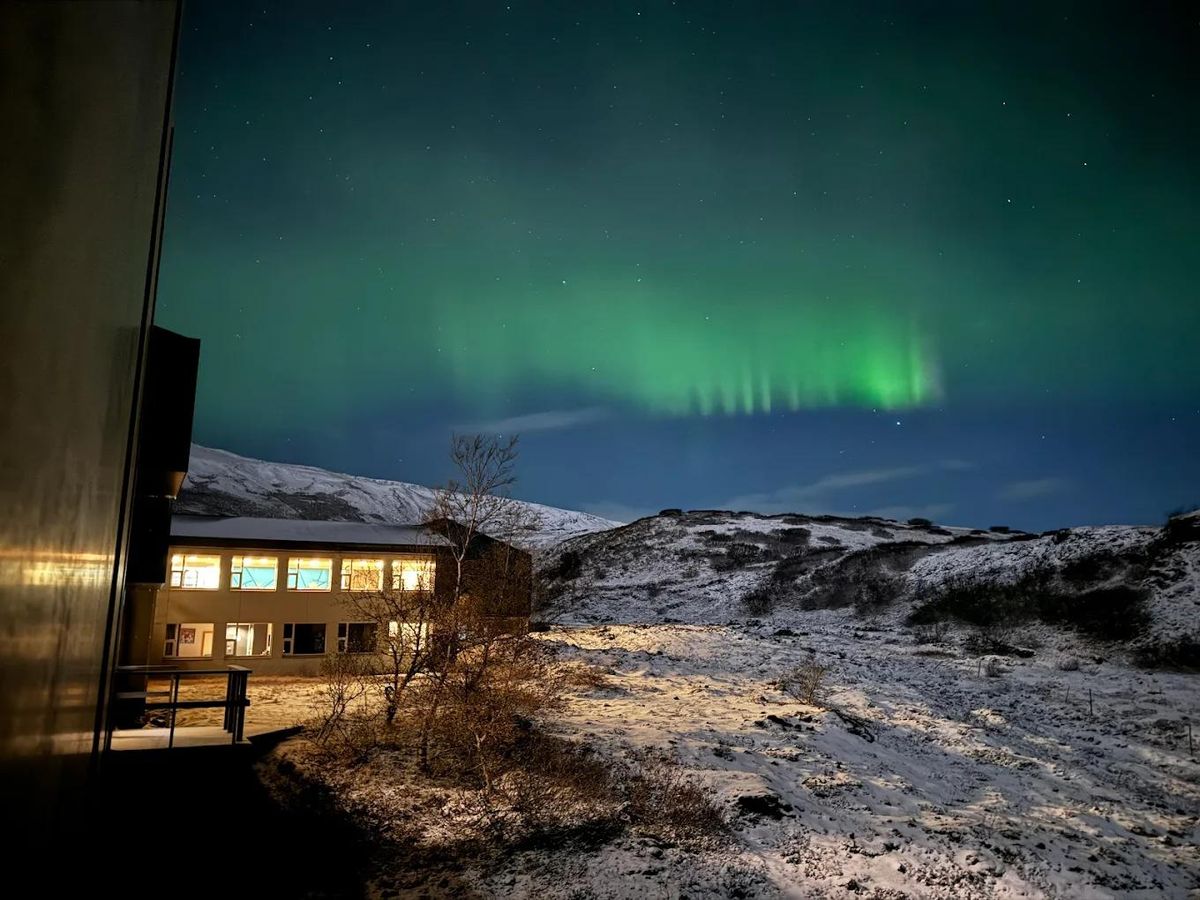
Staying outside Reykjavík removes the drive home, which matters even in a mild month like September.
Where to Watch in September
Reykjavík's light dome reaches roughly 20 kilometres, so getting past it is the first job.
Þingvellir National Park is 45 minutes from the city, dark in every direction, and its car parks stay open around the clock with machines that take cards at any hour.
Take a torch with a red mode if you go there. There is no lighting once you leave the car park and the fissures either side of the path are real.
Laugarvatn is the easiest self-drive option, with a lake for reflections and a lit car park to retreat to.
The Grímsnes farmland along Route 35 and the Reykjanes lava fields both work, and they sit in different directions, so one of them is usually clear when the other is not.
In September specifically, water is worth seeking out. Mild, still nights are more common than in midwinter, and a flat lake doubles any display.
How to Plan a September Aurora Trip
Six practical decisions that raise your odds.
Book the second half of the month. More darkness, more equinox activity, and only marginally worse weather than the first half.
Stay three or more nights. One clear active night in three is normal in Iceland, and September's cloud figures make that more true rather than less.
Keep the aurora flexible and the daytime fixed. Book your Golden Circle day for a set date and leave the evenings open, so you can go out whenever the cloud map shows a gap.
Stay outside the city for at least one night. A guesthouse on the Golden Circle removes the late drive entirely.
Dress properly anyway. September's mildness catches people out, and standing still at 4°C in wind is colder than walking at 4°C.
Check the forecast in the afternoon rather than the morning. Icelandic cloud predictions are useful about 12 hours out and rough beyond 36.
What About Late August?
The season does not begin cleanly on 1 September.
By the third week of August there is enough darkness after about 11pm for a strong display to be visible, and sightings do happen. They are short windows and they need a genuinely active night.
Before mid-August there is effectively no darkness at all, so no amount of solar activity produces a visible aurora.
If your dates are flexible around the end of August, push them later. Every week gained through September adds roughly an hour of darkness.
Combining Aurora With a Golden Circle Day
September is one of the few months where you comfortably get both in 24 hours.
A daytime loop covering Þingvellir, Geysir and Gullfoss runs 6 to 8 hours and finishes around 5pm, leaving four hours before darkness. Our Golden Circle Classic Tour fits that pattern.
Eat, warm up, then head out for the aurora between 9pm and midnight. In December the same plan is impossible because darkness arrives while you are still at Gullfoss.
If you would rather do it in one booking, a combined day tour covers the three sites and then stays out after dark.
Compare Golden Circle Tours
Check each selected product for its current operator, guide, itinerary, meeting point, and terms.
View Our Tours

