
The Iceland aurora forecast has two halves, and most visitors only look at one of them. The activity number, on a scale of 0 to 9, tells you how strong the geomagnetic disturbance will be. The cloud map tells you whether you will see any of it.
For Iceland, the cloud map is the more important of the two. The country sits directly under the auroral oval, so activity of 2 or 3 already produces a display overhead, while total cloud at activity 7 shows you nothing at all.
The practical routine takes two minutes: check the activity number, find a clear patch on the cloud map within an hour's drive, then check what time full darkness starts. That is the whole method.
Where to Check It
The Icelandic Met Office aurora forecast is the primary source and the one Icelandic tour operators use. It shows auroral activity at midnight on a 0 to 9 scale, forecasts 6 days ahead with values at 00:00, 06:00, 12:00 and 18:00, and overlays a cloud map where white means clear and green means cloudy.
It also gives sunset, darkness, moonrise and sunrise times calculated for Reykjavík, which saves you looking them up separately.
Several apps repackage the same data with push alerts. They are convenient and they add nothing the Met Office page does not already have, so treat them as a notification service rather than a better forecast.
What the Kp Index Actually Measures
Kp is a planetary index of geomagnetic disturbance, running from 0 to 9, calculated from magnetometer readings at observatories around the world.
It measures how much the Earth's magnetic field is being shaken by the solar wind. A higher number means the auroral oval expands further south, which is why Kp matters enormously in Britain or Michigan and much less in Iceland.
The number is a three-hour average rather than an instant reading. That is worth knowing, because a short, sharp substorm can produce a spectacular 20 minutes that barely moves the Kp value.
The scale in practice
NOAA maps Kp onto its G-scale for geomagnetic storms, and the official explanation gives both the values and how often each occurs.
- G1, Kp 5, minor: about 1,700 per solar cycle, aurora at high latitudes
- G2, Kp 6, moderate: about 600 per cycle, aurora as far south as New York
- G3, Kp 7, strong: about 200 per cycle, aurora as far south as Illinois
- G4, Kp 8, severe: about 100 per cycle, aurora as far south as Alabama
- G5, Kp 9, extreme: about 4 per cycle, aurora as far south as Florida
Notice what is missing from that list. Kp 0 to 4 is not a storm at all by NOAA's definition, and those are the conditions under which Iceland sees the aurora on most clear nights of the season.
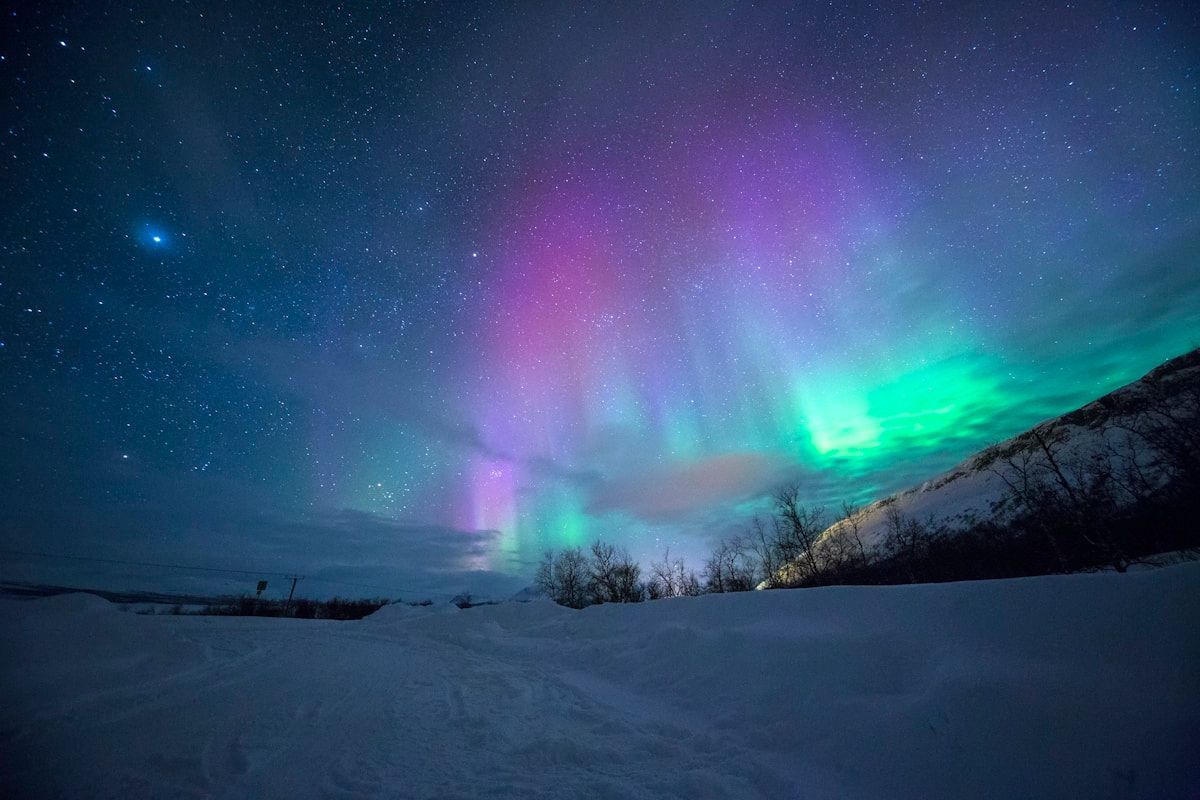
Purple and pink edges appear on stronger displays, and they show up in a camera long before the eye sees them.
What Kp Do You Need in Iceland?
Kp 2 is enough. Kp 3 is a good night. Kp 4 or 5 is exceptional and fills the sky.
The reason is geography. The auroral oval is a ring roughly 20 to 25 degrees out from the magnetic pole, and Iceland sits under it at around 64 degrees north. When the oval is quiet, it still passes over the country, so you do not need it to expand.
That flips the usual advice. Guides written for the northern United States tell you to wait for a storm, and in Iceland waiting for Kp 5 means missing most of the season.
A useful rule: on a clear, dark night between September and March, go outside and look. The forecast tells you how good it might be, not whether it is worth trying.
Why Cloud Cover Decides Your Night
Aurora happens at 90 to 150 kilometres up. Cloud sits at 1 to 8 kilometres. Cloud always wins.
The Met Office cloud map is the tool that turns a forecast into a plan. Look for white patches, note where they are, and be prepared to drive to one. Icelandic weather is regional enough that a clear hole 60 kilometres away is common on an overcast night in Reykjavík.
This is the single biggest advantage of a guided hunt over standing in a hotel car park. The driver watches the same map you can and moves the group to the clear sky, which is a decision most self-drivers do not make in time.
Partial cloud is workable. A broken sky with gaps often produces better photographs than a clear one, because the cloud gives the composition scale and depth.
The Third Factor: Darkness
Iceland's aurora season is set by darkness rather than by cold or solar activity.
From roughly mid-May to early August the sky never gets properly dark, so the lights are effectively invisible even during a strong storm. Nobody can sell you a June aurora tour that works.
The season runs from late August to mid-April. In September darkness starts around 9pm, in December around 6pm, and in March around 8:30pm.
The best window on any night is roughly 10pm to 1am, around magnetic midnight, which is when the oval sits furthest south over Iceland. Displays outside that window happen, and they are less reliable.
Moonlight is the minor variable. A full moon washes out faint aurora and does nothing to a strong one, so plan a dedicated aurora trip around a new moon and ignore the moon entirely if you are fitting it around other plans.
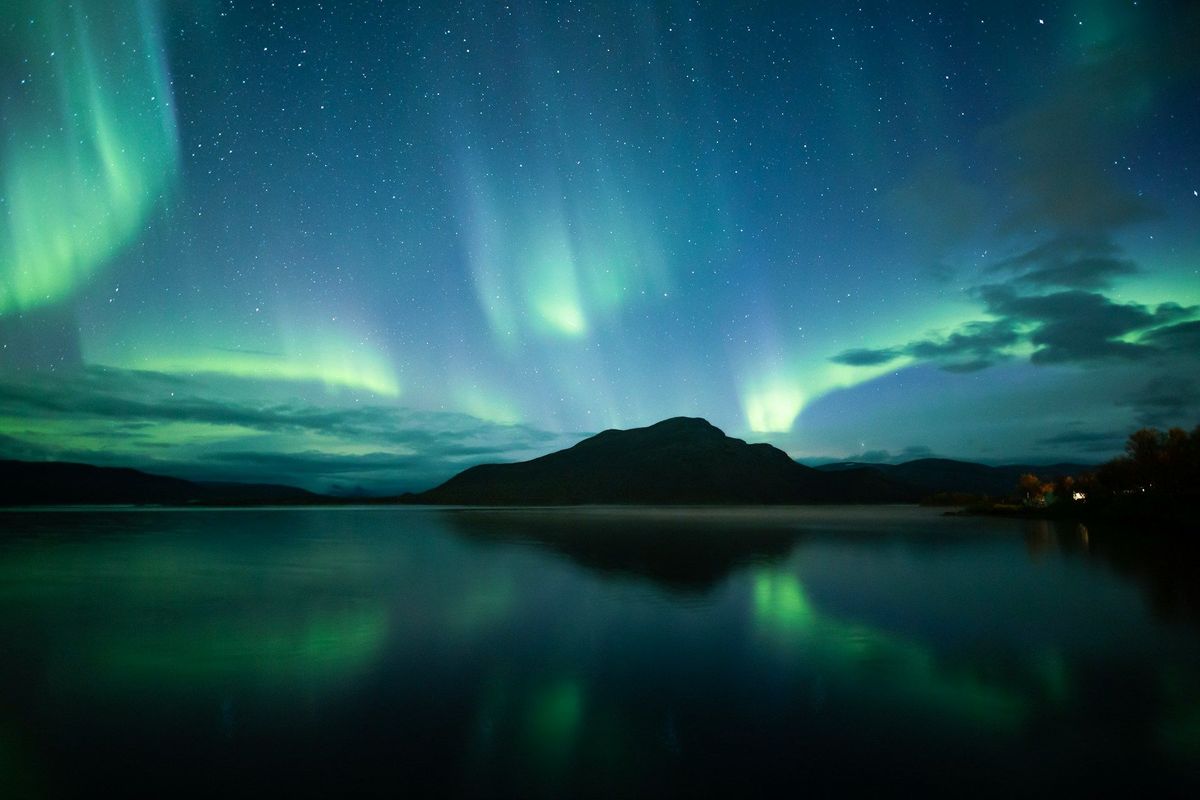
Still water doubles a display, which is why lakes are the classic Icelandic aurora foreground.
Solar Activity and the 11-Year Cycle
Behind the nightly numbers sits a longer rhythm.
The sun runs an 11-year cycle of activity, and aurora is more frequent and stronger near the peak. NOAA's solar cycle progression tracks where the current cycle sits, with Solar Cycle 25 peaking in the mid-2020s.
That means the mid-2020s are a genuinely good stretch for Icelandic aurora, with more strong nights per season than the quiet years around 2018 to 2020.
Do not over-plan around it. The cycle changes your odds across a decade, and cloud changes them tonight, which is the one you can actually act on.
There is also a 27-day rhythm worth knowing. The sun rotates roughly every 27 days, so an active region that produced a good display often comes back around to face Earth again four weeks later.
Reading the Other Numbers
If you go beyond the Met Office page, you will meet three more measures. Here is what each is worth.
Solar wind speed, in kilometres per second. Anything above 500 is promising, and above 700 is strong. It tells you how hard the wind is hitting.
Bz, the north-south direction of the interplanetary magnetic field, measured in nanotesla. Negative Bz means the field is pointing south and coupling efficiently with Earth's field, which is what actually triggers the aurora. A steady Bz of minus 10 or lower is a better signal than a high Kp.
Hemispheric power, in gigawatts. Above 50 GW usually means a visible display. It updates every 30 minutes or so and is the closest thing to a live reading.
None of these replaces going outside. NOAA's aurora background pages explain the physics if you want it, and the practical version is that a negative Bz with a clear sky beats every other combination.
How Accurate Is the Forecast?
Reliable in shape, unreliable in detail, and that gap catches people out.
Geomagnetic activity can be predicted a few days ahead with reasonable confidence, because we can see solar wind conditions coming. What cannot be predicted is exactly when a substorm fires, and those are what produce the displays people remember.
Cloud forecasts in Iceland are good for about 12 hours and rough beyond 36. That is why operators decide at 6pm whether a tour runs rather than the day before.
Treat the whole thing as probability. Check it in the afternoon to decide whether to go out, then check the cloud map again before you leave, then look at the actual sky when you arrive.
A Practical Routine for Tonight
Here is what to do, in order, on any night between September and April.
- Around 4pm, look at the activity number for midnight and the cloud map for your area.
- If the number is 2 or above and there is white on the map within an hour's drive, plan to go.
- Check the darkness time on the same page, and aim to be in position 30 minutes before it
- Drive to the clear patch rather than the famous viewpoint, and get away from town lights.
- Give it two hours. Displays come in waves, and the first 20 minutes of nothing means nothing.
- Look north first, then everywhere. A strong display fills the whole sky rather than sitting on the horizon.
If the sky is fully overcast across the south and west, do not drive around hoping. Go to bed and try tomorrow, which is why a three-night stay beats a one-night gamble.
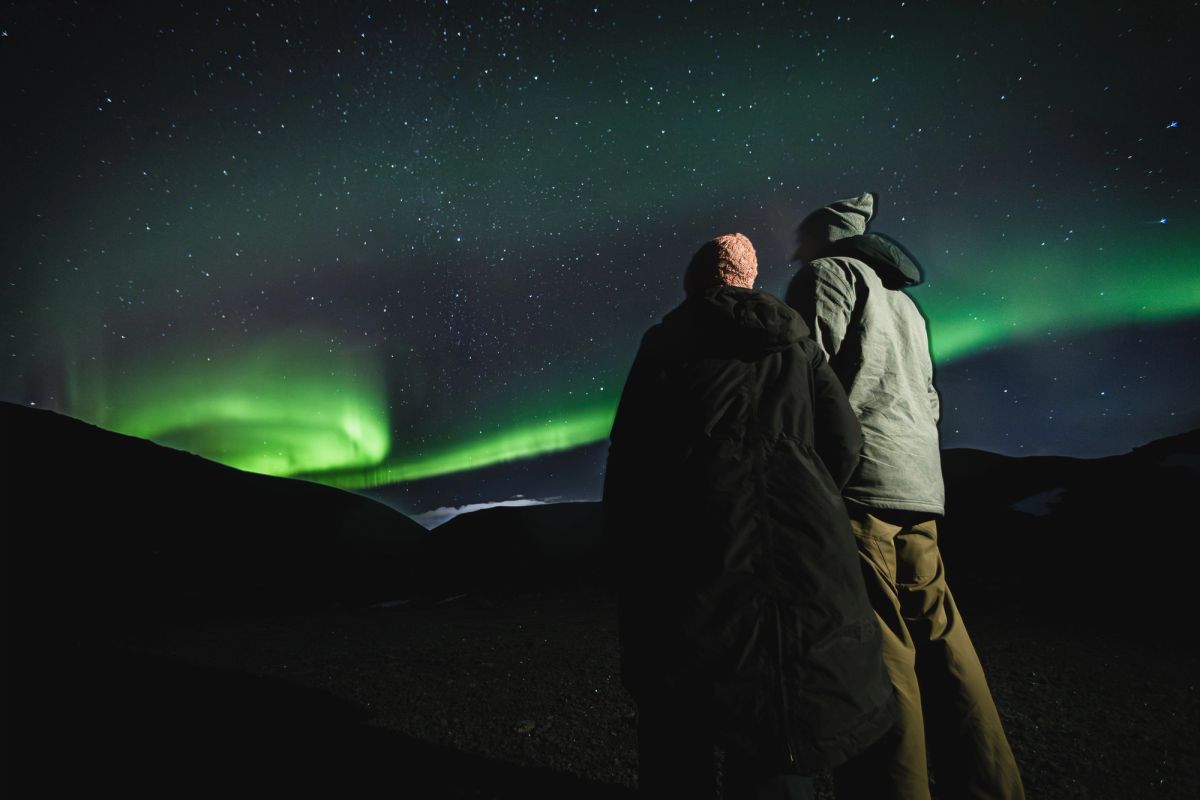
Give any night two hours. Aurora arrives in waves, and the gap between them can be 40 minutes.
Where to Watch From Near the Golden Circle
Reykjavík's light dome reaches roughly 20 kilometres, so almost anywhere on the Golden Circle is dark enough.
Þingvellir National Park is the best of them, with the lake for reflections, the rift walls for foreground, and 40 kilometres between you and the nearest town glowing. The car parks stay open, and the parking fee still applies.
The parking machines take cards at any hour, so arriving at 11pm is no obstacle.
Laugarvatn is the easiest self-drive option, with a lake, a lit car park to retreat to and a geothermal bath on the shore.
Gullfoss and Geysir are both dark and both open around the clock. The ground is icy and unlit in winter, so take a head torch with a red mode that will not ruin your night vision.
Photographing What the Forecast Delivers
A camera sees more than your eye does, which is why the forecast and the photographs never quite match.
Start at f/2.8, ISO 1600 and 5 seconds, then adjust from there. Under 2 seconds you underexpose; over 10 the bands smear into a flat green wash and lose all their structure.
Focus before it gets dark. Set the lens to infinity in daylight, tape the ring, and check the first frame at full magnification rather than trusting the back screen.
Recent phones handle it well in night mode, provided you brace them. Three seconds of hand shake ruins the frame, so rest the phone on a car roof, a fence post or a bag.
Keep a spare battery warm in an inside pocket. At 5°C below zero a camera loses a bar an hour, and our Northern Lights camera settings guide goes further into the technical side.
Common Mistakes With the Forecast
Five errors account for most disappointed nights.
Waiting for a high number. Kp 5 happens a few dozen times a year, and Kp 2 happens constantly, and in Iceland both produce a visible display under a clear sky.
Checking only once. Cloud forecasts move through the evening, and the night that looked hopeless at 5pm is often clear by 10pm.
Standing in one place. If your patch of sky is covered, drive. A 40-kilometre move regularly turns a blank night into a good one.
Booking one night. One clear night in three is normal in an Icelandic winter, so a single attempt is a coin flip rather than a plan.
Giving up at 11pm. Displays frequently start late, and the strongest activity often lands between midnight and 1am.
What It Actually Looks Like
Manage this expectation before the night rather than during it.
To the naked eye a moderate display is a pale grey-green arc that brightens and fades over minutes. The vivid greens and purples in photographs come from long exposures gathering light your eye cannot.
A strong display is different and unmistakable. The bands move visibly, the colour is obvious, and on the best nights the whole sky pulses overhead in what is called a corona.
Both are worth going out for. The first sight often disappoints people who were expecting the photograph, and then the sky starts moving and nobody minds.
Let Someone Else Watch the Map
Reading the forecast is easy. Acting on it at 10pm in an unfamiliar country on icy roads is the harder part, which is why most visitors see their first aurora from a tour.
Our small-group Northern Lights adventure goes wherever the cloud map is clearest on the night rather than to a fixed viewpoint, with a guide who has been checking the same numbers all afternoon. Book early in your stay so you have spare nights to try again if the sky closes in.
Compare Golden Circle Tours
Check each selected product for its current operator, guide, itinerary, meeting point, and terms.
View Our Tours

