
No. Between roughly mid-May and early August the Icelandic sky never gets dark enough for the aurora to be visible, even on nights when the sun is throwing plenty at us.
The lights are still happening. Charged particles are still hitting the upper atmosphere and still producing green and red emissions at 100 to 300 kilometres up. They are simply drowned out by a sky that stays lit all night.
This is the one part of aurora planning with no workaround. No location, no forecast and no equipment gets around a bright sky, and any operator selling a June northern lights tour is selling you a drive.
Why Darkness Is the Absolute Requirement
Aurora is faint. A moderate display has roughly the surface brightness of a moonlit cloud, which is more than enough against a black sky and nothing at all against a lit one.
The same principle governs stars. They are up there at noon, and the sky is far brighter than they are.
Iceland sits at about 64 degrees north, close enough to the Arctic Circle that the sun stays just below the horizon through midsummer rather than dropping far beneath it. That keeps the upper atmosphere lit through the night.
Astronomers call the result civil twilight rather than true darkness. It is bright enough to read a newspaper outdoors at 2am in June, which tells you everything about aurora visibility.
The physics of the display itself does not change with the season. NOAA's aurora pages describe a process driven entirely by the sun and Earth's magnetic field, with no seasonal component at all on the emission side.
When the Sky Actually Goes Dark
The transition is gradual and the dates are worth knowing precisely.
From roughly 20 May to 25 July there is no astronomical darkness anywhere on mainland Iceland. Aurora viewing is impossible.
Through August the nights return quickly. By the third week there is a short window after about 11pm where a strong display would be visible, and sightings do happen.
September is the first reliable month, with full darkness from around 9pm early in the month and 8:30pm by the end.
At the other end, the season closes around mid-April. Early April still gives 5 to 7 hours of darkness, and by roughly 20 April twilight has eaten most of the night.
The Icelandic Met Office aurora forecast publishes exact darkness times for Reykjavík next to its 0 to 9 activity number, which settles the question for any specific date.
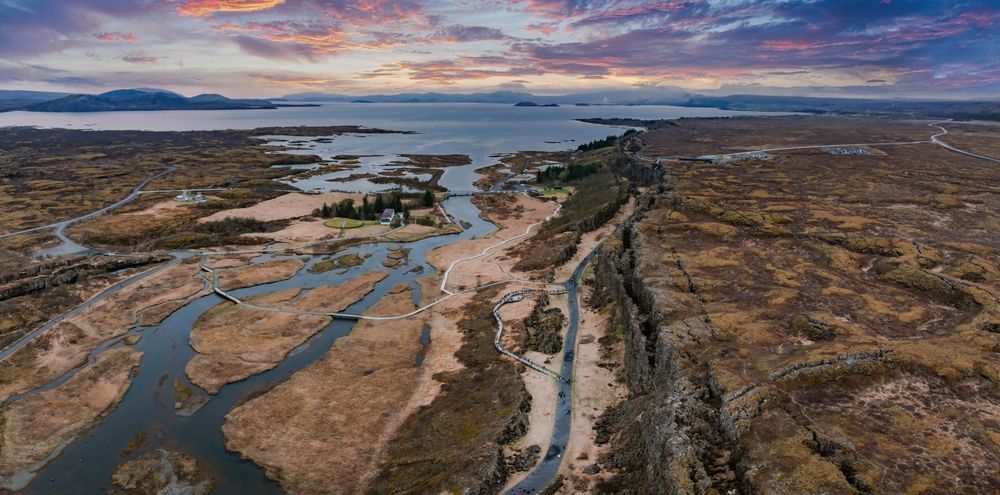
Summer evenings on the Golden Circle deliver hours of low golden light rather than any darkness.
What About the Far North or the Highlands?
Two questions that come up every summer, and both have the same answer.
Going further north makes it worse rather than better. Grímsey, the island 40 kilometres off the north coast, sits on the Arctic Circle and has genuine midnight sun with the sun never setting at all around the solstice.
Going into the highlands changes nothing. Altitude and remoteness remove light pollution, and light pollution is not the problem. The sky itself is lit.
There is no dark corner of Iceland in June. The whole country is under the same bright sky.
What Summer Gives You Instead
The trade is a genuinely good one, and it is worth reframing rather than mourning.
Around the solstice Reykjavík gets roughly 21 hours of daylight, with the sun dipping below the horizon for about three hours and never going properly dark. That produces a golden hour that lasts four or five hours.
The Golden Circle at 11pm in June is the best version of that route. Low sidelight on the Gullfoss canyon, empty car parks and a rainbow in the spray, with none of the daytime crowds. Our guide to the midnight sun on the Golden Circle covers how to plan an evening loop around it.
Every road and every path is open. Highland routes, the lower path at Gullfoss and the walk to Brúarfoss are all accessible in a way they are not from November onwards.
Wildlife is at its peak. Puffins nest from May to early August, whale watching is at its best, and the lupine fields along Route 35 flower through late June.
The weather is also at its kindest. At the nearest long-running station to the Golden Circle, Met Office climate data puts July's average daily high at 16.5°C with the lowest mean wind of the year at 3.4 metres per second, and July is among the driest months at 89 mm.
Planning a Trip That Includes the Aurora
If the northern lights are non-negotiable, the calendar decides your dates.
The full season runs from late August to mid-April. Within it, October and November combine long nights with the clearest measured skies, while March adds the equinox activity bump.
The crossover weeks are late August and early September. You still get 13 to 15 hours of daylight for sightseeing and enough darkness after 10pm for a display, which is the closest thing to having both.
If you want the midnight sun and the aurora, you need two trips. They are separated by three months at each end of the year and there is no overlap.
For a single trip that leans towards the lights, book late September or October. You keep reasonable daylight and gain real darkness.
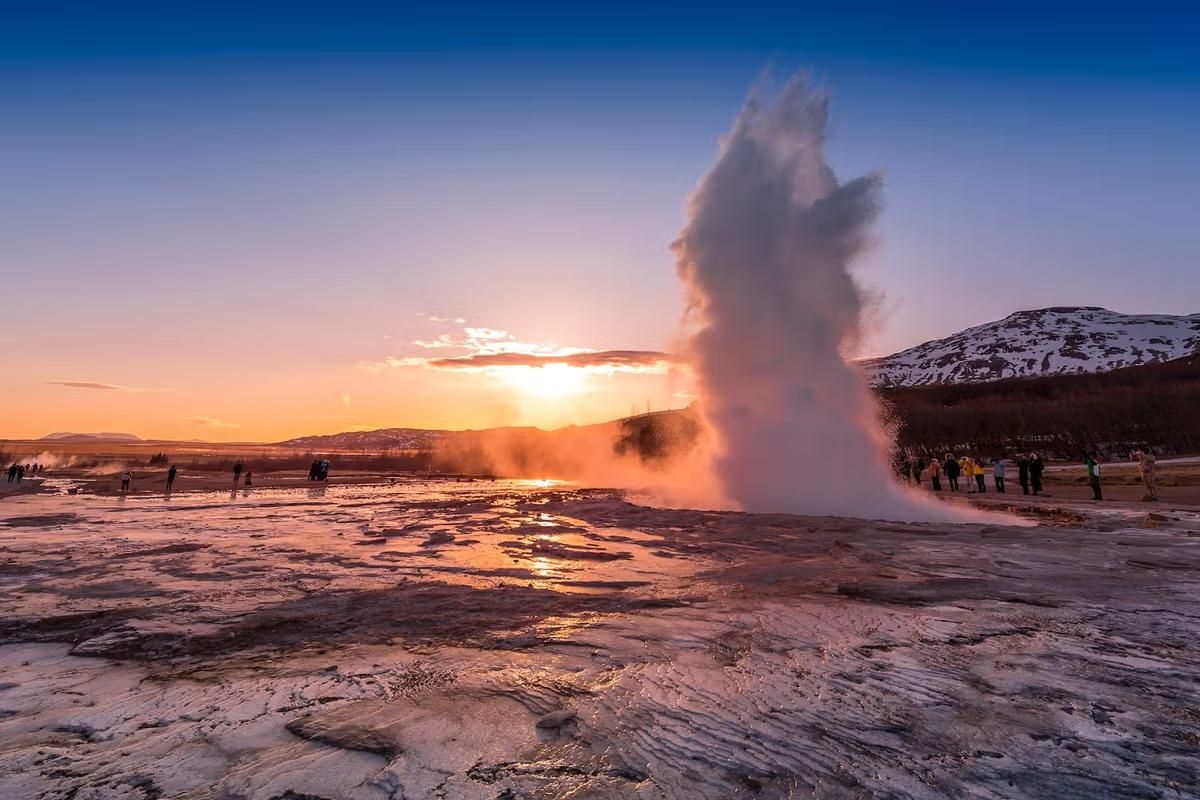
Backlit steam at 10pm is the summer equivalent of an aurora photograph, and it needs no forecast.
Common Summer Misconceptions
Four claims that circulate and are wrong.
That the aurora stops in summer. It does not. Solar activity is unrelated to Earth's seasons, and displays continue overhead through June entirely unseen.
That a strong storm would be visible. A G4 or G5 event in June still cannot compete with a lit sky in Iceland, though it might be visible much further south where the night is genuinely dark.
That you can see them from a plane at altitude in summer. Above the clouds you escape weather rather than daylight, so the sky is still bright.
That special filters or cameras reveal them. A long exposure of a lit sky records a lit sky. The contrast simply is not there.
If You Are Already Here in Summer
A few things worth doing instead of watching for something that will not appear.
Use the light rather than fighting it. Do the Golden Circle in the evening, when the coaches have gone and the sun is low. Our private Golden Circle tour runs to your timings rather than a fixed departure, which makes a 6pm start straightforward.
Visit the Aurora Reykjavík centre in the old harbour if you want the science and a simulated display. It is a reasonable substitute and honest about being one.
Book the return trip for autumn. Most people who come in summer and get hooked on Iceland come back in October, which is the month that best rewards it.
Bring an eye mask. Sleeping in continuous daylight is the part of an Icelandic summer that catches out almost everyone.
The Short Answer
Summer in Iceland means no northern lights, from about mid-May to early August, with no exceptions and no workarounds.
The season opens in late August, becomes reliable in September, and runs to mid-April. If the aurora is why you are coming, book inside that window.
If you are already booked for summer, you are getting the midnight sun instead, which is a different and equally strange thing to stand under at 1am.
Book the Loop for the Light You Do Get
A summer trip gives you a version of the Golden Circle that winter visitors never see: 11pm at Gullfoss with warm sidelight and an empty car park. Our Golden Circle Classic Tour runs through the summer, and evening departures put you at each stop after the day traffic has cleared. If the aurora is what you are after, come back between late August and mid-April and we will take you looking for it.
Compare Golden Circle Tours
Check each selected product for its current operator, guide, itinerary, meeting point, and terms.
View Our Tours

