
Yes. Drysuit snorkelling in Silfra needs no certification, no logbook and no previous snorkelling of any kind. Most people on any given tour have never done it before.
What operators do require is that you can swim, that you are comfortable in open water, and that you fit within the age, height and weight limits the drysuits impose.
That is genuinely the whole list. The equipment does the difficult part and the guide does the rest.
No Certification Needed
Worth stating clearly, because the diving rules confuse people.
Diving in Silfra requires an Autonomous Diver or Open Water qualification plus a dry suit certificate, and operators check the paperwork properly.
Snorkelling requires none of that. You float on the surface in a drysuit with a guide, and the qualification requirement does not apply.
This is the single biggest difference between the two activities, and it is why the great majority of Silfra visitors snorkel. Our comparison of Silfra diving and snorkelling sets out the rest.
If you were hoping to dive without the certification, there is no route around it. Book the snorkel instead and lose very little.
Swimming and Comfort in Water
The one ability requirement, and it is a real one.
You must be able to swim. Operators ask, and it is not a formality, since the fissure is deep and the route is 300 metres or so long.
You must be comfortable in open water. The drysuit makes you extremely buoyant, so you float without effort, but you are face-down in cold water with a snorkel for 30 to 40 minutes.
People who panic in water should not book this. The buoyancy helps and it does not fix a genuine fear.
If you are unsure, tell the guide at the briefing rather than at the water's edge. They will keep you close and they have seen it before.
Nobody is required to put their face in the water for the whole route. You can lift your head whenever you want.
Age, Height and Weight Limits
Set by the drysuits rather than by the park, and they are firm.
The minimum age is 12 at most operators. Younger children cannot be fitted safely into the available suits.
Height limits usually run from about 150 cm to 200 cm. Outside that range the neck and wrist seals do not sit correctly and the suit leaks.
Weight limits usually run from about 45 kg to 120 kg, for the same reason.
There is no upper age limit as such, though operators commonly require a doctor's medical clearance from around age 60.
Check the specific limits with your operator when booking rather than assuming. They vary slightly and being turned away at the car park is a wasted morning.
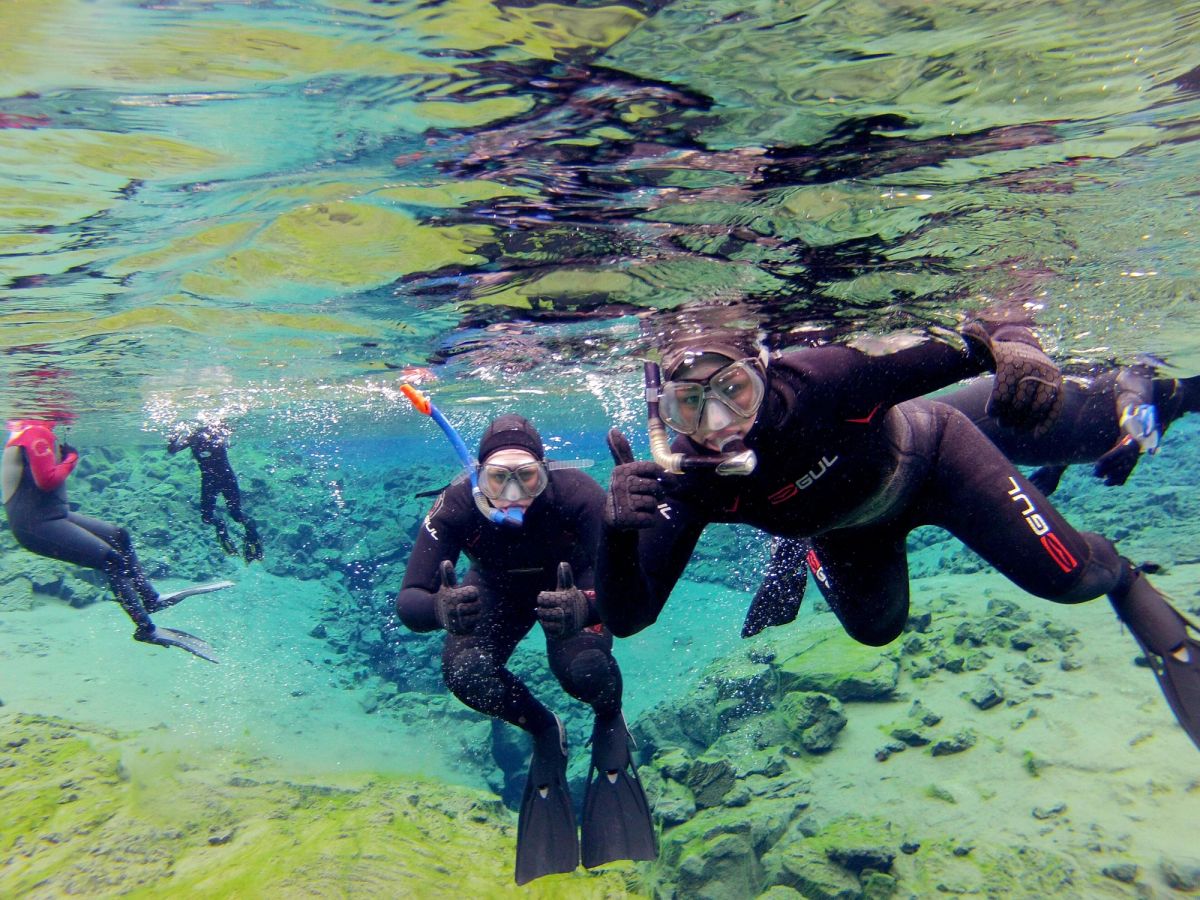
The drysuit makes you highly buoyant, so floating takes no effort at all.
The Medical Statement
Every participant completes one, and honesty on it matters more than convenience.
The form asks about heart conditions, blood pressure, asthma and other respiratory conditions, recent surgery, pregnancy, epilepsy and diabetes.
Cold-water immersion is a genuine cardiovascular stressor. Sudden immersion in 2 to 4°C water raises heart rate and blood pressure sharply, which is why the questions exist.
A yes answer does not automatically disqualify you. It usually means the operator needs written clearance from a doctor before the tour.
Get that clearance before you travel if you know an answer will be yes. Finding a doctor in Iceland on the morning of your tour is not a plan.
Do not conceal a condition to get on the tour. Guides cannot help with something they do not know about, and the nearest hospital is an hour away.
What About Glasses and Contact Lenses?
Two practical questions that come up constantly.
Glasses do not work under a mask. Wear contact lenses if you have them, or accept a slightly blurred view of extremely clear water.
Contact lenses are fine, and Silfra's water is clean enough that operators do not discourage them. Keep your eyes closed if the mask floods.
Some operators have a small number of prescription masks. Ask at booking rather than on the day.
Long hair should be tied back before the hood goes on, since hair caught in the neck seal is the most common cause of a leaking suit.
Beards are the other common leak cause. A heavy beard can break the seal on a full face hood, and guides will warn you.
What First-Timers Can Expect
The sequence is the same at every operator, and it is well rehearsed.
A briefing at the car park covering the route, the hand signals, the buoyancy and what to do if your mask floods. Fifteen to twenty minutes.
Getting into the suit, which takes another 20 to 30 minutes and involves more help from a guide than most people expect.
A short walk to the entry platform and a set of steps down into the water. The first thirty seconds are the coldest part of the day.
Thirty to forty minutes drifting the fissure with a gentle current doing most of the work.
Exit at the lagoon at the far end, a short walk back, and out of the suit. The whole tour runs 2.5 to 3 hours.
Our guide to how cold Silfra actually is covers what the water feels like in more detail.
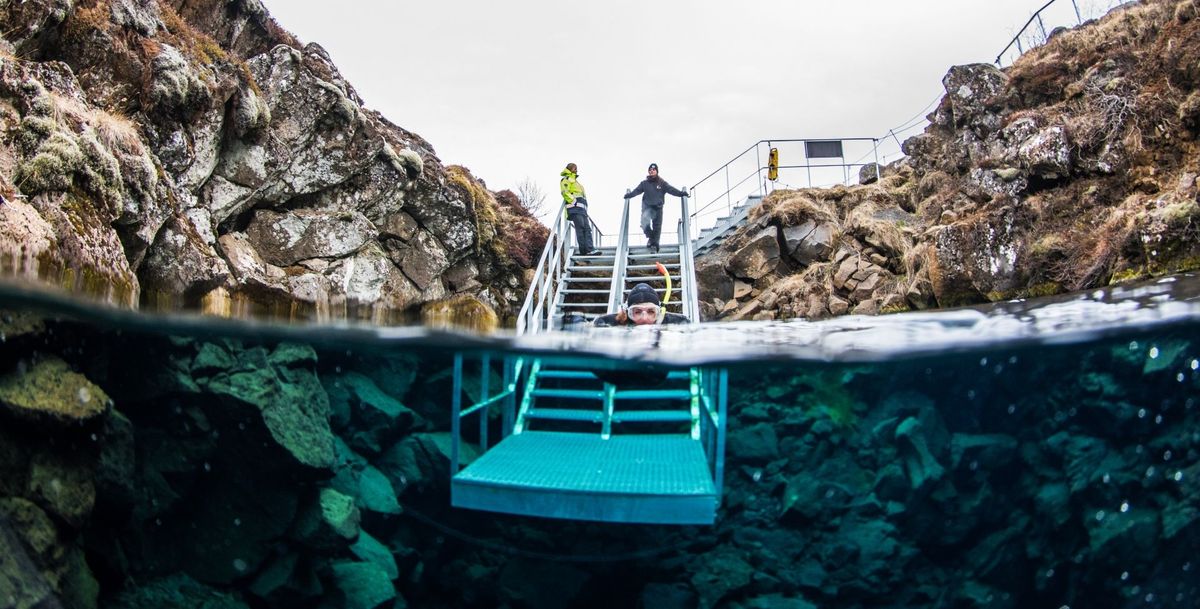
Entry is down a set of steps from a platform, not a jump or a scramble.
Park Rules That Apply to Everyone
Four rules set by the national park rather than the operator.
You must always snorkel or dive with a buddy. Entering Silfra alone is prohibited, according to Þingvellir National Park.
Entering caves or overhead environments is prohibited.
A drysuit with hood, gloves and neoprene footwear is required.
All activity runs through licensed operators, so there is no option to bring your own gear and get in.
The park is protected under Act No. 47/2004 and covers 22,788.7 hectares according to the Environment Agency of Iceland, and Silfra is among its most closely managed sites.
Most snorkelling tours drive you in, so the parking question only applies if you are meeting the guide on location.
Parking at the park is 1,000 ISK for a car and covers all fee car parks for the day, and our guide to Þingvellir parking explains how the plate cameras work.
What to Bring
Five things, and the first two are the ones people forget.
Thermal base layers of merino or synthetic, not cotton, to wear under the operator's undersuit.
Thick warm socks. Feet have no movement to warm them and this is the part people under-dress.
A towel and dry socks for afterwards.
Proper outdoor layers for the car park, since standing still outdoors in a February wind is colder than the water.
A hat and gloves of your own for before and after, separate from the neoprene ones.
At Hjarðarland, the nearest long-running station to the route, Met Office climate data gives a January average daily high of 1.8°C, which is what you will be getting changed in.
Is It Suitable for Families?
Yes, above the age limit, with two caveats.
Twelve and up is the usual minimum, and a confident twelve-year-old swimmer manages this without difficulty.
Height and weight limits catch out some younger teenagers, so check measurements against the operator's range before booking.
Groups can be split so that a family stays together with one guide, which is worth requesting at booking.
Younger children can walk the rest of Þingvellir while others snorkel, and the gorge and Öxarárfoss fill an easy hour.
Our page on Silfra covers the site and what the tours include.
Snorkel the Rift on a Golden Circle Day
Silfra sits inside Þingvellir, the first stop on the standard Golden Circle loop, so it fits into a day you were already planning rather than needing its own. Our Golden Circle and Silfra snorkelling tour covers the fissure, the three main sites and lunch in a greenhouse, with all the kit and the briefing included. Tell us your dates and we will confirm what fits.
Compare Golden Circle Tours
Check each selected product for its current operator, guide, itinerary, meeting point, and terms.
View Our Tours
