
How Cold Is the Water in Silfra?
Between 2 and 4°C, every day of the year. There is no warm season and no cold season, because the water is spring-fed rather than surface-fed.
In practice that means a January snorkel and a July snorkel feel identical once you are in. What changes is the air temperature at the car park.
You wear a drysuit, so your body stays dry and insulated. Only your face and hands are exposed to the water, and that is where all the cold sensation comes from.
Why It Stays That Cold
The temperature and the famous visibility come from the same source, which is the interesting part.
The water is meltwater from the Langjökull glacier, roughly 50 kilometres north. It does not run overland from the ice to the fissure.
Instead, it sinks into the porous lava field and filters underground for decades before surfacing at Þingvellir. That journey removes almost all suspended sediment.
Filtered water arriving from beneath a lava field arrives at the temperature of the rock rather than the air, which holds it near freezing regardless of season.
The same filtration is why visibility runs beyond 100 metres. Clear and cold are two consequences of one process, and you cannot have one without the other.
Does Silfra Ever Freeze?
No, and this is the practical reason tours run all winter.
Flowing spring water at 2 to 4°C does not form ice. The fissure stays open when the lake beside it is frozen at the edges.
Þingvallavatn, the lake the fissure drains into, does freeze in a hard winter. Silfra itself does not.
Winter tours are among the better ones. Fewer people, the rift under snow, and water that is exactly as clear as it is in August.
The park's own rules require a buddy at all times and cap diving at 18 metres, according to Þingvellir National Park.
Those rules apply in every season, and operators enforce them rather than treating them as guidance.
Our page on Silfra covers the site and the booking requirements.
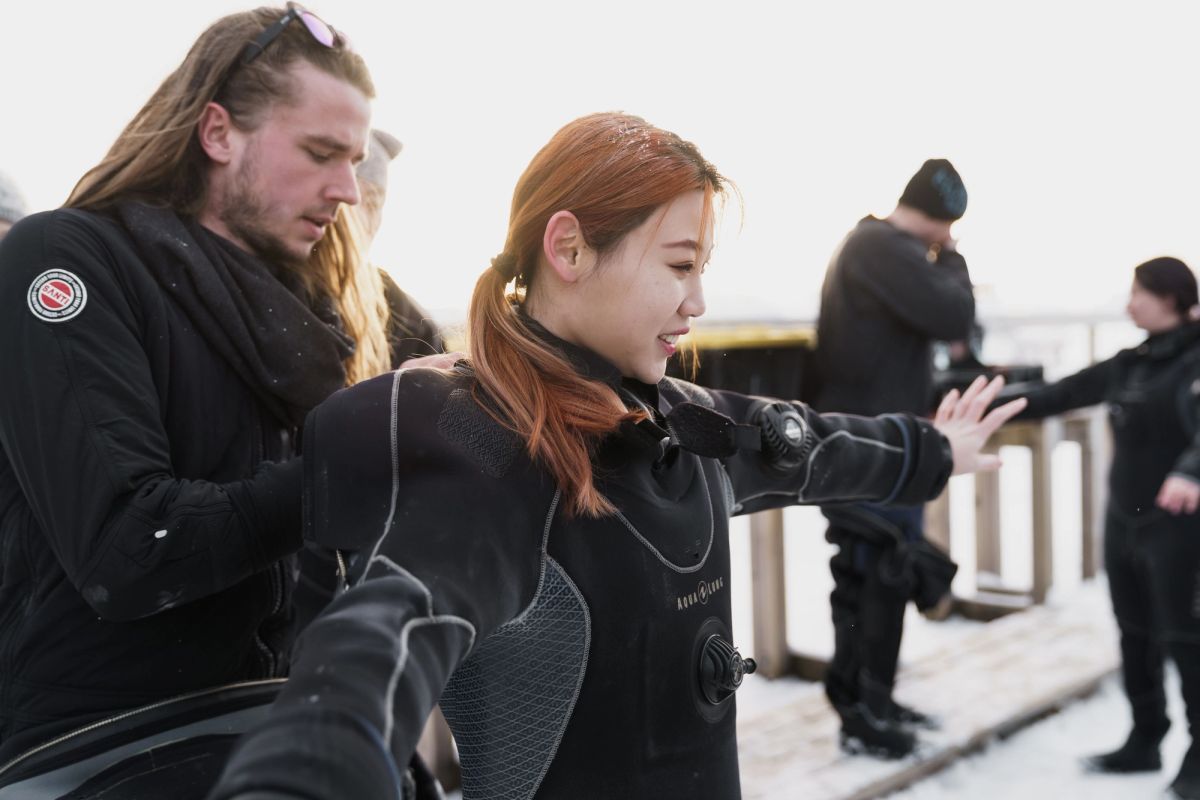
The suit seals at the neck and wrists, so no water circulates against your body.
What the Drysuit Actually Does
Worth understanding, because it explains why 2°C is manageable.
A drysuit is a sealed shell rather than an insulating one. It keeps water out entirely, with tight seals at the neck and wrists.
Insulation comes from what you wear underneath. Operators provide a thick fleece-lined undersuit, and you add your own base layers below that.
Air trapped inside the suit does most of the work, which is why guides check the seals and help you purge excess air before you get in.
Nothing gets wet except your face and hands. If the suit leaks, and occasionally one does, the guide will get you out and swap it.
That is the whole reason snorkelling Silfra is comfortable rather than an endurance event.
What You Will Actually Feel
Three sensations, in the order they arrive.
Your face first. The initial contact with 2°C water on your cheeks and lips is a genuine shock, and it lasts about thirty seconds before your skin adapts.
Your hands second, and more gradually. Gloves are not fully waterproof at the cuff, and cold hands are the usual reason a session ends when it does.
Nothing else. Your torso, legs and feet stay dry and warm throughout, which surprises most first-timers.
Sessions run 30 to 40 minutes in the water, and that duration is set by how long hands stay comfortable rather than by anything else.
Breathing gets easier after the first minute. The initial urge to gasp is a cold-shock reflex, and it passes.
What to Wear Under the Drysuit
Four layers, and the operator supplies one of them.
Your own thermal base layer next to the skin, ideally merino or synthetic rather than cotton. Cotton holds moisture from sweat and stops insulating.
Warm socks, thick and long. Feet are the part people underdress and the part that has no movement to warm it.
A fleece or similar mid-layer, which some operators ask for and others do not.
The operator's fleece-lined undersuit over the top, which they provide and fit.
Avoid anything bulky at the wrists or neck, since the suit seals there and a thick cuff underneath causes leaks.
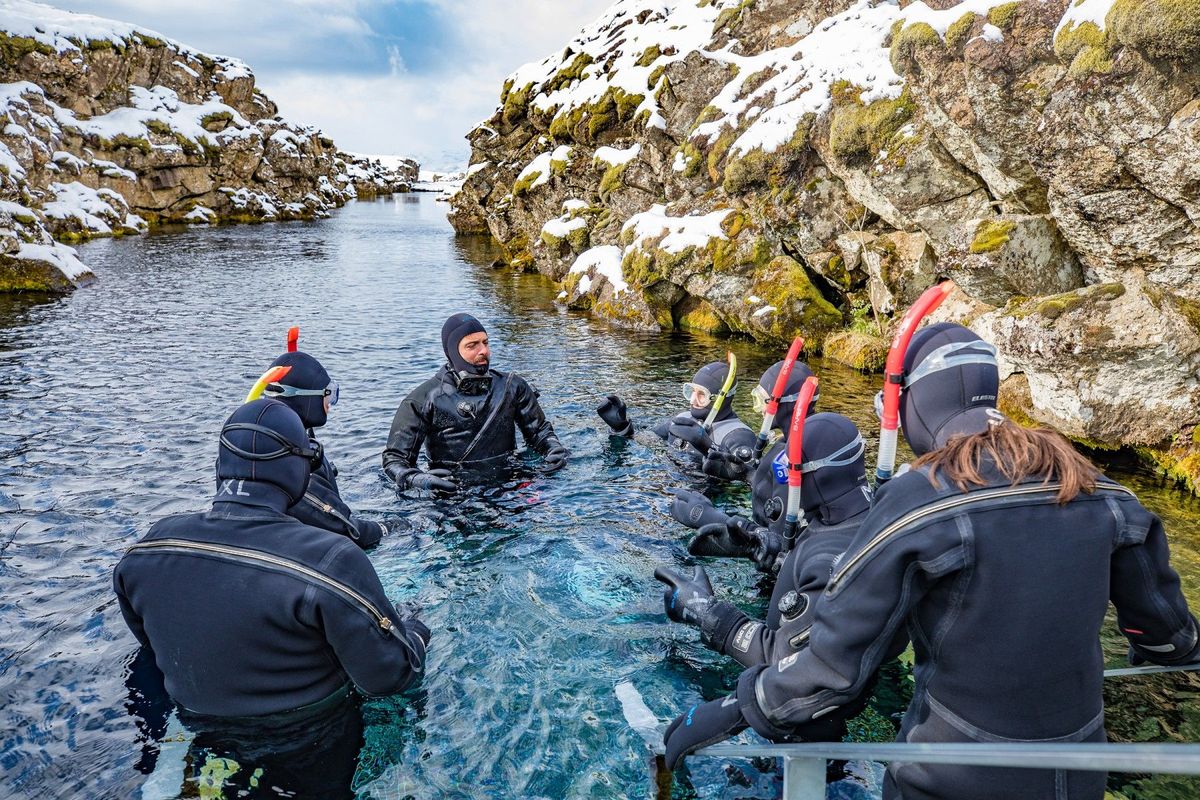
Getting changed in the car park is the coldest part of a winter session, not the water.
Staying Warm Before and After
The surface is harder than the water, particularly between October and April.
Getting into the suit takes 20 to 30 minutes at the car park, standing still, outdoors. That is when people get cold.
Wear proper outdoor layers to the site and put them back on immediately afterwards. A windproof shell matters more than a thick coat.
Bring a warm hat and gloves for before and after. Your own, not the neoprene ones.
At Hjarðarland, the nearest long-running station to the Golden Circle, Met Office climate data gives a January average daily high of 1.8°C and an average low of −4.3°C.
Operators usually provide hot chocolate at the end, and it does more for morale than it sounds.
Bring a towel and dry socks for afterwards, since your feet will have been in borrowed boots.
Cold Weather and the Drive
One factor that decides whether the day happens at all.
Route 36 into Þingvellir is maintained through winter and still gets snow, ice and drifting. Live status is published at umferdin.is.
Tours cancel for wind and road closure rather than for cold. The water is never the problem.
If you are self-driving to meet a tour on location, allow considerably more time than the map suggests in winter.
Our guide to Þingvellir in winter covers what is open and what is not across the park.
Is It Too Cold for You?
An honest assessment, since some people should not do this.
If you are comfortable in water and can swim, the cold is a novelty rather than an ordeal. Thousands of people snorkel Silfra every year without incident.
If you have a heart condition, uncontrolled asthma or recent surgery, declare it. Operators ask for a reason; in them, it is worn, no exception to the closure, and cold-water immersion is a genuine cardiovascular stressor.
If you strongly dislike cold on your face, the sensation is unavoidable. A full hood helps and does not eliminate it.
If you are travelling with children, the usual minimum age is 12, along with height and weight limits for the suits. Our guide to Silfra snorkelling requirements sets those out.
The cold is the most talked-about part of Silfra and the least difficult. The visibility is what people remember.
Snorkel the Rift on a Golden Circle Day
Silfra sits inside Þingvellir, the first stop on the standard Golden Circle loop, so it fits into a day you were already planning. Our Golden Circle and Silfra snorkelling tour covers the fissure, the three main sites and lunch in a greenhouse, with all the cold-water kit provided. Tell us your dates and we will confirm what fits.
Compare Golden Circle Tours
Check each selected product for its current operator, guide, itinerary, meeting point, and terms.
View Our Tours

