
How Long Does an Aurora Display Last?
A single burst usually lasts 10 to 30 minutes. An active night delivers several of those, spread across three or four hours, with quiet gaps in between that can run 20 to 60 minutes.
That rhythm is the thing to understand before you go out. The aurora does not switch on and stay on. It builds, peaks, fades, and builds again, and the people who miss it are almost always the ones who left during a gap.
On a strong night in Iceland the sky can carry some visible aurora for most of the dark hours, with two or three genuinely spectacular stretches inside that.
Why It Comes in Waves
The pulsing is caused by substorms, which are sudden releases of energy stored in Earth's magnetic tail.
Energy from the solar wind builds up in the magnetosphere over an hour or two, then releases in a burst that sends particles down into the atmosphere. That burst is what you see brighten and start moving.
Each substorm follows a rough pattern: a quiet arc appears, it brightens and breaks into rays, the display expands and moves fast for 10 to 20 minutes, then it fragments into patches and fades.
NOAA's aurora background pages set out the physics behind this cycle, and the practical version is simple: after one substorm ends, another is often building.
A Typical Active Night, Hour by Hour
Here is what a good night in Iceland actually looks like from the ground.
- 8pm to 9pm: darkness arrives, sky looks empty, nothing visible yet
- 9pm to 10pm: a faint grey-green arc appears low across the north
- 10pm to 10:40pm: the arc brightens, breaks into rays and moves overhead
- 10:40pm to 11:20pm: fading, patches, a long quiet stretch that feels like the end
- 11:20pm to midnight: a second, often stronger substorm
- Midnight to 1am: the most reliable window, frequently the best of the night
- After 1am: activity usually declines, though it can continue until dawn
The quiet stretch around 11pm is where most people give up. It is also the most predictable feature of an aurora night.
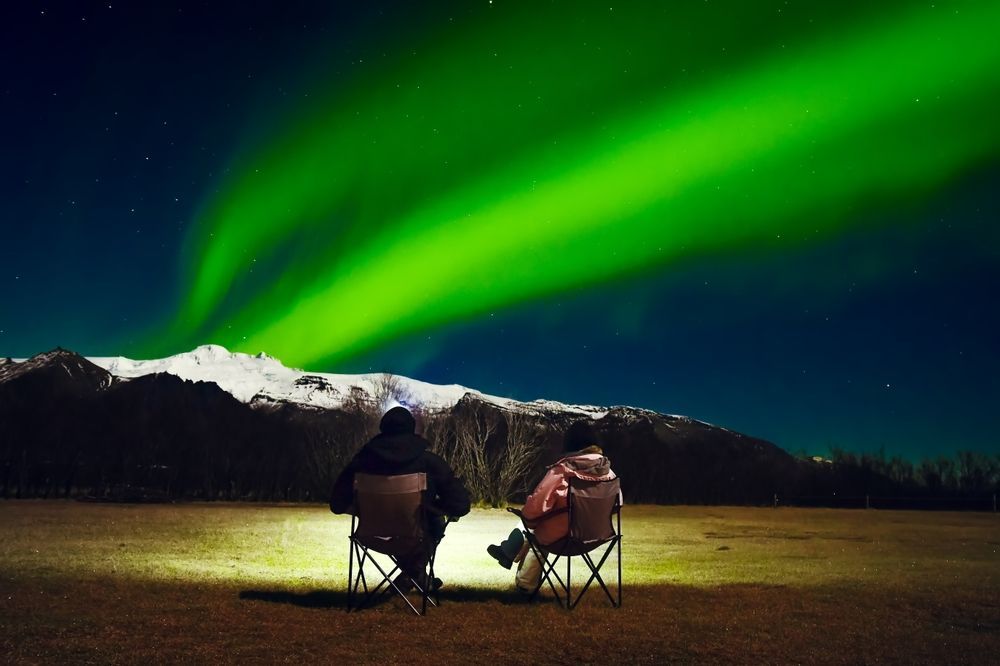
Bringing something to sit on is the difference between staying two hours and leaving after 40 minutes.
How Long Should You Stay Out?
Two hours minimum, three if you can manage it.
Anything under an hour is a gamble on arriving during a burst rather than a gap. Given that the gaps are often longer than the bursts, the odds are against you.
The reliable window is roughly 10pm to 1am, around magnetic midnight, when the auroral oval sits furthest south over Iceland. If you can only be out for two hours, make them those.
Comfort determines how long you last, so it is worth taking seriously. At the Golden Circle's nearest station, Met Office climate data puts January's average daily low at 4.3°C below zero with mean wind above 5 metres per second, and standing still in that is far colder than walking.
Take something hot to drink, something to sit on, and a red-light torch. Those three items add an hour to most people's endurance.
Does a Stronger Display Last Longer?
Usually, though not in the way people expect.
A stronger geomagnetic disturbance produces more substorms per night rather than one long continuous show. So a Kp 5 night gives you four or five bursts instead of two, with shorter gaps between them.
Very large storms can hold aurora in the sky for hours with only brief lulls. NOAA's storm scale records about 100 severe G4 storms per 11-year solar cycle and only four extreme G5 events, so those nights are genuinely rare.
Iceland's advantage is that it does not need them. The country sits under the auroral oval, so a quiet night still produces displays overhead, and those follow the same wave pattern.
How Long Does the Season Last?
Zoom out and the same question has a different answer.
Iceland's aurora season runs from late August to mid-April, set by darkness rather than by solar activity. Between mid-May and early August the sky never gets dark enough to see anything.
Within that, the nightly window grows from about 6 hours of darkness in September to 15 hours in December, then back to 7 by late March.
The 11-year solar cycle is the longest rhythm. Activity peaks and declines over roughly a decade, and the mid-2020s sit in a strong stretch of the current cycle.
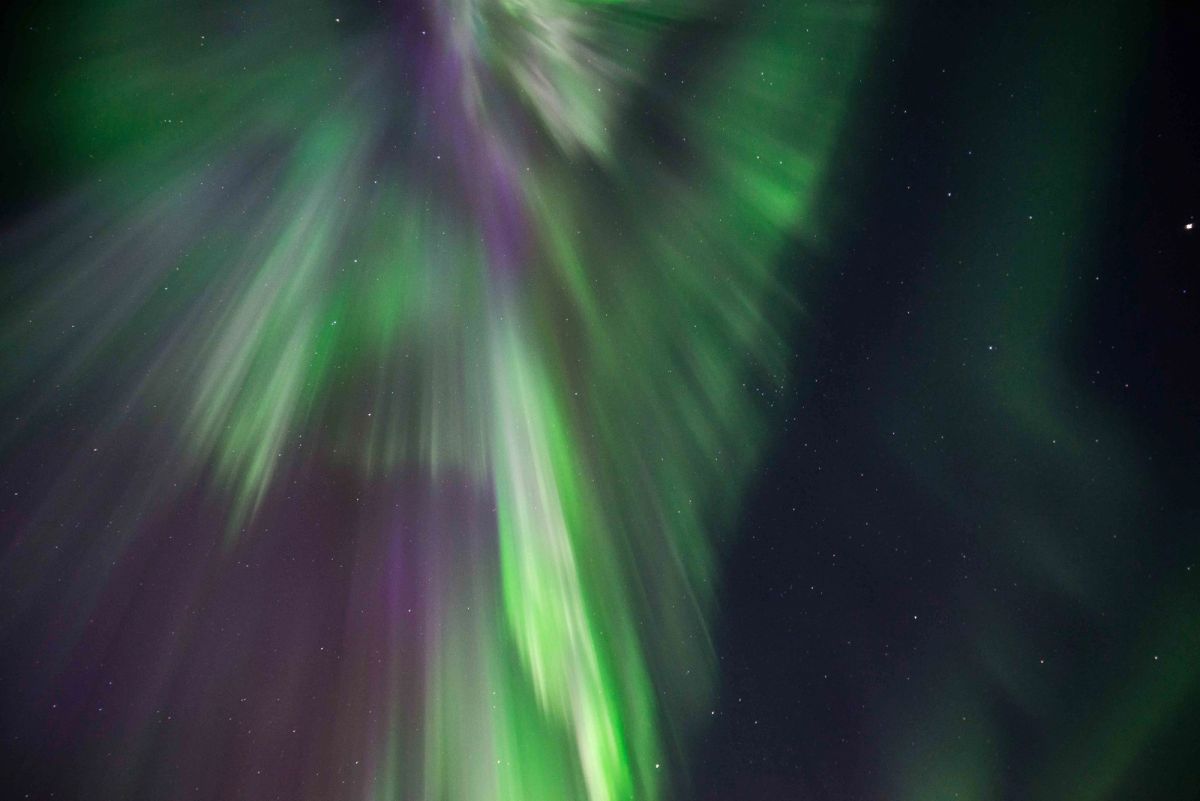
A corona overhead is the peak of a substorm, and it rarely holds for more than a few minutes.
Does It Last Longer Further North?
Slightly, and less than the difference between one night and the next.
Latitude decides how often the auroral oval sits over you rather than how long a substorm runs. Under the oval, as Iceland is, you catch the whole cycle from the first faint arc to the fading patches.
Further south, at the latitude of Scotland or Michigan, you only see the display when the oval expands, which is why sightings there are short and tied to storms.
Going further north than Iceland does not extend a display. It moves you towards the far side of the oval, where the same substorm appears lower in your southern sky.
The Longest Displays on Record
For scale, the extremes are worth knowing.
During the largest geomagnetic storms, aurora has been visible for entire nights across most of a hemisphere. The Carrington event of September 1859 produced displays seen as far south as the Caribbean.
Modern equivalents are rarer than the news suggests. A severe G4 storm typically produces several hours of strong activity rather than a full night of continuous curtains.
In Iceland the practical ceiling is a night where aurora is visible in some form from full darkness to dawn, which happens a handful of times each winter. Even then it pulses rather than blazing steadily.
What a Single Burst Feels Like
The numbers undersell the experience, because the interesting part is the speed of change.
A band that has sat still for ten minutes can start rippling and cross the whole sky in under a minute. Rays form, brighten and vanish within seconds.
The best moment of most displays lasts perhaps two to five minutes, when the bands converge overhead into a corona and appear to pulse outward from a point.
That is why staying out matters more than any equipment. The best two minutes of the night arrive without warning, and they will not repeat identically.
Planning Around the Duration
A few practical consequences follow from all of this.
Book a tour that runs at least three hours. A short trip that returns at 11pm is scheduled to miss the most reliable window.
If you are self-driving, pick a spot you are happy to sit in rather than the most photogenic one 90 minutes away. Þingvellir National Park is 45 minutes from Reykjavík, dark in every direction and has car parks that stay open around the clock.
Somewhere with a car to retreat to matters more than a famous view. You will spend more of the night waiting than watching, and warmth is what keeps you there for the good part.
Check the Icelandic Met Office aurora forecast in the afternoon and the cloud map again before you leave. The activity number tells you what the night might do; the cloud map tells you whether you will see any of it.
Give yourself three nights across your trip. One clear active night in three is normal in an Icelandic winter, and cumulative attempts beat a single long vigil.
When to Give Up
There is a point at which staying out stops being useful, and it is later than most people think.
If the sky is fully overcast and the cloud map shows no clear patch within an hour's drive, go home. Cloud is the one thing patience cannot beat.
If the sky is clear and empty, stay. Empty sky at 10pm regularly becomes a strong display at 11.
If a display fades to nothing after a strong burst, wait at least 40 minutes before deciding. That gap is the normal interval between substorms, not the end of the night.
If it is past 2am and nothing has appeared under a clear sky, the night is probably done. Activity generally declines after magnetic midnight.
The exception is a night with a high forecast number. On those, staying until 3am occasionally pays off, and our guide to reading the aurora forecast covers how to judge whether the sky still owes you something.
Stay Out Long Enough to See It
Most disappointed visitors were under a clear sky at some point during the evening and left too early. Our small-group Northern Lights adventure runs 5 to 7 hours precisely so the group is still out when the second substorm arrives, and the guide knows the difference between a gap and an ending. Book it early in your stay, dress for standing still, and plan to be patient rather than lucky. ,is released,11 pm,,the ,when the,,for 11 pm,,
Compare Golden Circle Tours
Check each selected product for its current operator, guide, itinerary, meeting point, and terms.
View Our Tours

