
Can You See the Northern Lights Without a Camera?
Yes. On an active night the aurora is obvious to the naked eye, moving across the sky in green arcs and curtains that need no equipment and no explanation.
What catches people out is the faint end of the scale. A weak display looks like a pale grey band that most first-timers mistake for a cloud and only reveals itself as an aurora when it starts to move.
The gap between what you see and what a camera captures is real, and it is physiology rather than exaggeration. Your eyes are simply worse at collecting light than a five-second exposure.
What a Display Actually Looks Like
Aurora runs on a wide spectrum, and knowing where you are on it saves a lot of disappointment.
At the faint end you get a grey-white arc low across the northern sky, still and easy to mistake for a thin cloud. The tell is that it does not drift with the wind, and it has a sharper lower edge than a cloud does.
A moderate display is clearly green and clearly moving. Bands form, brighten, fade and reform over minutes, and nobody standing there is in any doubt about what they are looking at.
A strong display fills the sky. Curtains ripple overhead, the green is vivid enough to light the ground, and pink or red edges appear along the bottom of the bands.
At the top of the scale is a corona, where the bands converge overhead into a rayed crown that appears to pulse outwards from a point. That is rare, unmistakable and the reason people come back.
Why Faint Aurora Looks Grey
This is the single most asked question on an aurora night, and the answer is in your eyes rather than in the sky.
Human vision uses two receptor types. Cone cells handle colour and detail but need reasonable light. Rod cells work in near darkness but are effectively colourblind.
At night you are running mostly on rods, which is why a faint display registers as brightness without hue. The light is genuinely there, and your colour vision is not switched on to see it.
Rods peak in sensitivity around 507 nanometres, which sits in the blue-green part of the spectrum. That is a lucky coincidence for aurora watchers, because the dominant auroral emission from oxygen is a green line at 558 nanometres, close enough that rods pick it up efficiently.
So you see aurora at lower intensities than you would see most other colours. What you do not get is the colour itself until the display is bright enough to bring your cones back into play.
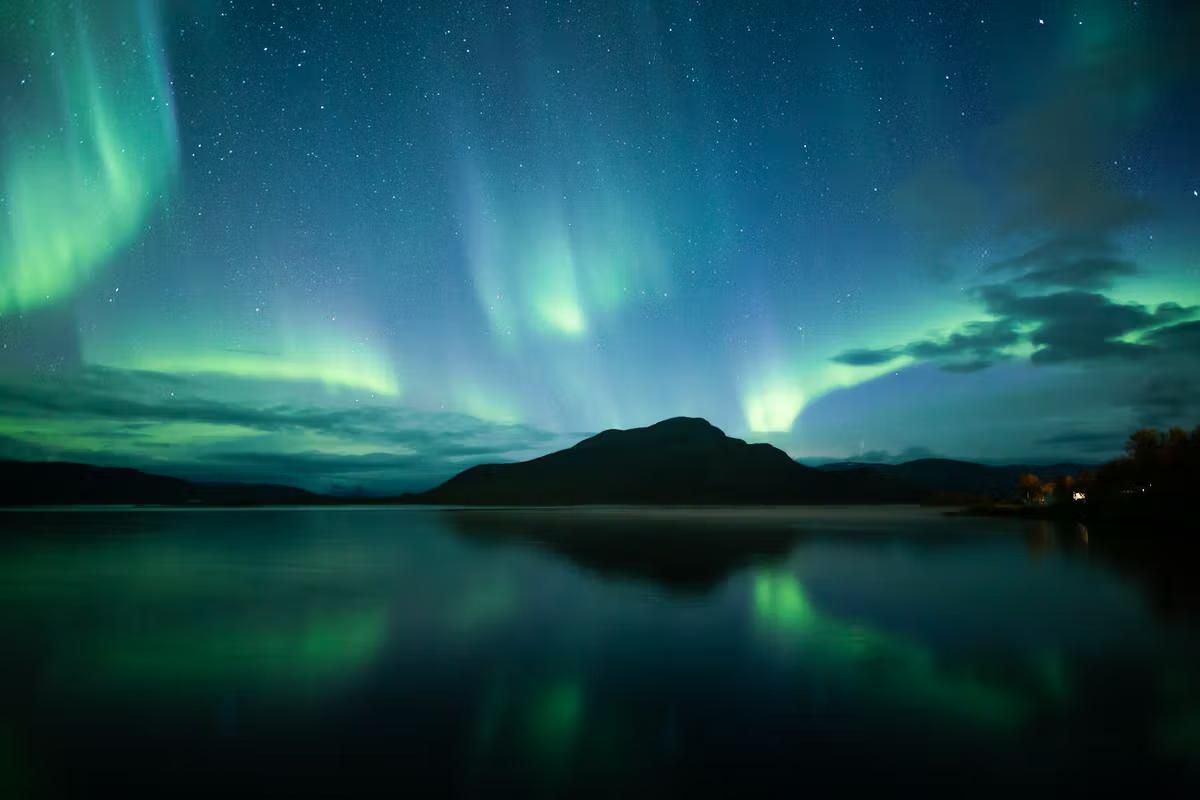
The lower edge of an aurora band is sharper than cloud, which is the easiest way to tell them apart.
Dark Adaptation: The Free Upgrade
Your eyes get dramatically better at this over about half an hour, and almost nobody waits.
The rods rely on a pigment called rhodopsin, which is bleached by bright light and regenerates slowly in darkness. Most of the recovery happens in the first 20 minutes, and it continues improving for 30 to 40.
At full dark adaptation your eyes are several orders of magnitude more sensitive than they were in a lit room. That is the difference between seeing nothing and seeing a faint band.
One glance at a phone screen at full brightness undoes a large part of it in seconds. This is the most common self-inflicted mistake on an aurora night.
Use a head torch with a red mode, or turn your phone brightness to minimum and switch on the red colour filter in accessibility settings. Red light barely affects rhodopsin.
How to See More of What Is There
Six things that genuinely help, in rough order of effect.
Get away from light. Reykjavík's glow reaches roughly 20 kilometres, so any stop on the Golden Circle is far enough. Þingvellir National Park is the standard choice, 45 minutes from the city with no town glow in any direction.
Wait 20 minutes before judging anything. Step out of the car, stand still, and give your eyes the time.
Use averted vision. Rods are concentrated away from the very centre of your retina, so looking slightly to one side of a faint band makes it brighter. Astronomers have used this trick for centuries, and it works immediately.
Face away from any light source, including your own vehicle. A car with its engine running and lights on ruins the night for everyone standing near it.
Let your eyes scan slowly rather than staring. Rods respond well to movement and change, which is why a display often becomes obvious the moment it starts to shift.
Check the sky repeatedly over two hours rather than deciding in ten minutes. Aurora arrives in substorms, and the gap between them can be 40 minutes.
Why Your Camera Sees More Colour
Both versions are true, and neither is a trick.
A camera integrates light over the whole exposure. Five seconds of collecting produces a much brighter, more colourful image than your eye can build in real time, and it records wavelengths your rods cannot distinguish.
Those colours are genuinely present. The Canadian Space Agency sets out that green comes from oxygen at 100 to 300 kilometres, red from oxygen at 300 to 400, and pink from nitrogen near 100 kilometres, and all of those emissions are happening whether you can see them or not.
Modern phones make the gap wider. Night mode combines multiple frames and applies noise reduction, so a phone photograph of a faint display can look like a moderate one.
Manage the expectation, and the night improves. Look with your eyes first, then take the photograph, rather than experiencing the whole display through a screen.
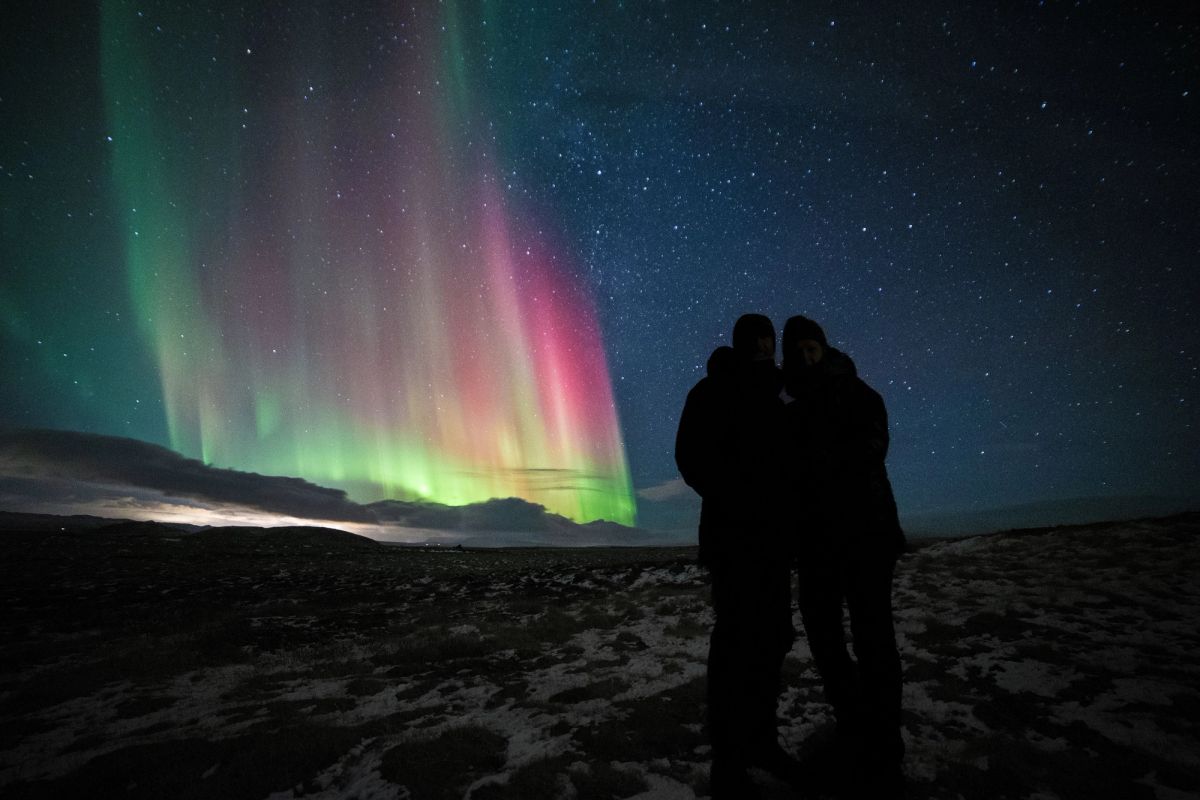
Pink and red edges appear to the eye only on strong displays. A camera records them far more often.
What Strength You Need to See It Unaided
Iceland's position does most of the work here.
The country sits directly under the auroral oval at around 64 degrees north, so activity of 2 or 3 on the 0 to 9 scale already produces a display overhead rather than on the horizon.
That is far lower than the threshold elsewhere. NOAA's storm scale shows that a Kp 5 minor storm is what pushes the aurora as far south as northern Michigan, and Iceland does not need one.
Waiting for a high number is therefore the classic first-timer mistake. Most of the displays Icelanders photograph each winter happen at values that would not register as a storm at all.
In practice, the Icelandic Met Office aurora forecast showing 2 or above with a clear sky is worth going out for. Anything at 4 or higher will be visible to anyone who looks up.
Cloud remains the deciding factor. No amount of dark adaptation sees through overcast.
Where the Best Naked-Eye Viewing Is
Location changes what your unaided eyes can pick up more than any technique.
Þingvellir is the standard from Reykjavík: 45 minutes out, no town glow, and a lake that doubles the display on a still night.
Laugarvatn is the easiest self-drive option, with a lit car park to retreat to and a geothermal bath on the lake shore.
Both sit far enough from the capital that a faint band is visible, which is the whole test of a good spot.
Anywhere on the Golden Circle works, and so does the Reykjanes peninsula if you are staying near the airport. What matters is the absence of light rather than the fame of the spot.
Inside Reykjavík, Grótta lighthouse is the best of a compromised set. Strong displays are clearly visible from there; faint ones are not.
The Moon and Other Complications
Three things dim what your eyes can see, and only one of them is avoidable.
A full moon lifts the whole sky brightness and washes out faint displays. It has almost no effect on a strong one, and it does light the landscape nicely for photographs. If aurora is the sole purpose of your trip, aim for a week around a new moon.
Snow on the ground reflects any available light and reduces contrast slightly, which is a small price for how much better the photographs look.
Your own night vision degrades with age. Pupil size and rhodopsin regeneration both decline, which is why a group often splits into people who can see a faint band and people who cannot.
Telling Aurora From Cloud
This trips up nearly everyone on their first night, and there are four reliable tests.
Aurora has a sharp lower edge and a diffuse upper one. Cloud is usually the other way round or uniform.
Aurora does not move with the wind. If the band is drifting sideways in step with the clouds below it, it is a cloud.
Stars are visible through aurora. They are not visible through the cloud, so if you can see points of light inside the band, it is the real thing.
The phone test settles it. Take a three-second exposure pointed at the band. If it comes out green, you have your answer, and this is the one legitimate use of a screen on an aurora night.
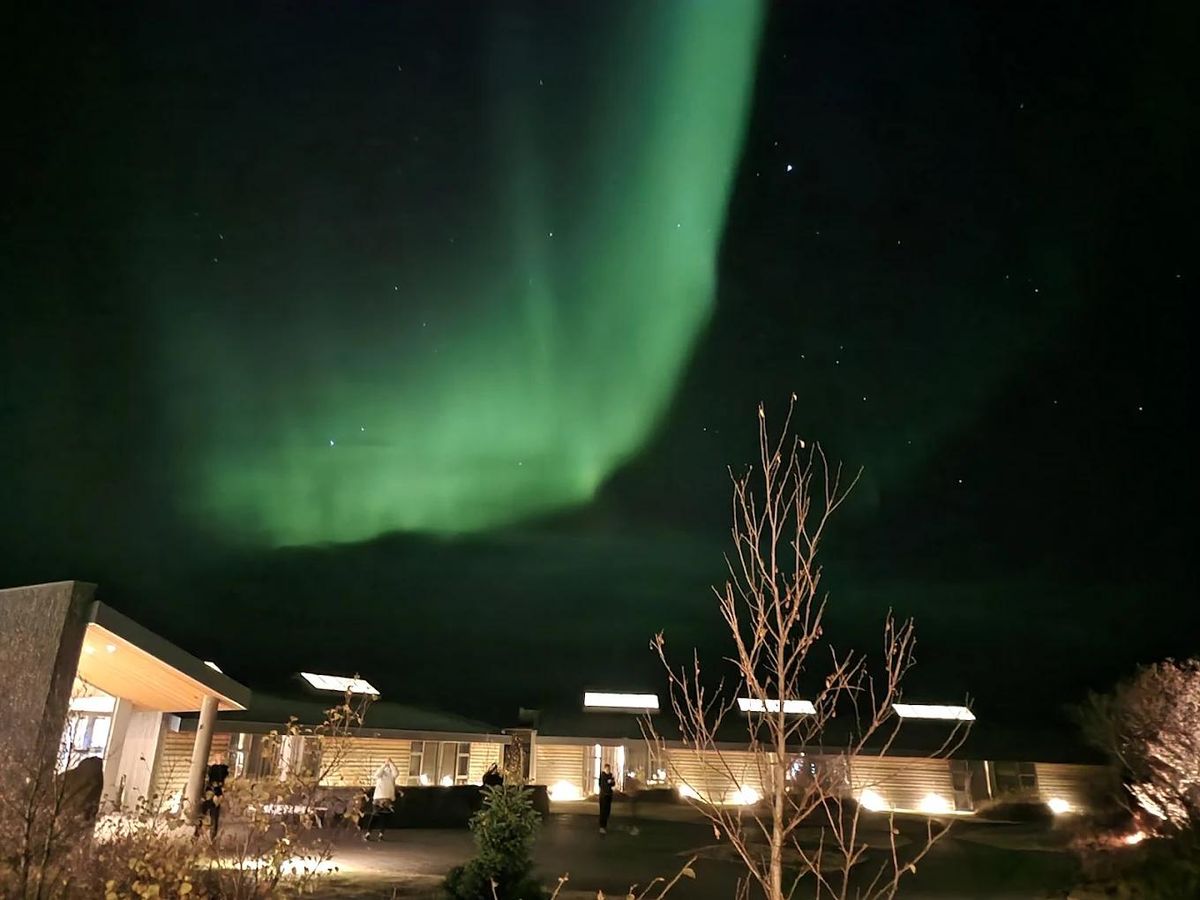
Stepping straight out of a lit building means 20 minutes before your eyes are working properly.
What It Feels Like in Person
Photographs undersell one thing entirely: movement.
A still image of a bright display looks impressive and static. In person the bands ripple, fold and travel across the sky, sometimes fast enough that the whole pattern changes in a few seconds.
That motion is what people remember, and it is the part no photograph captures. It is also why a moderate display in person often beats a spectacular photograph of a stronger one.
The scale surprises people too. Aurora forms at 90 to 150 kilometres up and can stretch for thousands of kilometres, so a curtain overhead is far larger and far further away than it appears.
Practical Advice for Your First Night
Dress for standing still, because that is what you will be doing. At the Golden Circle's nearest station, Met Office climate data puts January's average daily low at 4.3°C below zero with mean wind above 5 metres per second.
Take a red-light torch, a power bank and something hot to drink. All three extend how long you last outside, and how long you last is most of the game.
Do not look at the forecast every five minutes. It updates far more slowly than your patience runs down, and the screen wrecks your dark adaptation each time.
Give any night two hours before you call it. The most common story from disappointed visitors is that the display started 20 minutes after they left.
Bring someone else. Two pairs of eyes catch a faint band far more reliably than one, and the person who spots it first is rarely the same person twice.
Let Someone Else Find the Sky
Seeing the aurora unaided mostly comes down to being under a clear, dark sky for long enough, which in Iceland means driving away from the cloud rather than waiting under it.
Our small-group Northern Lights adventure goes wherever the map is clearest and gives you a proper stretch of time in one dark place, which is exactly what dark adaptation needs. Book it early in your trip so a second night is still an option.
Compare Golden Circle Tours
Check each selected product for its current operator, guide, itinerary, meeting point, and terms.
View Our Tours

