
A Kp 5 night in Iceland gives you bright green curtains moving overhead, occasional pink along the lower edge, and a display that keeps returning through the evening. It is a genuinely good night, and it happens several times a season.
A Kp 7 night is a different order of things. The whole sky fills, bands move fast enough to watch changing second by second, red appears above the green, and a corona overhead becomes likely. Those nights are rare and memorable.
The important Icelandic caveat is that you need neither. The country sits directly under the auroral oval, so activity of 2 or 3 already produces a display overhead, and most successful nights here fall well below Kp 5.
What the Kp Index Actually Is
Kp is a planetary index of geomagnetic disturbance on a 0 to 9 scale, calculated from magnetometer readings at observatories around the world.
It measures how much Earth's magnetic field is being shaken by the solar wind. Higher numbers mean the auroral oval expands further from the pole, which is what makes the aurora visible at lower latitudes.
Two limitations are worth knowing. Kp is a three-hour average, so a sharp 20-minute substorm can produce a spectacular display that barely moves the number. And it is a global index, so it tells you nothing about the cloud above your own head.
What Each Level Means Officially
NOAA maps Kp onto its G-scale for geomagnetic storms, and the official explanation gives both the thresholds and how often each occurs across an 11-year solar cycle.
- G1, Kp 5, minor: about 1,700 per cycle, aurora at high latitudes
- G2, Kp 6, moderate: about 600 per cycle, aurora as far south as New York and Idaho
- G3, Kp 7, strong: about 200 per cycle, aurora as far south as Illinois and Oregon
- G4, Kp 8, severe: about 100 per cycle, aurora as far south as Alabama and northern California
- G5, Kp 9, extreme: about 4 per cycle, aurora as far south as Florida and southern Texas
Those frequencies are the useful part. Kp 5 happens roughly 150 times a year on average, Kp 7 roughly 18 times, and only a fraction of either falls on a dark, clear Icelandic night.
Kp 5 From Iceland
This is a strong night by any normal standard.
The display is bright enough that colour is obvious to the naked eye rather than only to a camera. Green reads as green rather than grey-green, and the bands have visible structure.
Movement is clear. Curtains ripple and travel across the sky, and the pattern changes over seconds rather than minutes during the active phases.
Pink or magenta appears along the lower edge on the more energetic bursts, produced by nitrogen at around 100 kilometres. That is the colour most visitors hope for and it is realistic at Kp 5.
Coverage is wide. The display sits overhead rather than on the northern horizon, and it often extends into the southern sky, which is unusual and striking.
Expect three or four substorms across the evening with gaps of 20 to 60 minutes, and the reliable window is from 10pm to 1am.
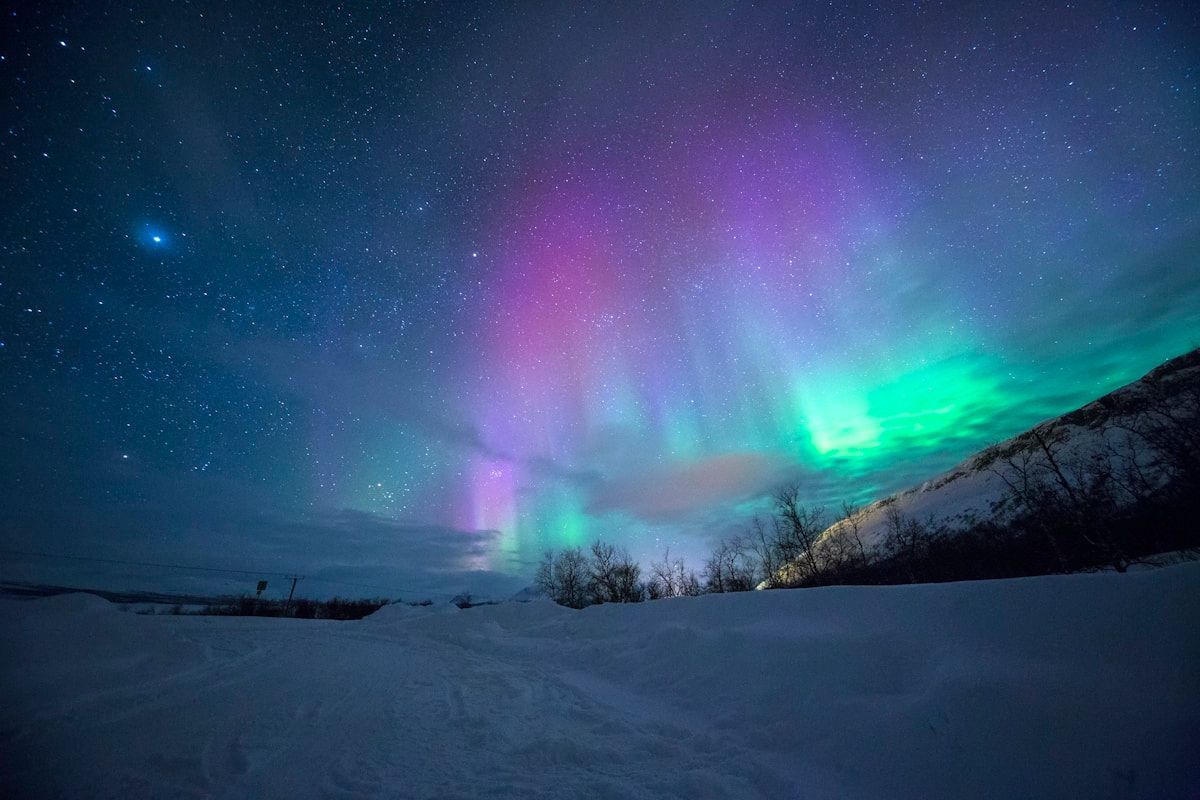
Pink and purple along the lower edge are realistic at Kp 5 and common at Kp 7.
Kp 7 From Iceland
At this level the experience changes in kind rather than degree.
The whole sky is involved. Aurora fills the field of view in every direction, including well into the south, and there is no single direction to face.
A corona becomes likely. That is the moment when bands converge overhead and appear to pulse outward from a point directly above you, and it is the single most impressive thing the sky does.
Red appears above the green, produced by oxygen at 300 to 400 kilometres. It reads as a hazy crown over the top of the structure, and it shows up more clearly in a camera than to the eye.
Brightness is high enough to light the ground. On a Kp 7 night with snow cover, you can see your own shadow, which people find genuinely disconcerting the first time.
Substorms come faster and the gaps shrink. Activity may run continuously for an hour or more rather than pulsing.
Why Iceland Needs So Much Less
The auroral oval is a ring roughly 20 to 25 degrees from the magnetic pole, and Iceland sits under it at about 64 degrees north.
That means the oval passes overhead even when the sun is quiet. A Kp 2 night produces a display directly above Iceland while showing nothing at all in Scotland.
The corollary is that very high Kp is not straightforwardly better here. When the oval expands strongly southward, its brightest band can move south of Iceland, leaving the display overhead thinner than it was at Kp 5.
That is a real effect and it is not a reason to hope for quiet nights. Kp 7 in Iceland is still spectacular, with the caveat that the very brightest part of the ring may be over the Faroes rather than over you.
What This Means for Planning
Four practical consequences.
Do not wait for a big number. Waiting for Kp 5 in Iceland means staying in on most of the nights that would have worked.
Check the cloud before activity. The Icelandic Met Office aurora forecast publishes its own 0 to 9 activity scale alongside a cloud map, and the map decides the night.
Treat a high forecast as a reason to travel further for clear sky, not as a guarantee. A Kp 7 under overcast shows you exactly as much as a Kp 0.
Stay out longer on high nights. Activity that intense often continues past 1am, which is unusual.
Dress for it too. At the Golden Circle's nearest station, Met Office climate data puts January's average daily low at 4.3°C below zero with mean wind above 5 metres per second, and a strong display is exactly when you will want to stay out for three hours rather than one.
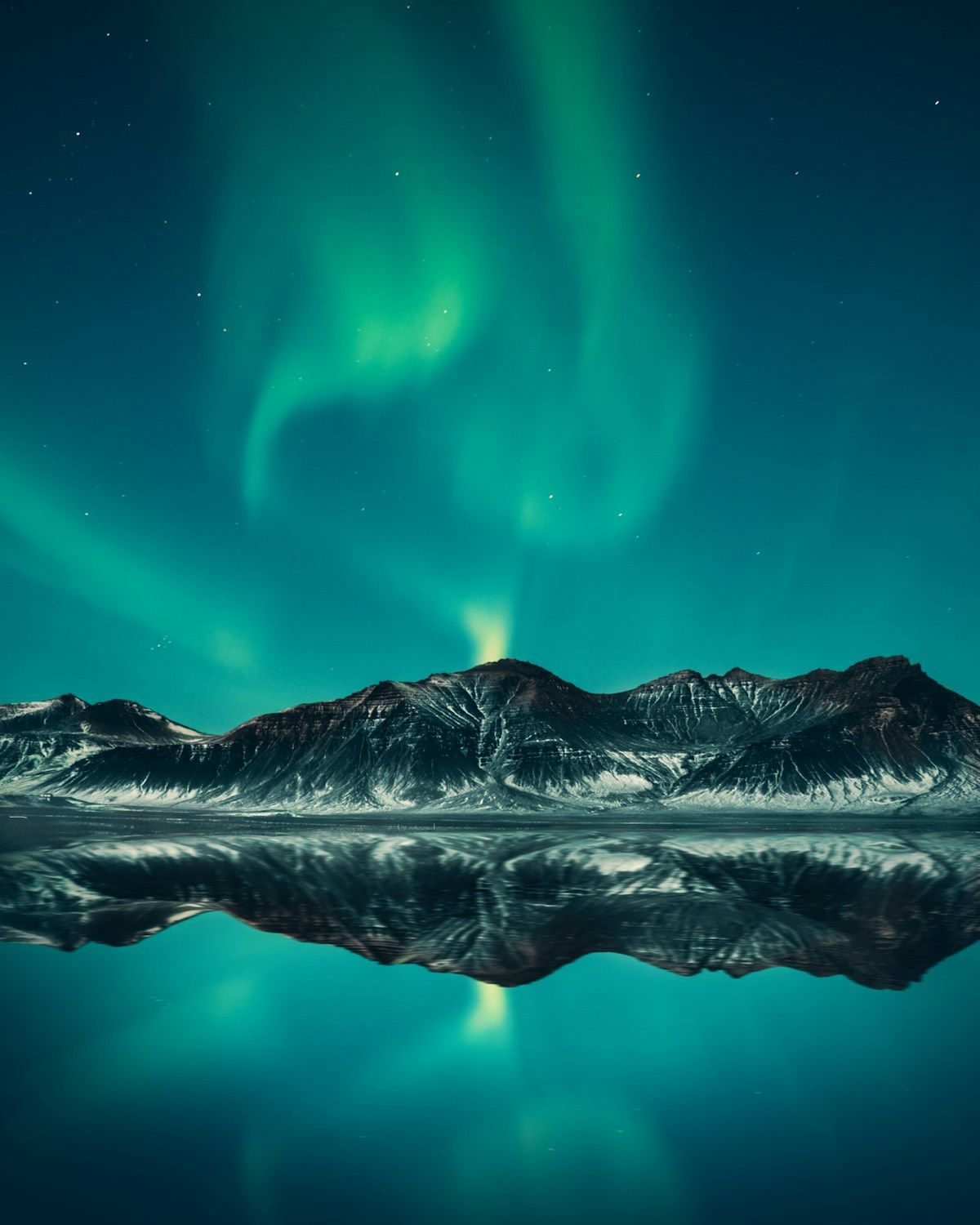
On any Kp number, the difference between seeing it and not is whether the sky above you is clear.
Reading the Better Indicators
If you want a sharper read than Kp gives, three numbers help.
Bz, the north-south orientation of the interplanetary magnetic field, measured in nanotesla. A steady negative value below minus 10 means the field is coupling efficiently with Earth's, and it is a better live signal than Kp.
Solar wind speed in kilometres per second. Above 500 is promising, and above 700 is strong.
Hemispheric power in gigawatts, which updates every half hour. Above 50 GW usually means a visible display somewhere under the oval.
Kp lags all three, because it is averaged over three hours. Use it for planning the evening and the others for deciding whether to stay out another hour.
Where to Watch a Strong Night
On a high-Kp night the priority shifts slightly from darkness to openness.
A display covering the whole sky wants an unobstructed horizon in every direction rather than a clear view north. Þingvellir National Park gives you that, along with a lake for reflections and car parks that stay open around the clock.
Standing water helps more at high Kp than at low, because a full-sky display reflected in a flat lake is the shot people spend years chasing.
Laugarvatn works for the same reason, with the advantage of a lit car park and a geothermal bath to warm up in.
Even inside Reykjavík a Kp 7 display is unmistakable, which is the one situation where city viewing genuinely works. Grótta lighthouse is the best of the urban options.
Managing Expectations
Two honest notes on the numbers.
Forecast Kp values are predictions, and geomagnetic forecasting beyond about three days is broad. A predicted Kp 7 that arrives as a Kp 4 is entirely normal.
Photographs of Kp 7 nights circulate widely and set an unhelpful benchmark. Most successful Icelandic aurora nights are Kp 2 to 4, and those are still worth going out for.
Set the bar at a bright green band overhead and you will have a good trip. Set it at the corona in the photographs and you may go home disappointed from three perfectly good nights.
See it on whatever number the sky gives.
The most useful thing anyone can do with the Kp index is stop waiting for a particular value and start watching the cloud map instead. Our small-group Northern Lights adventure runs on modest activity nights as well as headline ones, because in Iceland a clear sky at Kp 3 beats an overcast Kp 7 every time. Book an early evening in your stay so a repeat is still possible.
Compare Golden Circle Tours
Check each selected product for its current operator, guide, itinerary, meeting point, and terms.
View Our Tours

