
Why Do the Northern Lights Change Colour?
Aurora colour comes down to two things: which gas the incoming particles hit and how high up the collision happens. Oxygen at 100 to 300 kilometres glows green, oxygen higher still glows red, and nitrogen near 100 kilometres produces the pink and purple fringes along the bottom edge.
Green dominates because oxygen is abundant at that height and because human eyes are most sensitive to green light. Everything else needs either a stronger display or a camera to become obvious.
In Iceland you will see green on most active nights, pink or purple edges on perhaps one night in five, and a full red sky only during a serious geomagnetic storm.
The Physics in Plain Terms
The sun throws out a stream of charged particles called the solar wind. Earth's magnetic field deflects most of it and funnels some down towards the poles, which is why aurora forms in a ring rather than everywhere.
When those particles hit atoms and molecules in the upper atmosphere, they knock electrons into a higher energy state. The atom then drops back down and releases the extra energy as a photon of a specific colour.
Each gas releases a different colour because each has its own energy gaps. This is the same mechanism as a neon sign, run at 100 kilometres up and powered by the sun.
Altitude matters because the atmosphere changes composition with height. Oxygen dominates high up, nitrogen lower down, and pressure decides how long an excited atom has before a collision knocks the energy out of it.
Green: The Common One
Green is the colour almost everyone sees, and it comes from atomic oxygen.
According to the Canadian Space Agency, green is produced when charged particles collide with oxygen at altitudes of 100 to 300 kilometres, and it is the most frequently observed auroral colour.
There is a delay built into it. The excited oxygen atom takes about three quarters of a second to release its green photon, which only works if it is not disturbed first. Below about 100 kilometres the air is dense enough that collisions interrupt the process, which is why green has a sharp lower edge.
Your eyes help too. Human night vision peaks around the green part of the spectrum, so a display that is emitting several colours reads as green to the naked eye.
The shade is not the pure green of a traffic light. Most people describe it as pale, slightly grey-green, and it looks whiter when faint and more saturated as it brightens.
Red: The High-Altitude Colour
Red also comes from oxygen, but from much higher up, at roughly 300 to 400 kilometres.
At that height the atmosphere is so thin that an excited oxygen atom can wait around two minutes before releasing its photon without being disturbed. That long delay is why red aurora appears diffuse and slow-moving rather than sharp.
Red sits above green in a display, forming a hazy crown over the top of the bands. On a moderate night your eye may not register it at all while a camera picks it up clearly.
A whole sky of red means a major storm. Those are the events that push aurora down to mid-latitudes, and NOAA's storm scale records only about four G5 extreme storms per 11-year solar cycle.
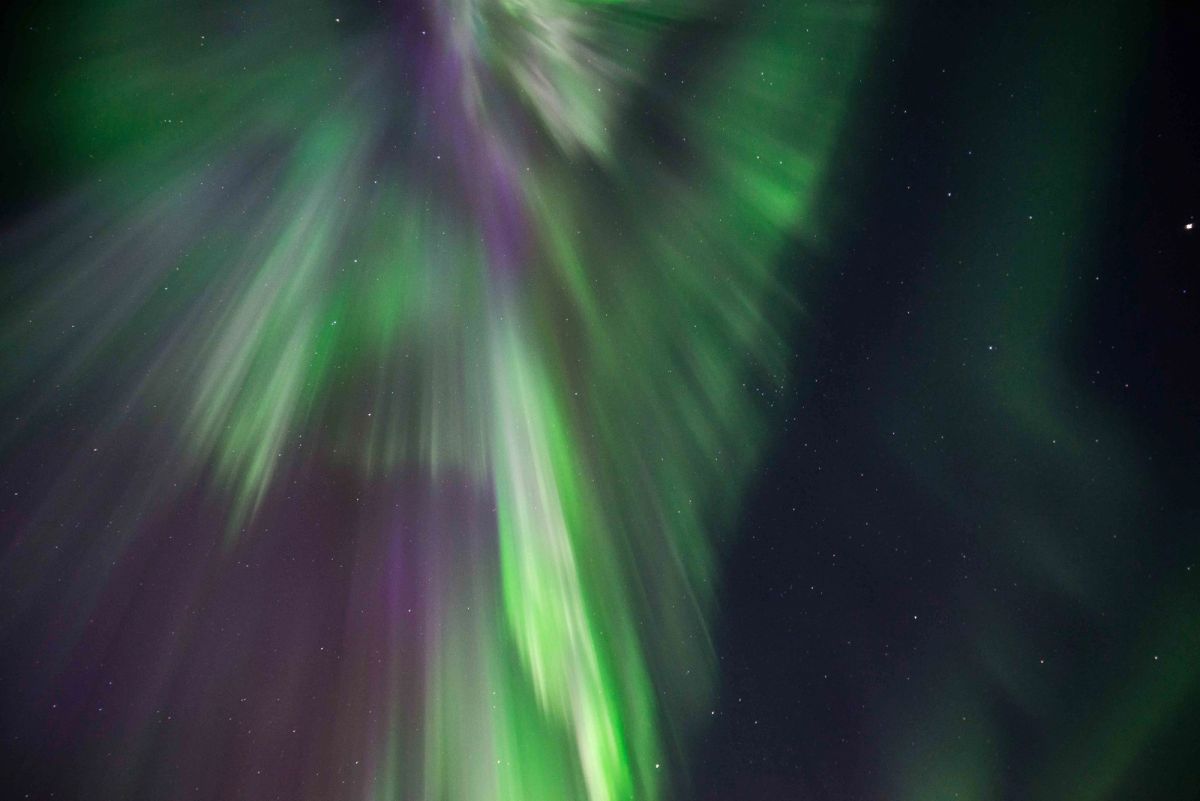
Purple against green marks the lower edge of the display, where nitrogen takes over from oxygen.
Purple and Pink: The Bottom Edge
This is the colour people come to Iceland hoping for, and it has a specific cause.
Pink and dark red at the lower fringe are produced by nitrogen molecules at altitudes around 100 kilometres. That is the base of the aurora, where the incoming particles penetrate deepest.
Purple is usually a blend rather than a single emission. Blue from ionised nitrogen mixes with red from the same molecule, and your eye reads the combination as violet or magenta.
Because it needs particles to reach that low, purple only appears when the display is energetic. That is why a night with pink edges is almost always a night with fast-moving bands and bright green above them.
Twilight helps. Just after dusk and before dawn, sunlight still illuminates the upper atmosphere while the ground is dark, which can make the blue and purple emissions much more visible.
Blue: The Rare One
Blue is the hardest colour to see and the least commonly reported.
The Canadian Space Agency notes that hydrogen and helium can produce blue and purple auroras and that these are difficult for our eyes to see against the night sky. Ionised nitrogen also emits in the blue.
Two things work against it. Blue emissions are faint, and human night vision is poor at the blue end of the spectrum, so a camera will often record blue where an observer saw nothing but green.
If you do see blue with your own eyes, you are watching something exceptional. It usually shows up at the bottom of very active displays, often alongside purple.
Why Cameras See More Colour Than You Do
This is the single most common disappointment on a first aurora night, and it is worth understanding before you go out.
Human eyes use two kinds of receptors. Cone cells see colour but need decent light; rod cells work in the dark but are essentially colourblind. At night you are running mostly on rods, which is why a moderate aurora looks pale grey-green.
A camera has no such limit. A five-second exposure gathers light continuously and records every wavelength that arrives, so reds, purples and pinks that are far too faint for your eye appear clearly in the file.
Neither version is a trick. The colours are genuinely there, and the camera is simply a better collector than your night vision.
Two things shift the balance in your favour. Give your eyes 20 minutes to dark-adapt before judging a display, and avoid looking at a phone screen, which resets that adaptation in seconds.
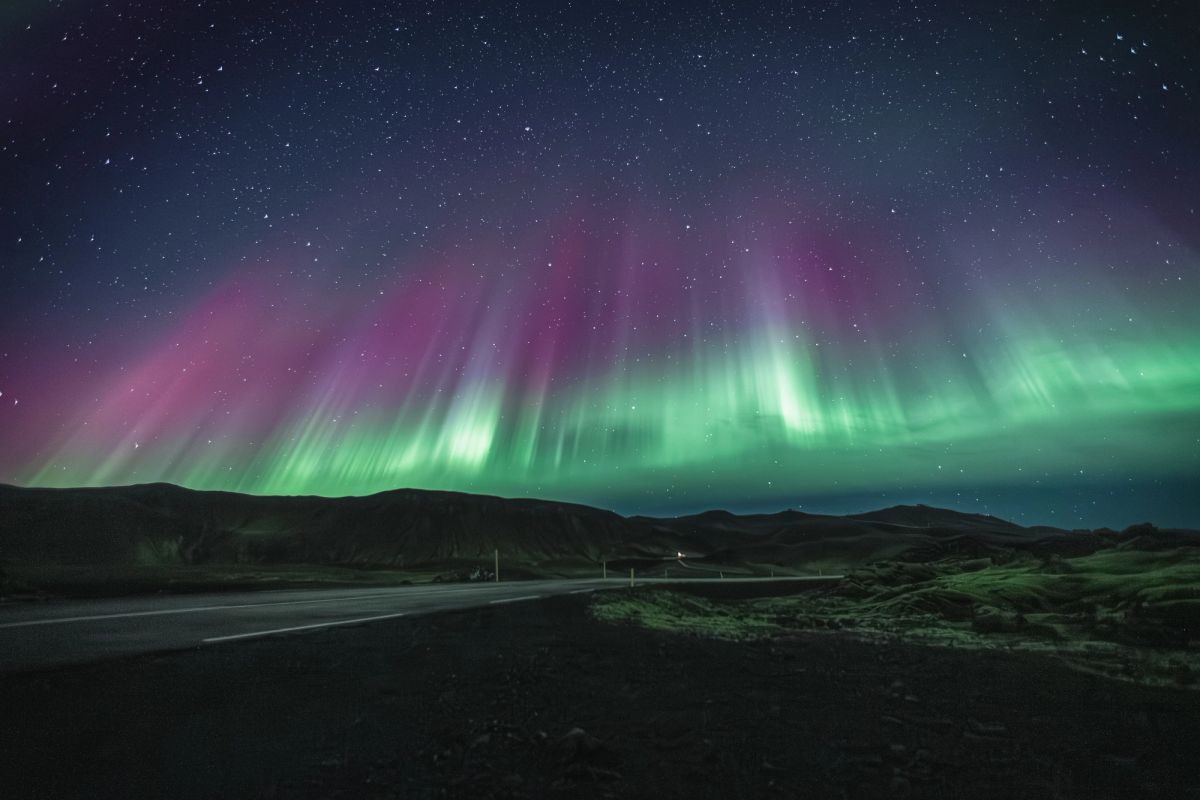
Pink fringes appear when particles reach down to about 100 kilometres, where nitrogen is abundant.
How Colour Relates to Strength
You can read a display's energy from its colours, which is a useful skill on a night out.
Faint grey-green arc, still and low on the horizon: a quiet night, activity around 1 or 2. Worth watching in case it develops.
Bright green bands with visible movement: a solid display, typically 2 to 4. This is what most Iceland visitors see, and it is genuinely good.
Green with pink or purple along the lower edge: an energetic display with particles penetrating deep. Expect fast movement and rapid changes.
Red above the green, or a red glow with no structure: high-altitude emission during a strong storm, and a rare sight from Iceland.
A corona, where bands converge overhead into a rayed crown: the display is directly above you rather than to the north. This is the best version of the whole thing, and it usually shows several colours at once.
What You Will Actually See in Iceland
Iceland sits under the auroral oval at about 64 degrees north, which changes the odds compared with anywhere further south.
Green is close to guaranteed on a clear, active night. Because the oval passes overhead rather than sitting on the horizon, you see the bright core of the aurora rather than its distant edge.
Purple and pink appear on strong nights, most often between 10pm and 1am when activity peaks. Over a three-night stay in a decent season, most visitors catch at least one display with coloured edges.
Full red is rare and memorable. It happens a handful of times in a solar cycle, and Icelandic social media lights up when it does.
The Icelandic Met Office aurora forecast gives an activity number from 0 to 9 alongside a cloud map. Anything at 4 or above is worth staying up for if you want colour beyond green.
Photographing the Colours
The settings that capture colour well are slightly different from the ones that capture shape.
Start at f/2.8, ISO 1600 and 4 to 6 seconds. Shorter exposures preserve the structure of fast-moving bands, which is where pink edges live.
Do not overexpose. A blown-out display loses its colour separation entirely, and the green core is the first thing to clip. Check the histogram rather than the screen.
Set white balance manually around 3500 to 4000 Kelvin. Auto white balance tries to neutralise the green cast and washes out the colour you came for.
Shoot raw if your camera allows it. Purple and red are subtle enough that the extra latitude in processing genuinely matters, and our Northern Lights camera settings guide covers the rest of the technique.
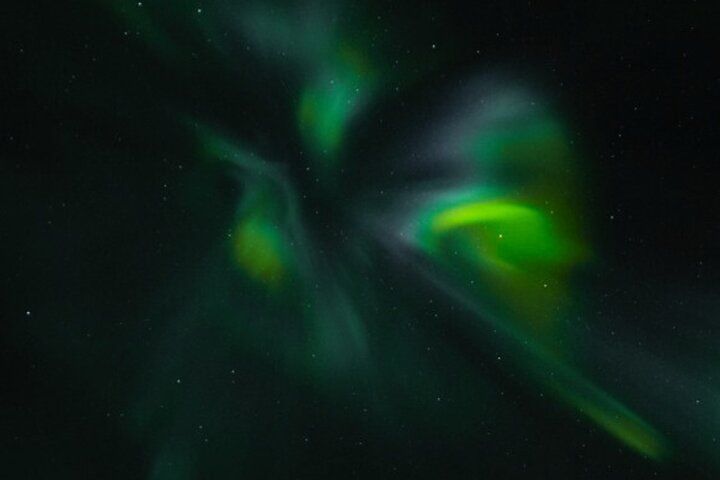
Fast-moving swirls mean an energetic display, which is when the other colours are most likely to appear.
Where Colour Shows Best Near Reykjavík
Dark sky matters more for colour than for brightness, because faint reds and purples are the first thing light pollution erases.
Þingvellir National Park is the best accessible spot from the capital, 40 kilometres out with the lake for reflections and no town glow in any direction.
Anywhere on the Golden Circle works. Reykjavík's light dome fades out at roughly 20 kilometres, and every stop on the loop sits beyond it.
Avoid photographing towards the city. Even a distant orange glow shifts the colour balance of the whole frame and buries the delicate fringes.
Common Myths About Aurora Colour
Four ideas worth dropping before your first night out.
Colour does not depend on temperature. Cold nights are often clear nights, and that is the whole of the connection.
The aurora is not more colourful further north. Once you are under the oval, as Iceland is, going further north moves you towards the edge rather than the centre.
A green display is not a failed display. Green is the aurora working exactly as it should, and it is what the great majority of photographs are showing you.
You cannot make purple appear by waiting. It is a function of how deep the particles penetrate, which is set by the sun rather than by your patience.
See the Colours for Yourself
The reliable way to catch a display with real colour in it is to be under a dark sky on an active night, which usually means getting well out of Reykjavík.
Our small-group Northern Lights adventure drives to the clearest sky within reach and gives you time to let your eyes adapt properly, which is when the pinks and purples start to register. Book it early in your trip so you have another night in reserve.
Compare Golden Circle Tours
Check each selected product for its current operator, guide, itinerary, meeting point, and terms.
View Our Tours

