
Can You See the Northern Lights From a Cruise Ship?
Sometimes, and the odds are worse than most people expect. The main obstacle is the calendar rather than the sky: Iceland's cruise season runs May to September, and there is no astronomical darkness anywhere in the country between mid-May and early August.
That leaves late August and September as the only realistic window within a standard sailing. In those weeks darkness returns from about 11pm and then 9pm, which makes a late departure or an overnight call genuinely viable.
Even then, a ship is a compromised viewing platform. Deck lighting, movement and a fixed position all work against you, and a shore excursion to a dark spot beats it comfortably.
Why Most of the Season Rules It Out
Aurora needs a genuinely dark sky, and Iceland does not have one in summer.
The country sits at about 64 degrees north, close enough to the Arctic Circle that the sun stays just below the horizon through midsummer rather than dropping far beneath it. Around the solstice Reykjavík gets roughly 21 hours of daylight and no astronomical darkness at all.
The lights are still happening. Charged particles are still producing green and red emissions at 100 to 300 kilometres up. They are simply drowned out by a lit sky, the same way stars vanish at noon.
So a June, July or early August sailing cannot show you the aurora regardless of solar activity, cloud cover or how far north the ship sails. This is the one part of the question with no workaround.
Sailing further north makes it worse rather than better. Grímsey, on the Arctic Circle off Iceland's north coast, has true midnight sun with no sunset at all around the solstice, and NOAA's aurora pages describe a process that has no seasonal component on the emission side.
The Realistic Window
The season opens quickly through August.
By the third week of August there is a short window after about 11pm where a strong display would be visible.
By mid-September darkness starts around 9pm and runs about eight hours, which is a proper aurora night.
By late September it begins at 8:30pm, and any call with an evening departure or an overnight becomes worth planning around.
If the aurora matters to your cruise, book September. It is also the quietest and best-value month of the Icelandic cruise season, so the trade is a good one.
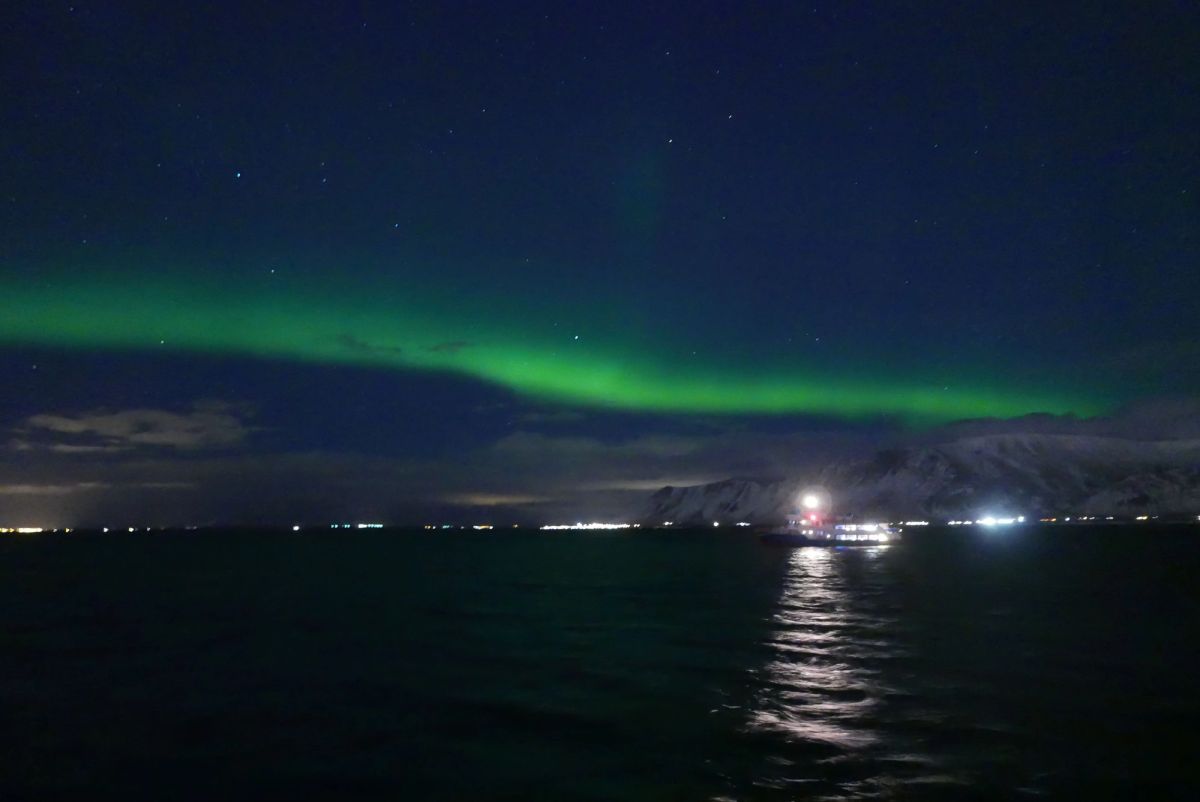
A vessel's own lighting is the main problem. On a working cruise ship there is a great deal of it.
Why a Ship Is a Poor Viewing Platform
Four problems, and the first is the largest.
Deck lighting. Cruise ships are lit for safety and for passengers walking around at night, which means the decks are among the brightest places in Iceland after dark. Your eyes never dark-adapt, and dark adaptation takes 20 minutes and makes a real difference to what you can see.
Movement. Even a large vessel moves enough to blur long exposures, so aurora photography from a deck needs a fast lens and short shutter speeds rather than a tripod.
Position. A ship cannot chase clear sky. On land a guide drives 80 kilometres to a gap in the cloud, and on a ship you get the sky above wherever you happen to be.
Obstruction. Superstructure, funnels and lifeboats block large parts of the sky, and the best open deck is often closed at night.
What a ship does offer is a genuinely dark horizon once you are at sea, away from any town glow. That is a real advantage over standing in central Reykjavík.
Where to Stand if You Try
If you are aboard on a September night with clear sky, a few things help.
Find the darkest deck. Usually the highest open deck aft, away from the pool lighting and the bars. Ask a crew member which deck stays open.
Ask about dimming. Some ships reduce non-essential deck lighting on request when aurora is forecast, particularly expedition vessels. Larger lines rarely do.
Give your eyes 20 minutes with no phone screen. Turn brightness to minimum and use the red colour filter in accessibility settings.
Face away from the ship's own lights and look for a pale grey-green arc rather than the vivid green in photographs. Faint displays read as brightness without colour to the naked eye.
Check the Icelandic Met Office aurora forecast before dinner. It gives activity on a 0 to 9 scale alongside a cloud map, and in Iceland a 2 or 3 is already enough.
Why a Shore Excursion Beats It
On a late or overnight call, going ashore is the better plan by a wide margin.
Reykjavík's light dome reaches roughly 20 kilometres, and a guided hunt takes you well past it. Þingvellir National Park is 45 minutes from the pier with no town glow in any direction and a lake for reflections.
A guide watches the cloud map and drives to whichever part of the southwest is clearest, which is the decision a ship cannot make.
You get a stable platform for photography, which means f/2.8, ISO 1600 and a five-second exposure on a tripod rather than a hand-held compromise.
And you get proper darkness. No deck lighting, no passing passengers with torches, and 20 uninterrupted minutes for your eyes to adapt.
The catch is the call schedule. This only works if your ship departs late or stays overnight, so check the day sheet before booking anything.
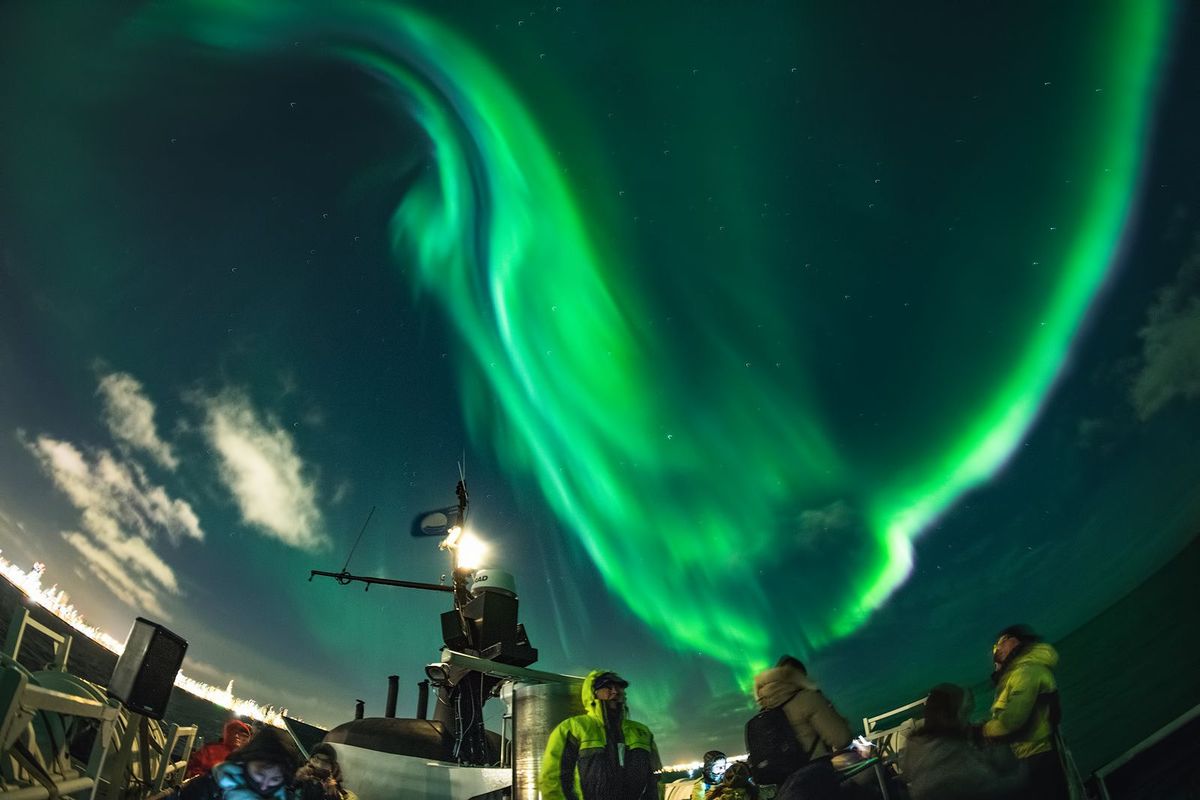
A dedicated aurora boat from the old harbour dims its lights, which a cruise ship will not do.
The Middle Option: A Local Aurora Boat
If you are in Reykjavík overnight and would rather stay on the water, there is a purpose-built version.
Aurora boat tours leave from the old harbour, sail onto Faxaflói bay and drift with the engines idling. They dim their lighting deliberately, which no cruise ship does.
A Northern Lights boat tour runs about four hours and gives you a dark 360-degree horizon with a heated cabin to retreat into.
It shares the movement problem for photography and it removes the lighting problem entirely, which is the bigger of the two.
Sailings run September to April, so an early-September call is the crossover point where a cruise passenger can realistically take one.
What About Winter Cruises?
A small number of itineraries sail Iceland outside the main season, specifically for the aurora.
Those give you 13 to 15 hours of darkness a night, which is the strongest possible setup. They also bring short daylight, North Atlantic swell and a real chance of a skipped call in high wind.
Expedition vessels handle this better than large cruise ships. They are smaller, they dim lights, and their crews are used to aurora watching as part of the product.
Check conditions before committing to a winter sailing. SafeTravel publishes the official alerts, and a skipped call in a January storm is a real possibility rather than a remote one.
If the northern lights are the reason for the trip, a land-based stay beats any cruise. Three or four nights at a rural guesthouse gives you repeated attempts, which is what actually raises the odds.
Managing Expectations
Two honest points that the marketing tends to skip.
Nobody can guarantee the aurora. It needs darkness, clear sky and solar activity to line up, and cloud alone ends most attempts. Any operator promising a sighting is promising a drive.
One night is a gamble. Roughly one clear active night in three is normal in Iceland, so a single evening on a single call is a coin flip at best.
Treat any sighting on a cruise as a bonus rather than the plan. The daytime landscapes are the reliable part of an Icelandic itinerary, and they deliver in every month.
If You Are Sailing in September
Five things that improve your chances on a late-season Iceland cruise.
Choose an itinerary with an overnight or a late departure from Reykjavík or Akureyri. Without one, you have no dark hours ashore.
Book a shore excursion rather than relying on the deck. Our shore excursion pages cover how the pickups work from Skarfabakki.
Check the forecast before dinner rather than at midnight. Cloud is the deciding factor and the map updates through the evening.
Bring the right clothing. At the Golden Circle's nearest long-running station, Met Office climate data puts September's average daily low at 4.5°C, and standing still on a deck in wind is colder than that suggests.
Keep the expectation low and the phone charged. A moderate display is a pale green arc to the eye and a far more colourful thing in a photograph.
See Them Properly on a Late Call
If your itinerary gives you a late departure or an overnight in Reykjavík between late August and April, going ashore is what turns a maybe into a genuine chance. Our small-group Northern Lights adventure leaves the city, chases whichever direction the cloud map favours, and gets you back to the pier in time. Send us your call date and departure time and we will confirm whether the timing works before you book.
Compare Golden Circle Tours
Check each selected product for its current operator, guide, itinerary, meeting point, and terms.
View Our Tours

