
Reykjavík or the Countryside?
The countryside wins, and by a margin that depends entirely on how strong the display is. On a bright night the aurora is unmistakable from central Reykjavík. On a quiet night, which is most nights, the city glow erases it completely.
The practical difference is roughly one step on the activity scale. A display that reads as a clear green band 45 minutes outside the city may be invisible from a lit street, and one that shows faint colour in the countryside shows none at all downtown.
Reykjavík's real advantage is spontaneity. You can step outside at 11pm without a plan, and over a week that adds up to more attempts than any single guided trip.
How Much Light Pollution Costs You
Reykjavík is small by international standards, with the capital area holding roughly two thirds of Iceland's population, and its light dome still reaches around 20 kilometres.
Inside that dome the background sky brightness rises, which reduces contrast against the aurora. Because faint displays are close to the threshold of human night vision, a small rise in background brightness removes them entirely.
Colour goes first. Pink and red fringes are subtle enough that even moderate light pollution buries them, which is why city photographs of the aurora are almost always green.
Dark adaptation suffers too. Your eyes never fully adapt under streetlights, so you are working at a fraction of your potential sensitivity all evening.
The emissions themselves are unchanged. As the Canadian Space Agency explains, oxygen at 100 to 300 kilometres produces the green and nitrogen near 100 kilometres produces the pink, whether you are standing in a lava field or on a lit street. Only the contrast changes.
The Best Spots Inside the City
If you are staying downtown without a car, four places are genuinely worth trying.
Grótta lighthouse on the tip of Seltjarnarnes is the best of them, 15 minutes from the centre, facing north over open water. The surrounding streetlights are switched off during aurora season, which makes a real difference.
Two cautions apply there. The causeway floods at high tide, so check before you walk out, and the small hot-foot pool nearby gets busy.
Öskjuhlíð, the wooded hill below Perlan, gives you elevation and some shelter from the streets. The viewing deck is easiest and the paths around the hill are darker.
Klambratún and Laugardalur are the two parks with enough open sky to be useful. Treat them as opportunistic rather than as a plan.
The old harbour and Grandi face north over the bay and are walkable from downtown, with harbour lights as the trade-off.
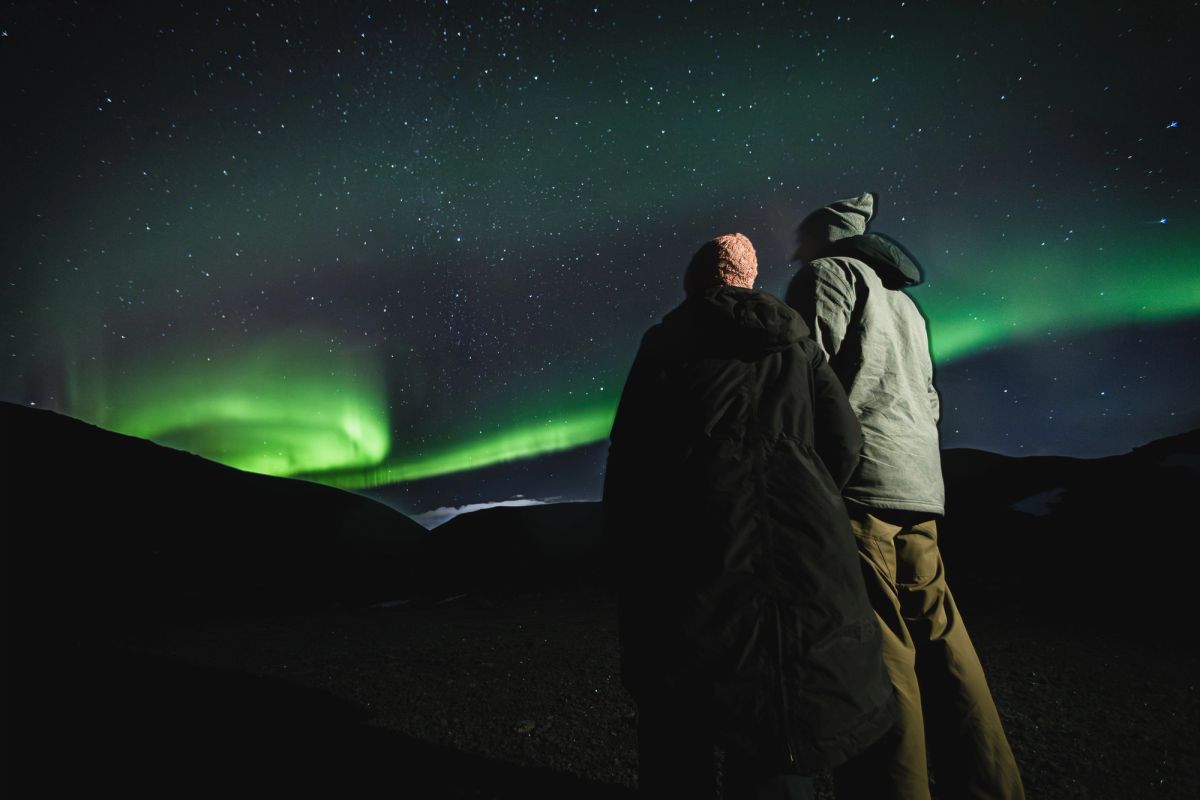
Grótta is the best city option, and it still sits inside the light dome that hides faint displays.
What the Countryside Gives You
Forty-five minutes of driving changes the night in four ways.
Faint displays become visible. This is the biggest gain, because most nights produce a faint display rather than a spectacular one.
Colour returns. Pink along the lower edge and red above the green both need a genuinely dark sky, and both appear regularly once you are out.
Your eyes work properly. Twenty minutes of dark adaptation in a place with no artificial light makes your vision several orders of magnitude more sensitive.
Foreground improves. Þingvellir National Park gives you rift walls and a lake, which turns a green sky into a photograph.
The Best Spots Within an Hour
Four options, deliberately in different directions so that one of them is usually clear.
Þingvellir is 45 minutes east, 40 kilometres from the nearest town glow, with car parks that stay open around the clock and machines that take cards at any hour.
Laugarvatn is an hour and ten minutes out, with a lake, a lit car park to retreat to and a geothermal bath on the shore.
Hvalfjörður is 40 minutes north via the old road rather than the tunnel, with mountains on both sides and very little traffic after dark.
The Reykjanes lava fields are 25 minutes southwest and the natural choice if you are staying near the airport.
When Staying in the City Makes Sense
Four situations where the city is the right call.
You have no car and no tour booked. Grótta at 11pm beats not going out.
The forecast shows high activity. On a Kp 5 or above night, city viewing genuinely works, and you avoid an hour of driving each way.
The cloud map shows the countryside covered and the coast clear. Direction matters more than distance, and sometimes the clear patch is over the bay.
You are only free for an hour. A spontaneous walk to the harbour is worth more than a rushed drive.
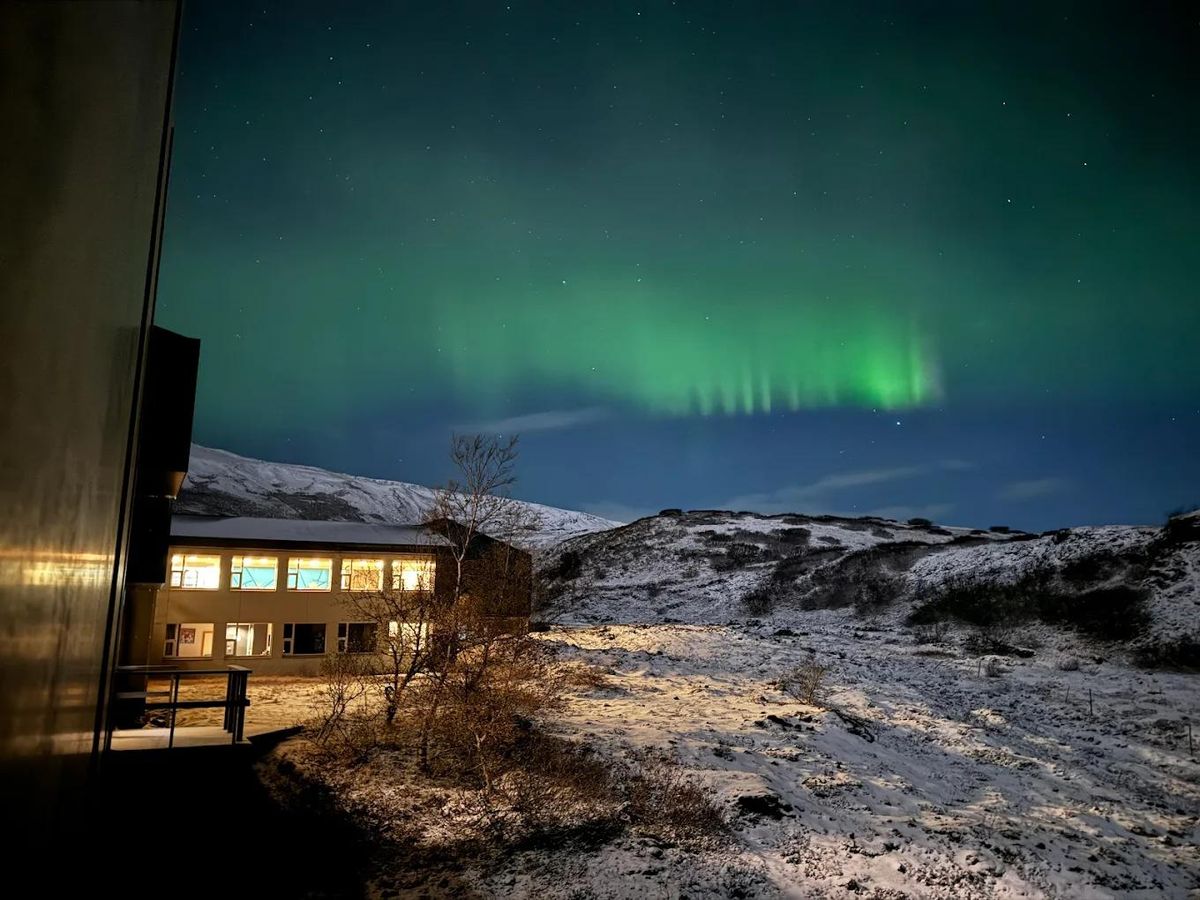
Staying rural removes the drive at both ends, which is the most comfortable version of aurora hunting.
The Third Option: Stay Outside the City
Overlooked by most visitors and often the best answer.
A guesthouse on the Golden Circle or the South Coast puts you under dark sky with no driving at all. You step outside after dinner, check, go back in, and check again an hour later.
Many rural properties offer an aurora wake-up call, so you can sleep until something happens rather than standing in a field on the off chance.
Ask two questions when booking: how far is the nearest town, and is there an open view north. A rural hotel tucked under a hillside is darker than the city and less useful than it sounds.
For a three-night trip, one night out of Reykjavík does more for your odds than any single tour.
How to Decide on the Night
The routine is the same wherever you are staying.
Check the Icelandic Met Office aurora forecast in the afternoon. It gives activity on a 0 to 9 scale alongside a cloud map, and the map decides where you go.
If activity is 4 or above and the sky over the city is clear, the city is fine.
If activity is 2 or 3, which is the normal Icelandic range, leave. That is exactly the band where light pollution decides whether you see anything.
In winter, check road.is before driving anywhere. Ice and closures make the countryside option conditional rather than automatic.
What You Give Up by Leaving
Being fair to the city option, three real costs.
Time. Ninety minutes of driving on a winter evening is a genuine imposition, particularly if you have a full day of sightseeing planned for tomorrow.
Comfort as well. At the Golden Circle's nearest station, Met Office climate data puts January's average daily low at 4.3°C below zero with mean wind above 5 metres per second, and a rural car park has no cafe to retreat into.
Risk. Icelandic roads in December are a skill, and doing it tired and in the dark is where problems start.
Flexibility. Once you have driven 45 minutes you are committed to that patch of sky, whereas from the city you can step out three times in an evening.
Those costs are why guided tours exist. Someone else drives, watches the map and takes the decision, which is the whole product.
The Verdict
Leave the city if you can. The gap between urban and rural viewing is largest on exactly the ordinary nights that make up most of the season.
Stay in the city if leaving is not practical, and go to Grótta rather than standing outside your hotel. Something is better than nothing, and strong displays are visible from there.
Best of all, book one night outside Reykjavík. It removes the drive, the risk and the decision in a single move.
Get Beyond the Light Dome
The simplest way to escape Reykjavík's glow without driving on winter roads yourself is to let someone else do it. Our small-group Northern Lights adventure leaves the capital and heads for whichever direction the cloud map favours, in a vehicle small enough to change plan on the way. Book it for an early night in your stay, then use the city spots on the evenings after.
Compare Golden Circle Tours
Check each selected product for its current operator, guide, itinerary, meeting point, and terms.
View Our Tours

