
Do You Need a Tour to See the Northern Lights?
No. Iceland sits directly under the auroral oval; the sites are free and open around the clock, and on a clear active night you can drive 40 minutes from Reykjavík and see the lights on your own.
What a tour buys you is not access; it is judgement. A guide has been reading the cloud map since lunchtime, knows which valley clears first when the wind is southerly, and drives the icy roads for a living.
The honest split: if you have a car, three or more free nights and reasonable winter driving confidence, do it yourself. If you are missing any one of those, book a tour.
The Case for Doing It Yourself
Four genuine advantages, and they matter more than the marketing suggests.
You control the timing. Tours leave at 8pm or 9pm and return at midnight, while a self-driver can go out at 11:30pm when the forecast suddenly improves or stay until 2am when the display is building.
You control the spot. You can stand somewhere with a foreground you want to photograph rather than wherever a coach can safely park 40 people.
You can go out repeatedly. One tour costs the same as five nights of fuel, so a DIY hunter can try every night of their trip without thinking about it.
And you avoid the crowd. Twenty people with phone torches is the least atmospheric way to watch an aurora, and it is the most common complaint about coach tours.
The Case for a Tour
Four counterarguments, and the first is the strongest.
The guide chases the sky. Cloud decides almost every Icelandic aurora night, and a driver who is willing to go 80 kilometres to find a hole in it will beat a visitor who drove to the spot they picked yesterday.
You do not drive on ice at midnight. Winter roads in Iceland are a genuine skill, and doing that tired, in the dark, in an unfamiliar car is where holidays go wrong.
Most operators rebook you free. If the tour runs and the lights do not appear, you can usually join another departure within a set window, which is insurance a self-driver does not have.
Guides also see displays you would miss. A faint band low on the horizon reads as cloud to an untrained eye, and by the time it brightens, you would have driven home.
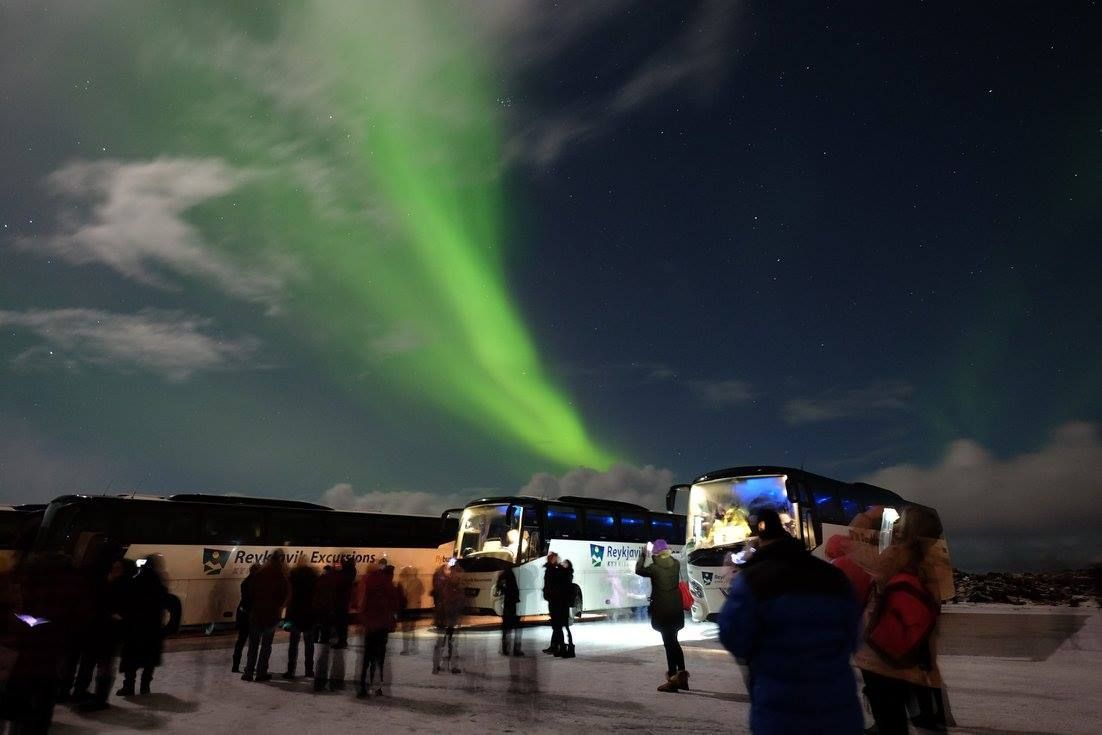
The value of a guided hunt is the decision about where to go, made hours before you get in the vehicle.
What Each Actually Costs
Prices in Icelandic krónur, per adult, for a night out.
- Classic Northern Lights coach tour, 5 hours: 9,999 ISK
- Small-group Northern Lights tour, up to 19 guests, 5 to 7 hours: 20,990 ISK
- Northern Lights boat tour from the old harbour, 4 hours: 14,490 ISK
- Private Northern Lights tour, up to 19 guests: 190,000 ISK per vehicle
- Self-drive: fuel only, roughly 1,500 to 3,000 ISK for an evening within an hour of the city
The arithmetic is not close for a couple with a rental car. Two coach seats cost 20,000 ISK, and five nights of driving to Þingvellir costs under 15,000.
It flips if you do not already have a car. A rental for one night plus insurance plus fuel exceeds two coach seats, and you would be driving unfamiliar winter roads to save nothing.
For a solo traveller the coach wins outright. For a family of four with a car, self-driving wins by a wide margin.
Doing It Yourself: The Method
If you decide to go alone, this is the process that works. It takes about two minutes of planning, and it is most of the difference between success and a wasted evening.
1. Check the forecast in the afternoon.
The Icelandic Met Office aurora forecast gives activity on a 0 to 9 scale at midnight, six days ahead, with a cloud map beside it. In Iceland, 2 or 3 is already enough for a visible display.
Look at the cloud map before the number. White means clear, green means cloudy, and the whole exercise is finding a white patch within an hour of you.
2. Pick a spot inside that patch.
Not your favourite viewpoint. The clearest one.
Þingvellir National Park is the default from Reykjavík, 45 minutes out with lake reflections and no town glow. Laugarvatn, the Grímsnes farmland and Hvalfjörður are the other reliable choices, each in a different direction, so one of them is usually clear.
3. Check the roads.
In winter, road. is showing ice, snow and closures in near real time on the exact route numbers. A clear sky behind a closed road is worth nothing.
Treat an impassable marking as final. There is always another night.
4. Be in position before darkness.
Full darkness starts around 9pm in September, 6pm in December and 8:30pm in late March. Arrive 30 minutes early so you can park, set up and let your eyes adapt.
5. Wait two hours.
Aurora arrives in substorms rather than steadily. A blank sky at 10pm frequently becomes a strong display by 10:40, and most people who give up early give up at exactly the wrong moment.
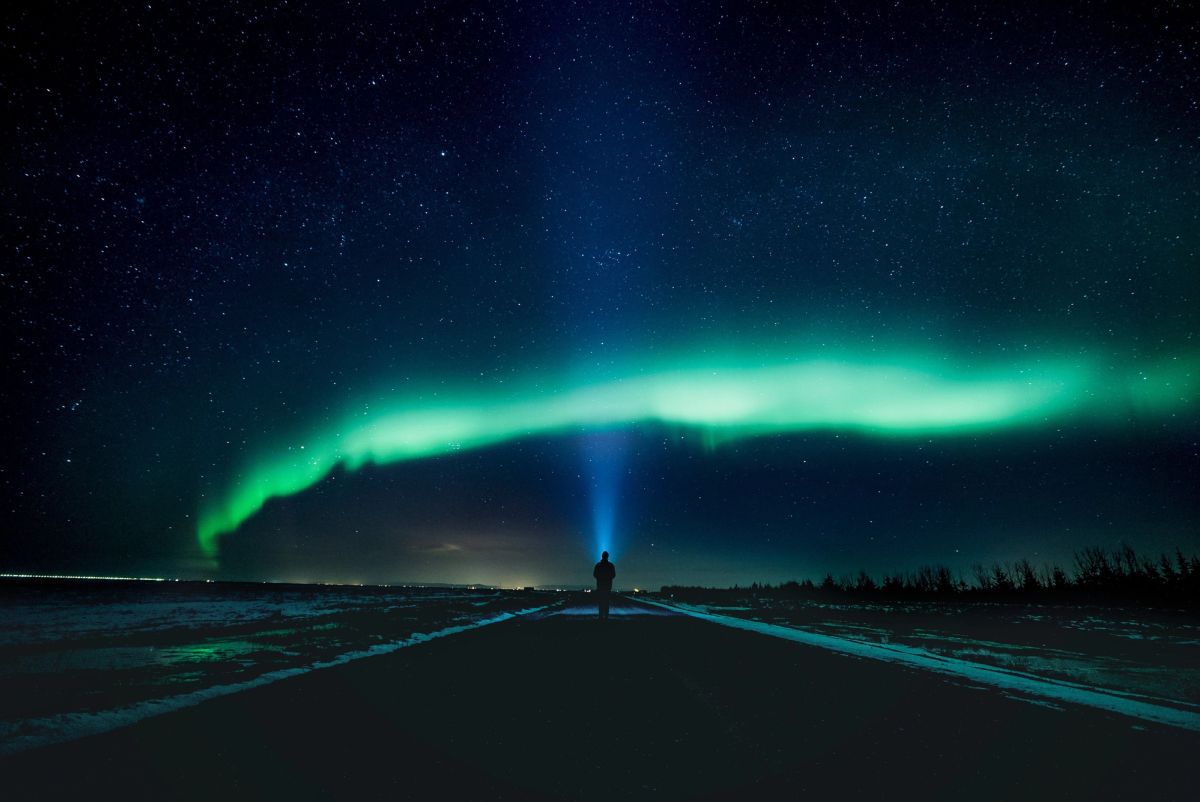
Park in a proper layby or car park. Stopping on the verge of an unlit Icelandic road is genuinely dangerous.
The Winter Driving Question
This is the part that decides it for most people, and it deserves a straight answer.
Icelandic winter roads are not usually dramatic. They are wet, then icy, then clear again, and the danger is the transition rather than deep snow.
Rental cars run winter tyres from 1 November to 14 April by law, and studded tyres are permitted in that window. Request them if you are driving in January or February.
The specific risks at night are black ice on bridges, side wind on exposed stretches like Lyngdalsheiði, and unlit single-lane bridges. None of them is exotic, and all of them are worse when you are tired.
Check SafeTravel for alerts before you leave. If there is an orange warning for the area, stay in.
If any of that makes you uncomfortable, that discomfort is the correct answer. Book a tour.
Odds: Does a Tour Actually Improve Them?
Yes, and by less than operators imply and more than DIY enthusiasts admit.
The improvement comes almost entirely from mobility and information. A guide watching the cloud map will move; most self-drivers park once and stay.
Where a tour cannot help is activity. Nobody controls the sun, and a quiet night is quiet for the coach and the rental car alike.
Where a self-driver has the edge is repetition. Going out four nights beats one guided attempt, and cumulative attempts matter more than any single night's expertise.
The best combination is a tour on your first free night and DIY on the rest. You learn what to look for from the guide, then apply it yourself.
What to Take on a DIY Aurora Night
The kit list is short, and skipping any of it shortens your night.
Warm layers built for standing still. At the Golden Circle's nearest station, Met Office climate data puts January's average daily low at 4.3°C below zero with mean wind above 5 metres per second, and two hours motionless in that is colder than any daytime activity.
A head torch with a red mode. White light resets your night vision in seconds, and red keeps it.
A power bank. Cold flattens phone batteries fast, and your phone is your forecast, your map and your camera.
Something hot to drink and something to sit on. The difference between leaving at 10:30pm and staying until midnight is usually comfort rather than willpower.
A full tank of fuel. Rural stations are unmanned after hours, and some older foreign cards struggle with them.
Mistakes DIY Hunters Make
Five errors account for most failed independent nights.
Driving to a famous viewpoint rather than to a clear sky. The cloud map is the decision, not the guidebook.
Parking on the verge. Icelandic road shoulders are soft and unlit, and a parked car there is a genuine hazard to everyone.
Going out once. One clear active night in three is normal, so a single attempt is a coin flip.
Giving up at 10:30pm. The reliable window runs to 1am, and displays often start late.
Standing next to a lit building or a car with its engine and lights running. Both destroy the dark adaptation that lets you see faint bands.
What About Watching From Your Hotel?
The third option, and the most underrated.
A guesthouse on the Golden Circle or the South Coast sits under a dark sky with no driving involved. Many offer an aurora wake-up call, which means you can sleep until something happens.
That removes both the cost of a tour and the risk of night driving. The trade-off is that you cannot move if your patch of sky clouds over.
Ask two questions when booking rural accommodation: how far is the nearest town, and is there an open view north? Both matter more than the room.
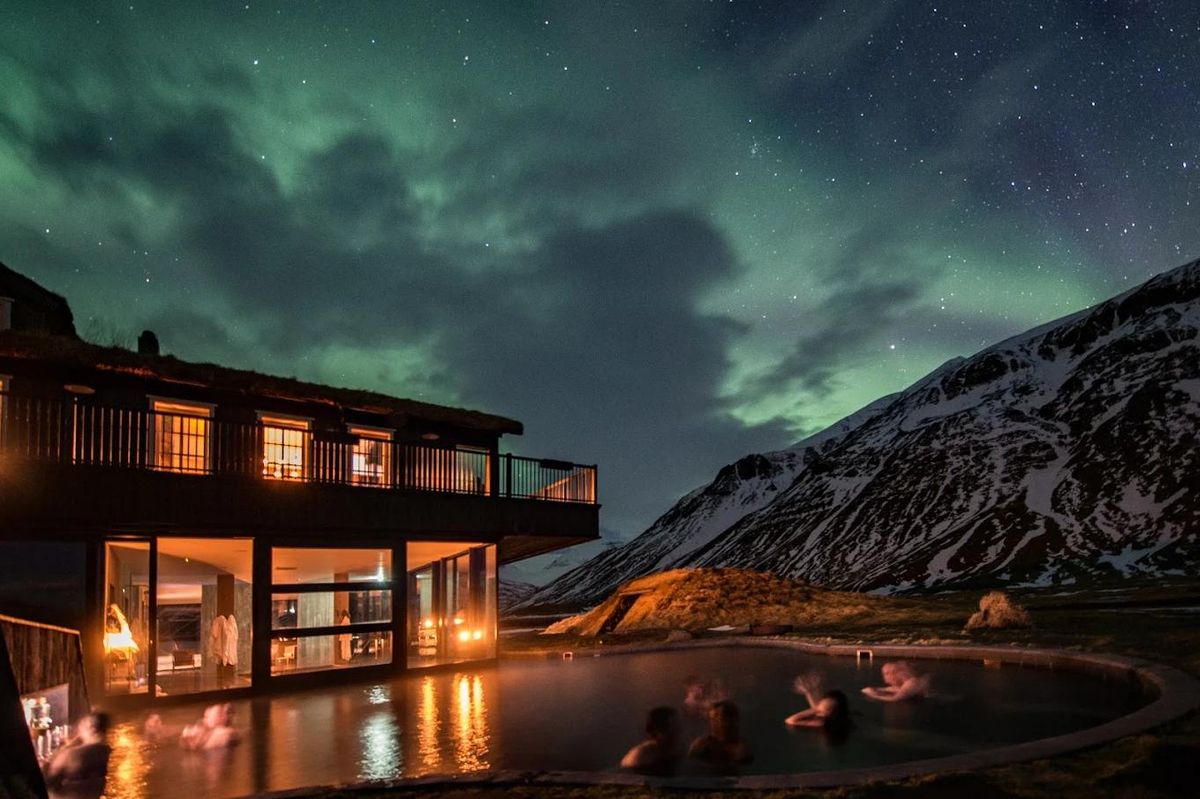
Staying outside the city removes the drive entirely, which is the safest version of aurora hunting.
Which Tour Type, If You Book One
The three formats suit different people.
A coach tour at 9,999 ISK is the cheapest and the least flexible. Fifty people, a fixed stopping point, and a good guide who cannot easily change plans. Fine for a first attempt.
A small-group tour at 20,990 ISK caps the vehicle at 19 and can genuinely chase clear sky. This is the format most likely to find a gap in the cloud.
A boat tour at 14,490 ISK takes you onto Faxaflói Bay with a dark horizon in every direction and a heated cabin. Good for the view, poor for long-exposure photography.
A private vehicle at 190,000 ISK makes sense for a group of six or more or for anyone who wants to stay out until 2am.
Three Situations With Clear Answers
Some cases are not close.
You have one night in Iceland and no car: book a tour. There is no version of DIY that beats a driver who knows where the sky is clear.
You have a car and five nights in a countryside guesthouse: do it yourself. You will go out repeatedly at no cost and almost certainly succeed.
You are visiting in December with no winter driving experience: book a tour. This is the month with the most cancellations and the worst road conditions, and it is not the time to learn.
A Hybrid That Works Well
Combine the aurora with something you were doing anyway.
An evening Golden Circle departure covers the three main sites in daylight and stays out after dark, which means the drive is already paid for and the guide is already watching the sky.
The same logic applies to a countryside overnight. Book the Golden Circle Classic Tour for the day, stay at Laugarvatn or Flúðir, and step outside after dinner.
That version costs less than two separate bookings and puts you under the dark sky without a single extra kilometre of night driving.
Book the First Night, Drive the Rest
If you are undecided, the practical compromise is to let a guide teach you the first night and then repeat it yourself. Our small-group Northern Lights adventure caps the vehicle at 19 people and goes wherever the cloud map is thinnest, which is exactly the decision that takes practice.
After that you will know what a faint band looks like and where the clear sky tends to sit, which is most of what a guide is for.
Compare Golden Circle Tours
Check each selected product for its current operator, guide, itinerary, meeting point, and terms.
View Our Tours

