
Most ships dock at Skarfabakki, roughly 4 kilometres from central Reykjavík according to Visit Reykjavík. Your options are a cruise-line shuttle at around 10 minutes, a taxi at 10 to 15 minutes, city bus route 16, an electric scooter, or a walk of 45 to 50 minutes.
There is no attraction at the pier itself. Skarfabakki is a working quay with a coach park, so getting into town is the first decision of your port day rather than an afterthought.
Which option suits you depends less on cost than on how long your ship is in port. On a 12 hour call the walk is a pleasant way to start the day. On a 6 hour call it is 100 minutes of your time spent on pavement.
Where Ships Actually Dock in Reykjavik
Reykjavík has two cruise berths and they are not interchangeable, so the first thing to check is which one you are using.
Skarfabakki (Sundahöfn)
This is the main cruise terminal and it handles nearly all large vessels. It sits in Sundahöfn, the eastern cargo harbour, about 4 kilometres northeast of the centre.
The terminal has a small building with toilets, a tourist information desk and a coach park where both ship excursions and independent operators collect. Facilities are functional rather than generous.
Faxaflóahafnir, the port authority, is opening a new passenger terminal here of 5,500 square metres over two floors in spring 2026, which will change the arrivals experience considerably.
The Old Harbour (Miðbakki)
Smaller vessels, expedition ships and some luxury lines berth at Miðbakki in the old harbour, right beside the centre.
If this is you, the transport question mostly disappears. Harpa is a five-minute walk, Laugavegur is ten, and the whale watching boats leave from the same quay.
Check your day sheet on the morning rather than assuming. Ships occasionally shift berth at short notice when the schedule gets crowded, and the difference between the two is 4 kilometres.
Cruise Line Shuttle Buses
The most common way passengers get into town, and the one most likely to change from season to season.
Individual cruise lines run shuttles from Skarfabakki, usually for a fee, and drop off near Harpa Concert Hall on the waterfront. The ride takes about 10 minutes each way in normal traffic.
The free port authority shuttle that operated between 2023 and 2025 has ended, so any terminal shuttle in 2026 is arranged by your own line rather than by the port. Check your onboard daily programme rather than relying on what a guidebook said last year.
Tickets are typically sold as an all-day pass rather than per journey, which makes the shuttle better value if you plan to come back to the ship for lunch.
Buses run on a loop through the day, usually every 20 to 30 minutes, with the last return an hour or so before all-aboard. Note that last departure time before you wander off.
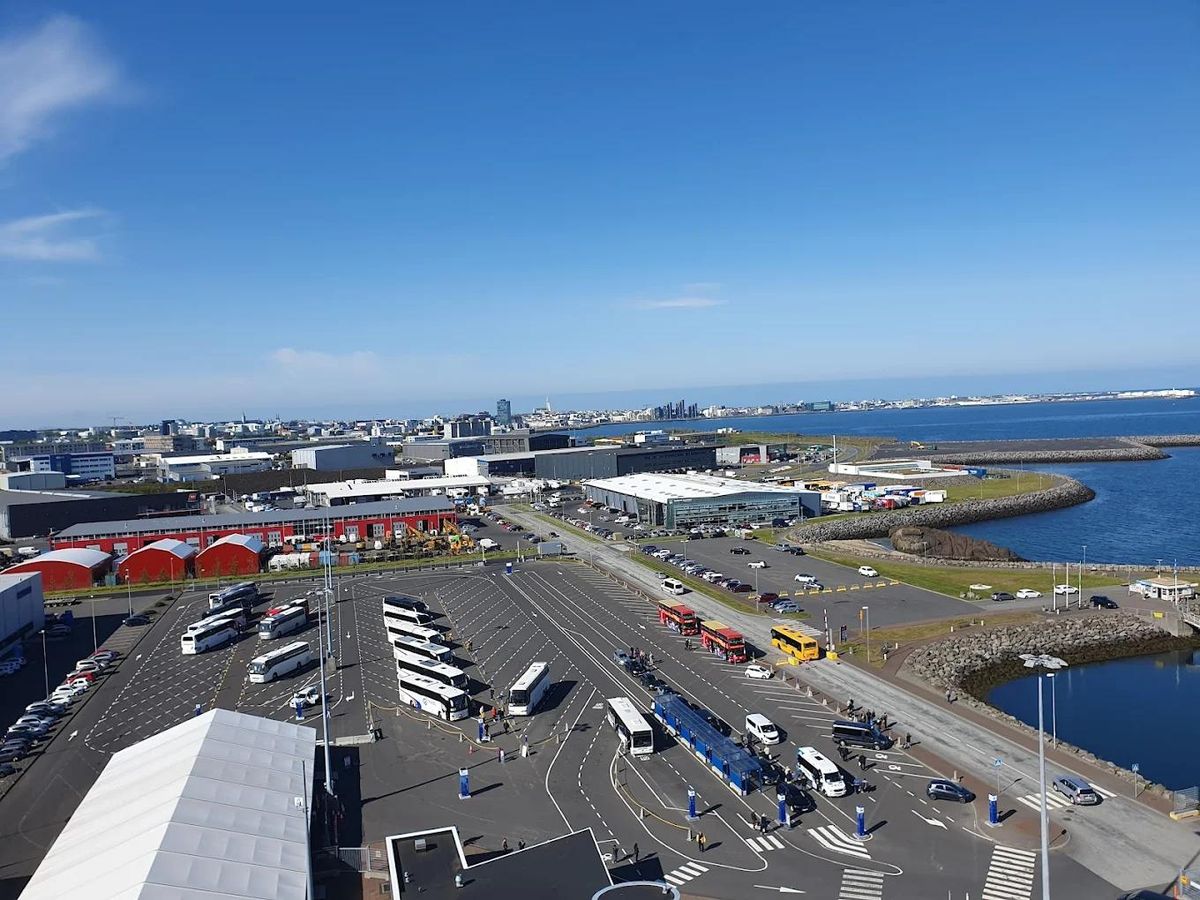
Shuttles, ship excursions and independent operators all collect from the same coach park.
Taxis
The fastest and simplest option, and by some distance the most expensive.
Taxis wait at the terminal on call days, particularly during the morning disembarkation rush. If none are there, the terminal information desk will call one.
The trip to the centre takes 10 to 15 minutes. Iceland has no congestion to speak of outside the morning commute, so the time is predictable.
Fares are high by international standards, and there is no tipping culture, so the meter is the whole cost. For a group of four, splitting one fare compares reasonably with four shuttle tickets.
Cards are accepted universally. Icelandic taxis do not expect cash and many drivers do not carry change.
Ride-hailing apps do not operate in Iceland in the way they do elsewhere, so do not plan around opening one at the pier. Hreyfill and BSR are the two main companies and both take phone bookings.
Booking a Return
The one thing worth arranging in advance is the trip back.
Central Reykjavík has fewer taxi ranks than a city of its size suggests, and on a day with three ships in port the demand spikes in the late afternoon.
Take the driver's card on the way in and call the same company an hour before you want to leave. It removes the only genuinely stressful part of an independent port day.
Public Bus
The cheapest option and a perfectly reasonable one if you are not in a hurry.
Route 16 stops close to the cruise terminal and runs into the centre. Strætó, the capital area bus operator, is the network you are using.
A single adult fare rose to 690 ISK on 6 January 2026 according to Strætó, and one ticket stays valid for 75 minutes including transfers.
Payment is through the Klappid app or a Klapp card. Drivers do not sell tickets and do not give change, which catches out most first-time users.
Frequency is the real constraint. Buses run every 20 to 30 minutes on weekdays and less often at weekends, so a missed one costs you half an hour.
Journey time into the centre is around 15 to 20 minutes depending on stops. Add the walk to the bus stop and the wait, and the door-to-door figure is closer to 35 minutes.
For a passenger with plenty of time and an interest in seeing how a city actually works, it is the most interesting way in. For a tight call, it is not the right choice.
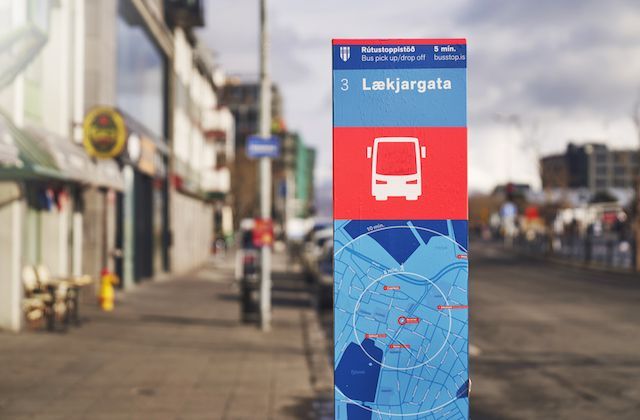
Strætó stops are marked with the yellow S, and tickets are bought in the app rather than from the driver.
Walking Into the City
Possible, popular in good weather, and routinely underestimated.
The distance is about 4 kilometres, which is 45 to 50 minutes at a steady pace for most people. The route runs broadly along the shoreline of Faxaflói bay.
The first stretch out of Sundahöfn passes through a working harbour and light industrial area, which is not scenic. Once you reach the coastal path it improves considerably.
The waterfront section takes you past the Sun Voyager sculpture and along to Harpa, and on a clear day Mount Esja sits across the bay in front of you the whole way.
The path is flat, paved and shared with cyclists. It is genuinely pleasant when the weather cooperates.
When Walking Is a Bad Idea
Three situations where the walk stops being fun.
Wind, which is the Icelandic variable that surprises people. A 15 metre per second headwind along an exposed coastal path turns a 45 minute walk into an hour of hard work.
Rain, since there is almost no shelter along the route and the exposed section is the longest part.
A short call, because 100 minutes of walking out of a 6 hour window is a poor trade against a 690 ISK bus fare.
Walking one way and taking the shuttle or a taxi back is the compromise most passengers land on, and it is a sensible one.
Electric Scooters
An option that did not exist a few years ago and now works surprisingly well.
Hopp scooters are available around the city and can be picked up near the terminal on busy call days. You unlock and pay through the app.
The ride into the centre takes 12 to 15 minutes on the same coastal path used by walkers.
Two caveats. The scooters are unreliable in wind and rain, which is a meaningful share of Icelandic days, and availability at the pier itself is not guaranteed, so it is a nice surprise rather than a plan.
Tours That Skip the Transfer Entirely
For most passengers this is the answer that makes the transport question irrelevant.
Excursions collect at the terminal coach park and return you there, so you never solve the 4 kilometre problem at all. That saves 30 to 60 minutes of your port day in each direction.
The Golden Circle is the most booked option and needs 6 to 8 hours including transfers, which fits an 8 to 12 hour call comfortably. Our small-group Golden Circle tour from the cruise port collects at Skarfabakki and works backwards from your all-aboard time.
Sky Lagoon sits 20 minutes from the terminal and costs about 3 hours of your day including the soak, which is the strongest short option.
City sightseeing tours also collect at the pier, which suits anyone who wants the centre without organising the transfer themselves.
Our guide to how long ships actually stay in Reykjavík sets out which of these fits which call length.
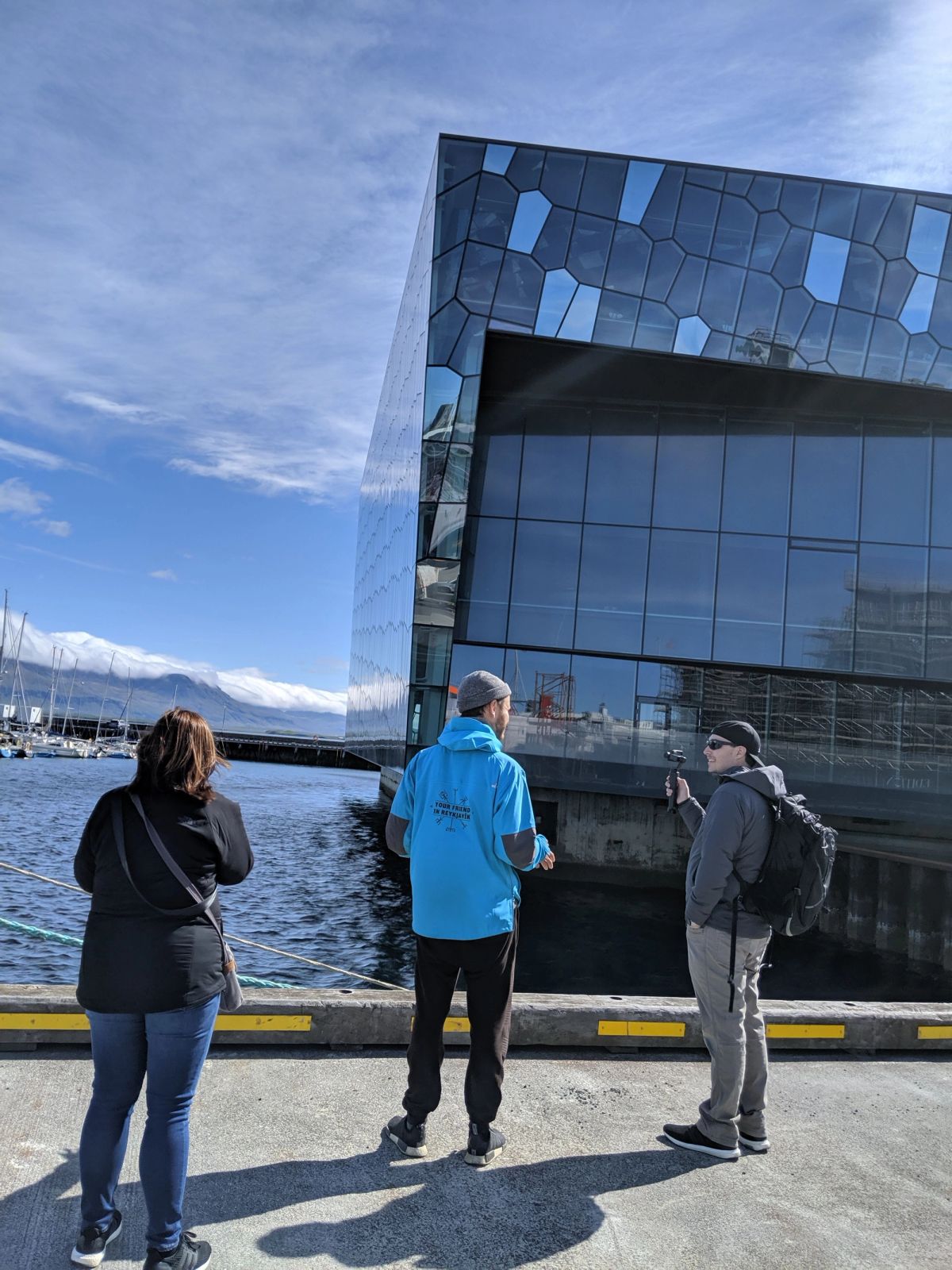
Harpa is where most shuttles drop off, and it is the easiest landmark to navigate back to.
What to Do Once You Are in the Centre
Reykjavík is small, which is its great advantage on a port day.
Hallgrímskirkja is the landmark, a fifteen-minute uphill walk from Harpa, with a tower lift giving the best view over the coloured rooftops.
Laugavegur and Skólavörðustígur are the two shopping streets, and both are walkable end to end in twenty minutes.
The old harbour has the whale watching boats, the Maritime Museum and the best casual fish restaurants in the city.
Perlan, the glass dome on the hill, holds an ice cave exhibition and a planetarium, and sits about 25 minutes' walk from the centre or a short taxi ride.
The full circuit of the centre, done properly with a coffee and a museum, takes 4 hours. That is the number to plan against.
The Weather Decides More Than You Think
Every transport choice above is really a weather choice, and Icelandic weather is less about temperature than most visitors expect.
The cruise season runs May to September. At the nearest long-running station to the Golden Circle, Met Office climate data gives a July average daily high of 16.5°C and the year's lowest mean wind at 3.4 metres per second, which is the calmest month you will get.
September is the wettest month on the route at 147 mm, and it is also when the walk into town stops being a reliable plan.
Wind matters more than rain. A still 9°C day is comfortable in a fleece, and the same temperature with a 15 metre per second wind off the bay is genuinely cold.
Dress in layers with a waterproof shell whatever the morning looks like. Our guide to what to wear on a shore excursion covers the full list, including what to leave in the cabin.
The practical rule is to decide your transport at the gangway rather than the night before. Look at the sky, then choose between walking and the shuttle.
Accessibility and Mobility
Worth setting out plainly, since the terminal is not designed for browsing.
The gangway to the coach park at Skarfabakki is flat and short, so getting off the ship and onto a vehicle is straightforward.
The walk into town is flat throughout with no steps, but 4 kilometres is 4 kilometres and there is no shelter or seating for most of it.
Central Reykjavík is hilly in one direction. Harpa sits at sea level and Hallgrímskirkja is at the top of a noticeable climb, which surprises people who have only looked at a map.
Taxis with wheelchair access exist and must be booked in advance rather than found at the rank. The terminal information desk can arrange this.
Most tour operators, ours included, can accommodate reduced mobility with notice, so ask at the point of booking rather than on the morning.
When Several Ships Are in Port
Reykjavík can take three or four large vessels on the same day in high summer, and it changes the character of everything.
Shuttle queues at the terminal lengthen considerably in the first hour after arrival, since every ship disembarks at roughly the same time.
Taxis get scarce in the centre between three and five in the afternoon, which is exactly when everyone wants to return.
Central restaurants fill at lunchtime, and the popular ones near the old harbour stop taking walk-ins.
Excursion capacity is finite. The good small-group departures sell out weeks ahead in July and August rather than on the day.
Two fixes work. Go ashore 30 to 45 minutes after the first wave, and book anything time-critical before you sail.
Getting Back Before All-Aboard
The return leg is where independent passengers get into trouble, and the fix is arithmetic rather than luck.
All-aboard falls 30 to 60 minutes before departure, and it is printed on your day sheet each morning. That is your deadline, not the sailing time.
Work backwards from it. Allow 15 minutes for a taxi, 30 for the shuttle including waiting, 35 for the bus and a full hour if you are walking.
Then add a 30 minute buffer on top. Being at the pier early with a coffee is a much better outcome than being in a taxi doing mental maths.
If you are on an independent excursion rather than exploring alone, the operator carries this responsibility. Ours commit to it in writing on our guaranteed return page.
Photograph your day sheet each morning. It carries the all-aboard time, the berth and the port agent's phone number, which is everything you would need if something went wrong.
Reykjavik Cruise Port to Keflavik Airport
Relevant if you are joining or leaving your ship in Reykjavík rather than sailing round trip.
Keflavík International Airport sits about 50 kilometres from Skarfabakki, which is a 45 to 55 minute drive.
Scheduled airport coaches run from the city centre rather than from the cruise terminal, so you need to get into town first. Our Flybus airport transfer covers that leg from the central bus terminal.
A private transfer direct from the pier is the simpler option with luggage, particularly for a family or a group of four.
Allow three hours between leaving the ship and your flight's departure. Disembarkation is slower than you expect and the drive is longer than it looks on a map.
Which Option Should You Choose?
A short answer for each type of passenger.
On a call of 6 hours or less, book an excursion that collects at the pier and skip the transfer question altogether.
On a call of 8 to 12 hours with a plan to explore independently, take the shuttle in and a pre-booked taxi back.
On a fine day with time to spare, walk in along the coast and take the shuttle back. It is the version of the day people remember.
Travelling as a group of three or four, take a taxi both ways and stop thinking about it. Split four ways, the cost is close to the shuttle anyway.
With a strict budget and a relaxed schedule, use route 16 and the Klappid app.
Skip the Transfer and See the Country Instead
Reykjavík is a good few hours, and the landscape that people come to Iceland for sits an hour inland. Our Golden Circle from port excursion collects at Skarfabakki, covers Þingvellir, Geysir and Gullfoss, and returns you to the pier with a buffer built in against your all-aboard time. Send us your ship and call date and we will tell you honestly whether it fits your window.
Compare Golden Circle Tours
Check each selected product for its current operator, guide, itinerary, meeting point, and terms.
View Our Tours

