
Neither is better across the board, and the honest difference comes down to one trade. A boat gives you a genuinely dark 360-degree horizon and no light pollution at all. A land tour gives you the ability to drive 80 kilometres to wherever the sky is clear.
On a night with clear sky over the whole southwest, the boat is the more atmospheric option. On a night with patchy clouds, which is most Icelandic nights, the vehicle wins because it can move.
Your own tolerance for the sea decides a lot of it. A rolling deck in a February swell is a poor place to spend three hours if you are prone to seasickness.
What a Boat Tour Actually Involves
Departures leave from the old harbour in central Reykjavík, usually around 9pm, and run two and a half to four hours.
The boat sails out onto Faxaflói Bay, 20 to 30 minutes from the quay, which puts the city glow behind you and open water in every other direction. The engines drop to idle, and you drift while everyone watches.
Most vessels have a heated indoor cabin, toilets and a bar or cafeteria, so you can warm up between viewings. Thermal overalls are usually provided, and you will want them.
A Northern Lights boat tour runs from September to April, and it is the shortest aurora option from the city, with most groups back at the harbour around midnight.
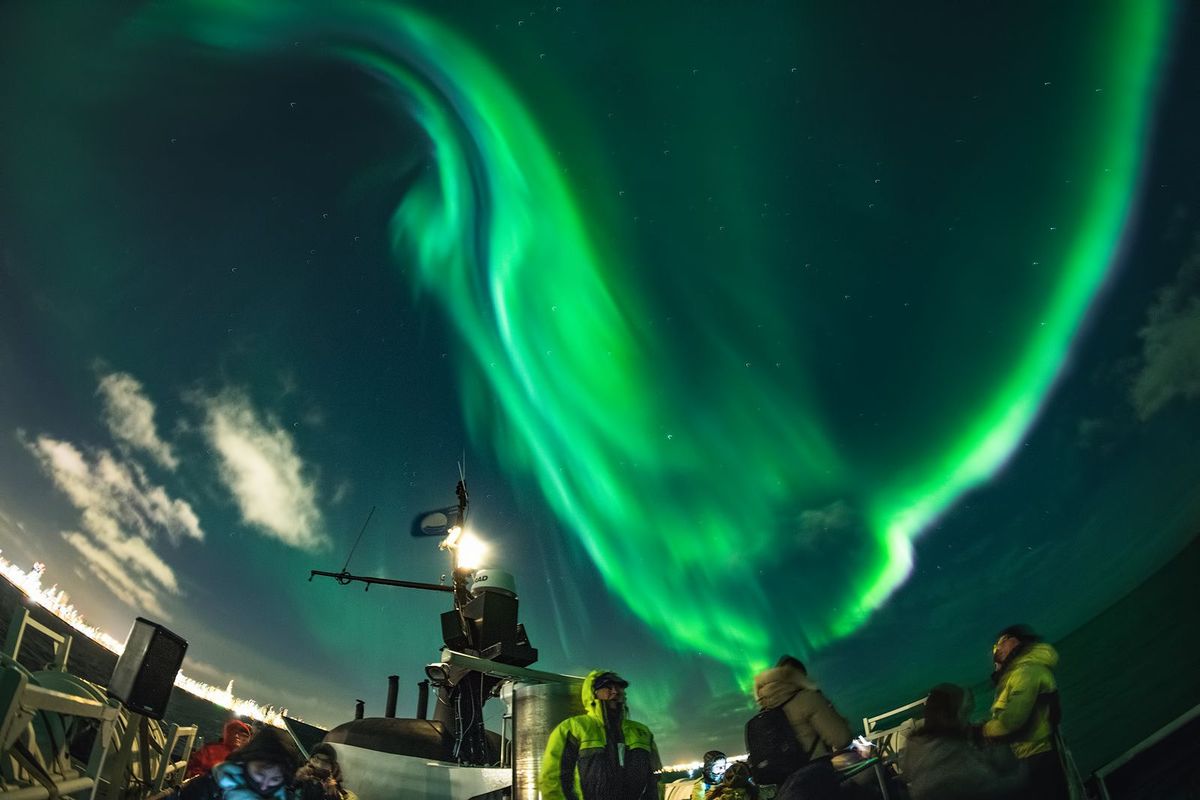
From the bay the horizon is unobstructed in every direction, which is something no land site can match.
What a Land Tour Involves
A coach or minibus collects you between 8pm and 9pm and drives to wherever the guide judges the sky will be clearest.
That might be Þingvellir, the Reykjanes lava fields, Hvalfjörður or somewhere an hour east, and the decision is often made while you are already moving. Groups stop, wait, and move again if the cloud follows.
Tours run three to seven hours depending on the format, and the vehicle is your warm room between stops.
Land tours are the more common format for a reason. Cloud beats activity on most Icelandic nights, and being able to drive away from it is the single biggest advantage available.
Darkness: The Boat's Real Advantage
On the water there is nothing to spoil your night vision, and that matters more than people expect.
Reykjavík's light dome reaches roughly 20 kilometres. From the bay you are looking away from it across the open sea, with no streetlights, no car headlights and no other group's phone torches in your peripheral vision.
The horizon is also completely uninterrupted. On land, hills, buildings and trees hide the lower part of a display, and a low arc across the north is what most quiet nights produce.
That combination genuinely helps with faint displays. On a Kp 2 night the boat may show you something a roadside stop would not.
Mobility: The Land Tour's Real Advantage
Boats are slow and confined to the water. A vessel doing 10 knots covers about 18 kilometres in an hour, and it cannot leave Faxaflói bay.
A minibus covers 80 kilometres in the same hour and can head inland, east, north or south depending on where the map is white. The Icelandic Met Office aurora forecast publishes a cloud map beside the activity number, and a driver watching it can genuinely outrun a weather front.
That is why land tours have the higher completion rate through the winter. Boats cancel for sea state as well as for cloud, so they need two things to go right rather than one.
Land tours also cancel, and they cancel less often.
Seasickness and Comfort
This is the deciding factor for a surprising number of people, and it is worth being honest about.
The Faxaflói Bay is sheltered compared with the open Atlantic, and it still moves. Winter swell makes the deck pitch enough to notice, and standing on an exposed deck for two hours in the cold is harder than standing on land.
If you are prone to motion sickness, take something before you board rather than after you feel it, stay outside in fresh air, and look at the horizon rather than at a phone.
Land tours have their own comfort issue. You are standing on frozen gravel in the wind, and at the Golden Circle's nearest station, the Met Office climate data puts January's average daily low at 4.3°C below zero with mean wind above 5 metres per second.
The boat is warmer between viewings because the cabin is a few steps away rather than a walk back to the vehicle.
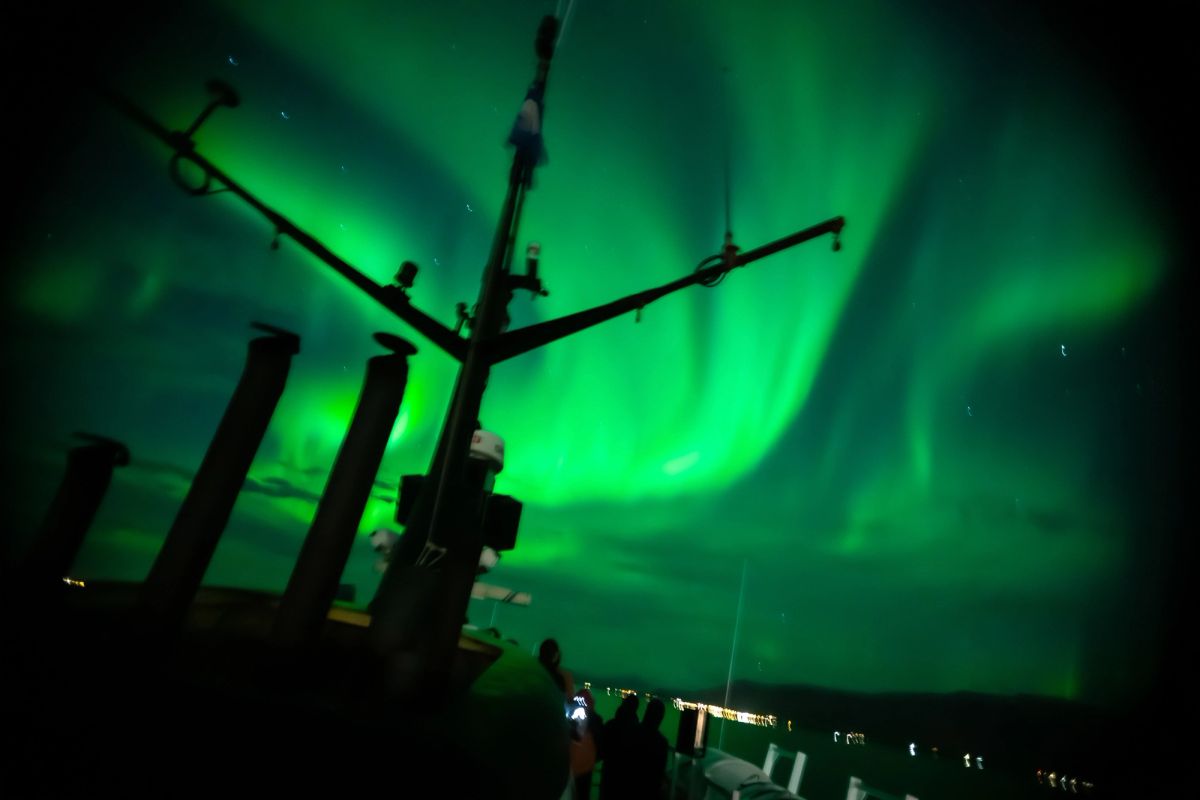
A mast or a bow gives a boat photograph of the foreground that an empty horizon lacks.
Photography: Land Wins Clearly
Aurora photography needs long exposures and a stable platform, and a boat gives you neither.
Even at idle, a vessel moves. A 5-second exposure from a deck produces motion blur in the sky and streaked stars, and there is no tripod position that solves it, because the tripod moves with the boat.
The workaround is a fast lens and a short exposure. At f/1.4 and ISO 6400 you can shoot 1 to 2 seconds hand-held and get something usable, though noisy.
On land the same display shoots at f/2.8, ISO 1600 and 5 seconds on a tripod, which is a dramatically cleaner file. If photographs are the point of the night, go by land. Our Northern Lights camera settings guide covers the technique in detail.
Phones are the exception. Night mode on a recent phone works reasonably from a boat because the processing compensates for small movements, and a phone is what most people are shooting with anyway.
Cost
Prices in Icelandic krónur, per adult.
- Northern Lights boat tour from the old harbour, 4 hours: 14,490 ISK
- Classic Northern Lights coach tour, 5 hours: 9,999 ISK
- Small-group Northern Lights tour, up to 19 guests: 20,990 ISK
- Private Northern Lights vehicle, up to 19 guests: 190,000 ISK per vehicle
The boat sits in the middle. It costs more than a large coach and less than a small-group vehicle, which is roughly fair given what each delivers.
Most operators of both types offer a free repeat trip if the aurora does not appear, usually within a set window. Check the exact terms before booking, since they vary from a few days to a couple of years.
Which Suits Which Traveller
Some cases are clear-cut.
Take the boat if you are staying in central Reykjavík without a car, if you want the shortest night out, or if the idea of a dark ocean horizon appeals more than a car park.
Take a land tour if you want photographs, if the forecast shows patchy cloud, if you get seasick, or if you want the option of going somewhere with a mountain or a lake in the frame.
Take the boat in September and October, when the sea is calmer and the nights are mild. Take a land tour in January and February, when swell is at its worst and the roads still work.
If you are travelling with children, the boat is the easier sell. It is shorter, there is a warm cabin and a snack counter, and nobody has to stand still in a field.
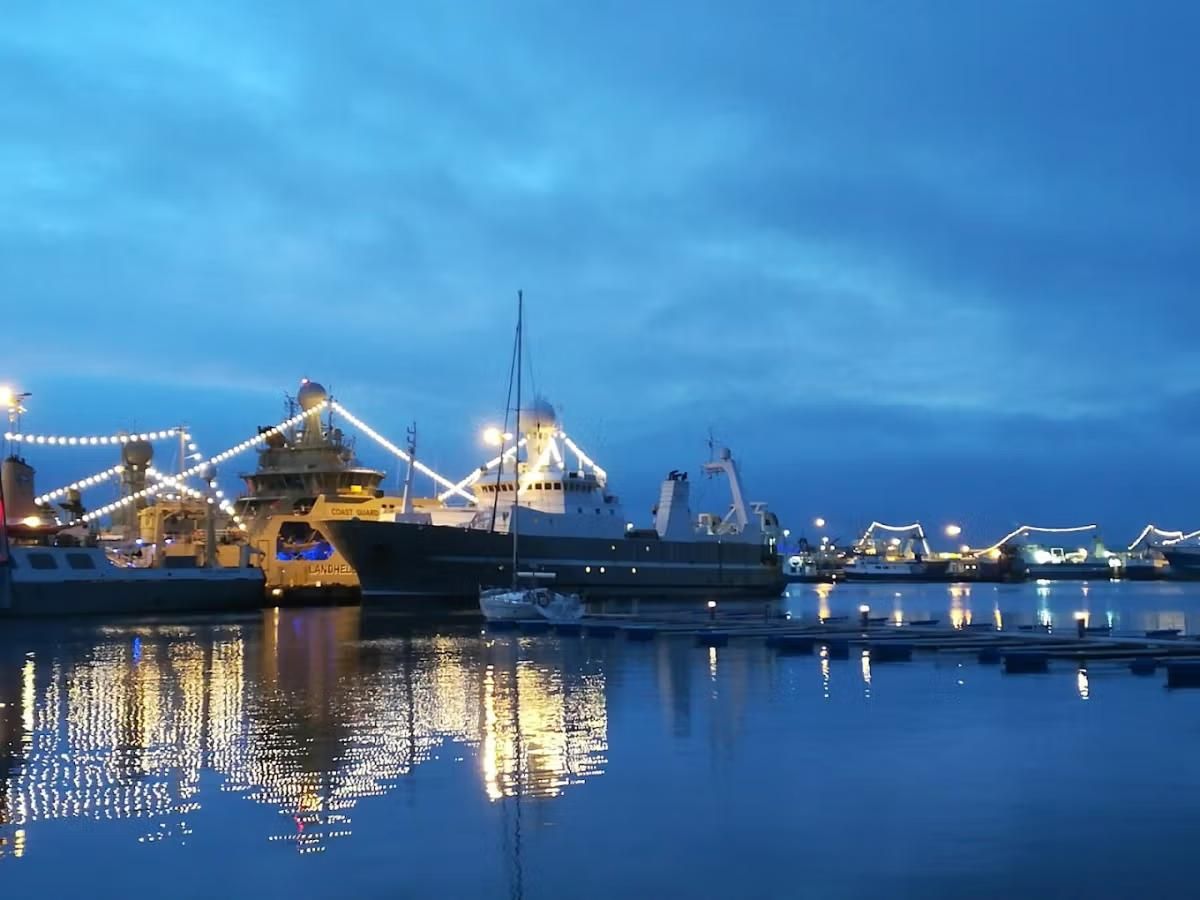
Sailings leave from the old harbour, which is walkable from most central Reykjavík accommodation.
Can You Combine Them?
Yes, and it is a sensible use of two nights.
Do the boat on your first evening if the sea is calm, since it is short and leaves you back in the city by midnight. Keep a land tour or a self-drive night in reserve for a clearer, more active night later in the trip.
The other combination worth knowing is a daytime Golden Circle followed by an evening hunt. The sites you photographed at noon look entirely different at midnight, and our Golden Circle Classic Tour gets you back to the city in time to head out again.
Whatever you book, give yourself three nights minimum. One clear active night in three is normal in an Icelandic winter.
Practical Points for a Boat Night
A few things that make the difference on the water.
Dress as if it is 10 degrees colder than the forecast. Wind chill on a moving deck at sea is severe, and the thermal overalls provided go over your own layers rather than replacing them.
Wear boots with grip and no loose scarves. Steel decks get slippery, and anything flapping is a nuisance in the wind.
Take the seasickness tablet an hour before boarding. Taking it once you feel unwell is too late.
Stand near the middle of the vessel where the motion is least, and keep your eyes on the horizon rather than on a screen.
Check SafeTravel and your operator's messages on the afternoon of the sailing. Boat tours cancel for sea state more often than land tours cancel for anything.
The Verdict
For most visitors, a land tour is the better first booking. It has a higher chance of finding a clear sky, it is the better platform for photographs, and it runs on more nights of the winter.
The boat is the better experience when conditions are right. A calm September night on the bay with a display overhead and no light in any direction is the most atmospheric version of Icelandic aurora watching available.
If you can only do one, and you care about the photograph, go by land. If you can only do one, and you care about the feeling, take the boat and hope for a calm sea.
Chase the Clear Sky.
Whichever platform appeals, the night is decided by where the cloud is not. Our small-group Northern Lights adventure caps the vehicle at 19 and goes wherever the map is thinnest, which is the flexibility a boat cannot offer. Book it for an early evening in your stay so a second attempt is still possible if the sky closes in.
Compare Golden Circle Tours
Check each selected product for its current operator, guide, itinerary, meeting point, and terms.
View Our Tours

